The tiny kitchen gadget that saved my roast chicken ego
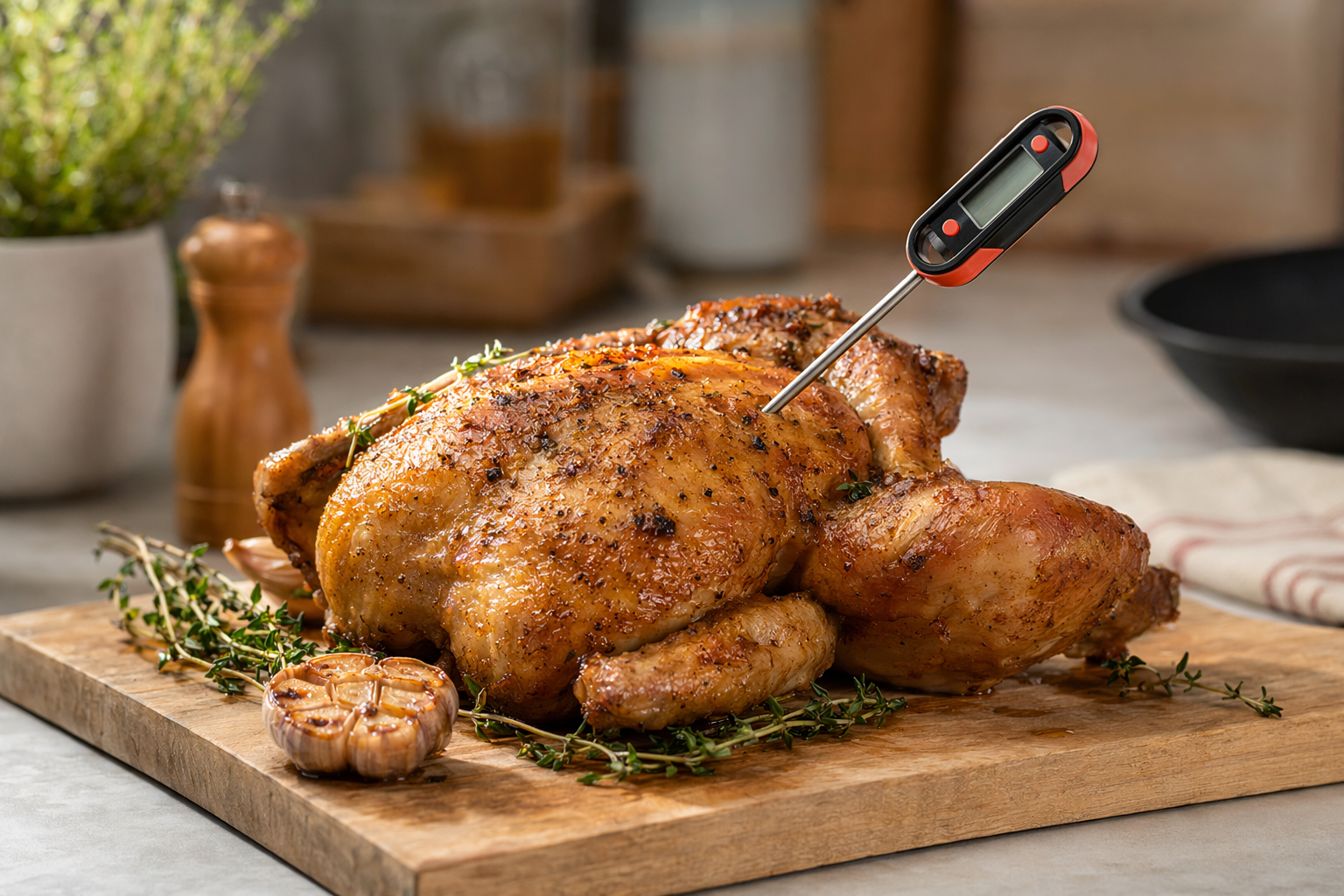
#I used to be one of those people who poked chicken with a fork and acted like I knew what was going on inside. Like, yep, juices look clear, we’re good. Very confident. Very wrong. The roast chicken incident that finally humbled me happened on a rainy Sunday, years ago, when I had invited a few friends over and made this whole cozy dinner situation: potatoes under the bird, lemon halves, too much garlic because there is no such thing, and a bottle of white wine I definitely bought because the label was cute. The chicken looked gorgeous. Golden skin, smelled like a little French bistro had moved into my apartment. Then I carved near the thigh and... nope. Pink in that deeply unsettling way. Everyone smiled politely while I shoved the whole thing back in the oven and pretended this was “part of the resting process.” It was not. That was the day I bought my first food thermometer, and honestly, it changed the way I cook more than any fancy pan ever did.
I know a food thermometer doesn’t sound sexy. It’s not a copper skillet hanging in a sunlit kitchen, or a sourdough starter named something ridiculous, or a tiny tin of smoked paprika you brought back from Spain. But it’s one of those tools that quietly makes you better. Steak gets more consistent. Chicken stops being a guessing game. Custard doesn’t scramble. Leftovers get reheated properly instead of “eh, it’s steaming, probably fine.” And once you start using one, you realize how much home cooking is basically us pretending our eyes can see internal temperature. They cannot. Mine especially cannot, apparently.
Why I think every home cook needs one, even if you’re not a “serious” cook
#People sometimes act like thermometers are for barbecue dads, pastry chefs, and people who own more than one kind of salt. But I’m telling you, if you cook meat, fry anything, bake bread, reheat leftovers, make caramel, or even just host dinner occasionally, you’ll use it. A food thermometer is part safety tool, part confidence booster, part little kitchen therapist that says, calm down, the pork is done. The USDA’s food safety guidance is pretty clear about using internal temperatures rather than color alone, especially for poultry, ground meats, and leftovers. Color lies. Texture lies. Your hungry impatience definitely lies.
The big safety numbers I keep taped in my brain are these: poultry should hit 165°F, ground meats like beef or pork are generally 160°F, whole cuts of beef, pork, lamb, and veal are 145°F with a rest, fish is 145°F, and leftovers should be reheated to 165°F. Also, the old food safety “danger zone” idea matters: bacteria grow faster between 40°F and 140°F, which is why time and temperature together matter. That’s not me trying to scare anyone into eating sad dry chicken, by the way. It’s the opposite. When you know the real temperature, you stop overcooking everything “just to be safe.” I made chicken breast for years like I was punishing it for crimes.
Instant-read thermometers: the one I’d buy first
#If you only buy one thermometer, make it a digital instant-read. This is the everyday workhorse. You open the oven, stab the thickest part of whatever you’re cooking, wait a few seconds, and get an answer. Done. The good ones are fast, accurate, and easy to read while steam is fogging your glasses and your dog is standing directly under your feet like a furry health inspector. I use mine for roast chicken thighs, burgers, salmon, banana bread, reheated lasagna, Thanksgiving turkey, and sometimes just to check the temperature of water when I’m being weird about yeast dough.
What matters most with instant-read models is speed and accuracy. A thermometer that takes 15 seconds to settle feels like an eternity when your oven is blasting heat into your face. I like something that reads in about 2 to 4 seconds, with an accuracy around ±1°F if possible. A thin probe is also a big deal, especially for fish fillets, pork chops, and anything small where you don’t want to leave a crater. Backlit screens are great. Rotating screens are even better if you’re left-handed, or just awkward, which I am depending on the day. Waterproof or water-resistant is nice too because kitchens are wet, greasy, chaotic places, and at some point you will splash stock on it. It’s not a matter of if.
Leave-in probe thermometers are for the big dramatic meals
#A leave-in probe thermometer is the one with a metal probe that stays in the food while it cooks, usually attached to a cable and a little display outside the oven or grill. This is the Thanksgiving turkey thermometer, the prime rib thermometer, the “I spent too much money on this roast and refuse to ruin it” thermometer. I didn’t understand the point until I cooked a pork shoulder for a party and spent 6 hours opening the oven like a nervous raccoon. A leave-in probe would’ve saved me so much heat loss and emotional damage.
These are amazing for roasts, whole birds, smoker projects, and anything where you want to watch the temperature climb without constantly poking. Look for a heat-safe cable, a probe that feels sturdy, and an alarm you can actually hear from the next room. Some models have multiple probes, which is helpful if you’re cooking two pieces of meat or tracking oven temperature at the same time. And yes, oven temperature can be wildly off. I once had an apartment oven that claimed 375°F but was giving 425°F energy. No wonder my cookies had crispy little villain edges.
Wireless and Bluetooth thermometers: cool, but not always necessary
#Wireless thermometers have gotten really popular, especially with grilling and smoking people. You stick a probe into the meat, connect it to a receiver or phone app, and then wander around acting casual while your brisket slowly becomes dinner. I get the appeal. It feels very modern, and for long cooks it can be genuinely useful. If you grill outside in winter, or you’re smoking ribs for hours, being able to check the temp without hovering is lovely. There’s something luxurious about sitting on the couch with coffee while your phone tells you the roast is at 128°F.
But, and this is where I sound like someone’s slightly grumpy aunt, don’t buy the fanciest wireless one just because it looks cool. Think about range, battery life, app reliability, and whether you actually want another kitchen thing that needs charging. Some people love app alerts. Some people hate them. I’m somewhere in the middle. For weeknight cooking, I still reach for my basic instant-read because it’s faster and doesn’t ask me to update firmware when I’m trying to make dinner. For barbecue or big roasts though, wireless can be fantastic.
Infrared thermometers: fun little laser gun, but know the limits
#Infrared thermometers measure surface temperature, not internal temperature. That’s the key. They’re great for checking a pizza stone, cast iron pan, griddle, fryer oil surface, or whether your oven has hot spots. They are not great for telling you if a chicken thigh is safe to eat. I repeat: surface only. I say this because I once watched a guy at a backyard cookout point an infrared thermometer at burgers and declare them done like he was scanning groceries. No. Absolutely not. The outside of a burger can be sizzling while the center is still undercooked.
That said, I do love an infrared thermometer for pizza nights. There’s a certain joy in pointing the little red dot at a baking steel and seeing if it’s ripping hot enough. If you’re serious about homemade pizza, griddled tortillas, smash burgers, or wok cooking, it’s a useful extra. Just pair it with an instant-read for actual food doneness. Tools have jobs. Don’t make the laser gun do chicken math.
Candy, deep-fry, and oven dial thermometers: old school, still useful sometimes
#Candy thermometers and deep-fry thermometers are usually long, clip-on thermometers that hang on the side of a pot. If you make caramel, jam, fudge, doughnuts, fried chicken, tempura, or even just proper French fries, you’ll understand why they matter. Sugar goes from pale and friendly to burnt bitterness so fast it feels personal. Oil is the same. Too cool and your food turns greasy and sad. Too hot and the outside burns before the inside has a chance. I learned this the hard way with homemade churros that looked beautiful for 20 seconds and then collapsed into oily little ropes of regret.
Oven-safe dial thermometers, the kind that stay in a roast or sit in an oven, are a mixed bag. They can be slow and less precise than digital ones, but an oven thermometer that sits on the rack is still useful if your oven runs hot or cold. For meat, I’d rather use digital. For checking oven reality versus oven fantasy, a simple oven thermometer can be eye-opening. Mine revealed that my “preheated” oven needed another 15 minutes to actually stabilize. Betrayal, honestly.
The features that actually matter when you’re buying one
#There are a million features printed on thermometer packaging, and some of them sound more important than they are. I care about a few things first: accuracy, speed, readability, build quality, and whether it feels good in my hand. That last one sounds silly until you’re trying to temp a roast while wearing oven mitts and the handle is slippery or tiny or shaped like a spaceship for no reason. A thermometer should be easy to grab, easy to clean, and not make you think too hard.
- Fast readings matter because open ovens lose heat and hot pans don’t wait for your gadget to make up its mind.
- A clear display matters more than people admit. Big numbers, backlight, maybe rotating display if you’re fancy or just tired.
- A thin probe is best for delicate foods like fish, chicken cutlets, and steak tips. Big chunky probes leave big chunky holes.
- Water resistance is nice, but I still wouldn’t toss it into the sink like a spoon. Treat it decent, you know?
- Calibration or accuracy checking is useful. Even good tools deserve a reality check once in awhile.
Temperature range matters too, especially if you want one tool for many jobs. Meat doesn’t need crazy high readings, but candy and frying do. If you fry chicken or make caramel, check that the thermometer handles high heat. If you bake bread, an instant-read can tell you if a loaf is done inside, which is one of those baker tricks that feels like cheating in the best way. Many enriched breads are done around the high 180s to 190s°F, while lean crusty loaves often go higher, around 200°F-ish. Recipes vary, of course, and bread people will fight lovingly about this forever.
How to check if your thermometer is telling the truth
#I don’t calibrate every week like some hyper-organized kitchen wizard. I wish I was that person. I am not. But I do check my thermometer now and then, especially before holidays or after it’s been dropped, which has happened more times than I’d like to admit. The easiest check is an ice bath: fill a glass with lots of ice, add cold water, stir, let it sit for a minute, then place the probe in the slushy center without touching the sides or bottom. It should read about 32°F. If it’s a little off, some thermometers let you adjust it. If it’s way off and can’t be calibrated, it might be time to replace it.
You can also check boiling water, which should be around 212°F at sea level, but altitude changes that number. So if you live somewhere higher up, don’t panic when it reads lower. Ice bath is usually simpler for most of us. Also, clean the probe before and after checking food, especially if you’re moving between raw meat and cooked food. I keep alcohol wipes in a drawer sometimes, but hot soapy water works if you’re not being chaotic. And yes, I have forgotten and had to stop mid-recipe to wash it. Real kitchens are not cooking shows.
Where to stick the probe, because this is where people mess up
#The thermometer is only as smart as where you put it. For chicken or turkey, go into the thickest part of the breast or thigh, avoiding bone. Bone heats differently and can give you a weird reading. For burgers, insert from the side into the center if you can, especially thin patties. For steak or pork chops, aim for the thickest part, again avoiding bone and fat pockets. For fish, the thickest part of the fillet is your friend. If the food is uneven, check a couple spots. I know it feels fussy, but it takes seconds and saves dinner.
With casseroles and leftovers, check the center, not the bubbling edges. This is huge. The edges of lasagna can be molten lava while the middle is still lukewarm and suspicious. Same with rice, pasta bakes, soups reheated too quickly, and that container of curry you forgot in the fridge until it became either lunch or a moral question. Leftovers should hit 165°F when reheated, and if you’re already thinking about pizza from last night, this piece on Leftover Pizza Safety: Stay Out, Reheat or Toss? is exactly the kind of practical food-safety rabbit hole I appreciate.
My personal “what to buy” recommendation, depending on how you cook
#If you’re just starting out, buy a solid digital instant-read thermometer. Not the cheapest flimsy thing at the grocery checkout, but you also don’t need to mortgage your spice drawer. Get one that reads quickly, has a thin probe, and feels durable. If you roast meat often, host holidays, or grill, add a leave-in probe thermometer later. If you smoke brisket, ribs, pork shoulder, or big birds, then wireless or multi-probe setups start making sense. If you make candy or deep fry, get a dedicated clip-on thermometer or a digital model that can handle those temperatures safely.
| How you cook | Best thermometer type | Why it helps |
|---|---|---|
| Weeknight chicken, steak, fish | Digital instant-read | Fast doneness checks without drying food out |
| Turkey, prime rib, pork shoulder | Leave-in probe | Tracks big roasts without opening the oven constantly |
| Smoking or long grilling | Wireless or multi-probe | Lets you monitor food and grill temps over hours |
| Pizza, griddle, cast iron | Infrared plus instant-read | Surface heat checks, but internal doneness still needs a probe |
| Candy, jam, frying | Candy/deep-fry thermometer | Handles high temps and clips to the pot |
If you’re buying for a tiny apartment kitchen, think storage too. Folding instant-reads are easier to tuck into a drawer. Magnetic backs are handy if your fridge is close to your cooking area, though mine once slid down the side of the fridge and scared me so badly I dropped a spoon into soup. If you cook outside, get something with a bright display and decent weather resistance. If your hands get messy, auto-wake and auto-sleep are weirdly delightful features. Not essential, but nice in that “oh, someone actually cooked with this before designing it” way.
Thermometers and the leftovers conversation nobody wants but everyone needs
#I love leftovers. Cold pizza for breakfast, pasta eaten straight from the container, hummus plates made from random fridge bits... that’s my kind of lazy luxury. But leftovers are also where people rely way too much on smell and vibes. Food can look and smell fine and still not be handled safely. Time, temperature, and storage matter. A thermometer won’t tell you if something sat out too long yesterday, but it will help you reheat properly today. For pasta especially, the time-outside question comes up a lot, and this guide on How Long Can Cooked Pasta Stay Outside? Safety Rules pairs nicely with the whole thermometer mindset: don’t guess when you don’t have to.
The same goes for dips and spreads. I’ve been at parties where hummus sits on the table for hours looking innocent, surrounded by carrot sticks and crackers like nothing bad could ever happen. But cold foods have safety limits too, and visual checks only go so far. If you’ve ever wondered about that exact thing, Can Hummus Stay Outside? Safe Timing and Storage Rules gets into it in a very real-life way. My rule now is boring but effective: keep cold food cold, hot food hot, and don’t let wishful thinking be the main ingredient.
The mistakes I made so you can skip them
#First mistake: I used to check meat too early and then panic because it wasn’t done. Of course it wasn’t done, babe, it had been in the oven for 12 minutes. Now I start checking near the recipe’s lower time estimate, not constantly from the beginning. Second mistake: I poked the same piece of steak five times like I was trying to learn its secrets. One or two smart checks are better than repeatedly stabbing dinner. Third mistake: I forgot carryover cooking. Meat keeps rising a bit after you take it off heat, especially big roasts. That’s why resting matters, and not just because recipe writers enjoy making hungry people wait.
Another mistake was trusting the pop-up timer in a turkey. I’m sorry, but those little plastic things are not my favorite. They often pop at a temperature that can mean overcooked breast meat, and they don’t check every part of the bird. Use your thermometer in the breast and thigh. Also, don’t temp stuffing inside a bird casually. If you cook stuffing inside poultry, it also needs to reach 165°F, which can mean the turkey itself goes too far. I usually bake stuffing separately because I want crispy edges and fewer food safety gymnastics. Plus more surface area. Crispy stuffing edges are the point, don’t argue with me.
A few foods that got better once I stopped guessing
#Salmon was the big one. I used to overcook salmon because I was terrified of the translucent center, and then I’d drown it in sauce and pretend it was fine. With a thermometer, I can pull it when it’s where I like it, depending on the recipe and my comfort level, and it stays silky instead of chalky. Pork tenderloin also became a weeknight hero. People still have old memories of pork needing to be cooked into shoe leather, but whole cuts are safely cooked to 145°F with rest, according to USDA guidance, and that makes pork tenderloin juicy and slightly rosy and beautiful. Ground pork is different, so don’t mix those rules up.
Fried chicken improved too, but in a different way. I use a thermometer for both the oil and the chicken. If the oil drops too low, the crust gets heavy. If it’s too high, the crust gets dark before the meat is cooked. There’s this perfect moment when the crust is shattery, the meat is juicy, and everyone gets quiet for a second after the first bite. That quiet is the best restaurant review. I had fried chicken like that once at a tiny roadside place while driving through Georgia, served with peppery greens and a biscuit that tasted like someone’s grandmother had strong opinions. Been chasing that feeling ever since.
Cleaning, storing, and not being gross about it
#A thermometer touches food, sometimes raw food, so cleaning matters. Wash the probe with hot soapy water after each use, especially after raw meat, poultry, or fish. Don’t dunk the whole digital unit unless the manufacturer says it’s waterproof, and even then I’m cautious because I have trust issues with electronics. Wipe the handle if your hands were messy. Store it somewhere protected so the probe doesn’t bend or jab your hand when you’re digging for measuring spoons. Ask me how I know. Actually don’t.
If your thermometer has batteries, keep spares around before the holidays. Nothing says festive like a dead thermometer and a house full of people asking when the turkey will be ready. If it has a probe cover, use it. If the probe gets bent, readings may get wonky. If it starts taking forever or giving strange numbers, test it in ice water. A thermometer is small, but it deserves a little care. Like a good knife, but less dramatic.
So, what would I buy today?
#If I were building my kitchen from scratch, I’d buy three things eventually, but only one immediately. First: a reliable digital instant-read thermometer. That’s the must-have. Second: a leave-in probe for roasts, grilling, and big holiday food. Third: an infrared thermometer only if I was doing lots of pizza, griddle cooking, or cast iron nerd stuff. Candy/deep-fry thermometer if you fry or make sweets often. That’s it. You don’t need a drawer full of gadgets to cook well. You need the right tool that you’ll actually use when dinner is happening and the kitchen is loud and someone is asking if they can “help” while standing directly in front of the drawer you need.
A good thermometer doesn’t make cooking less intuitive. It makes your intuition smarter. That’s the thing I wish someone had told me earlier.
And honestly, I still cook by smell and sound and touch. I listen for onions changing from sharp sizzle to soft sweetness. I smell when garlic is about to go from golden to bitter. I press steak sometimes, badly but with confidence. The thermometer didn’t replace that. It just gave me a number when a number actually matters. There’s room in cooking for romance and science, for vibes and verification. Maybe that’s why I love it so much. Dinner is emotional, but bacteria does not care about our feelings.
Final bite
#Buying a food thermometer isn’t the flashiest kitchen upgrade, but it might be the one that saves the most meals. Start with a good instant-read, learn where to place the probe, check it now and then, and use it for more than meat. Use it for bread, leftovers, frying oil, casseroles, custards, whatever makes sense. The more you use it, the less fussy it feels, until one day you’re temping chicken thighs without thinking and wondering how you ever cooked without it. I still burn toast sometimes, so please don’t imagine perfection over here. But my roast chicken? Much better now. If you’re into these practical, food-obsessed kitchen rambles, I’ve been finding more good reads over on AllBlogs.in, especially when I’m supposed to be meal planning and instead just dreaming about dinner.