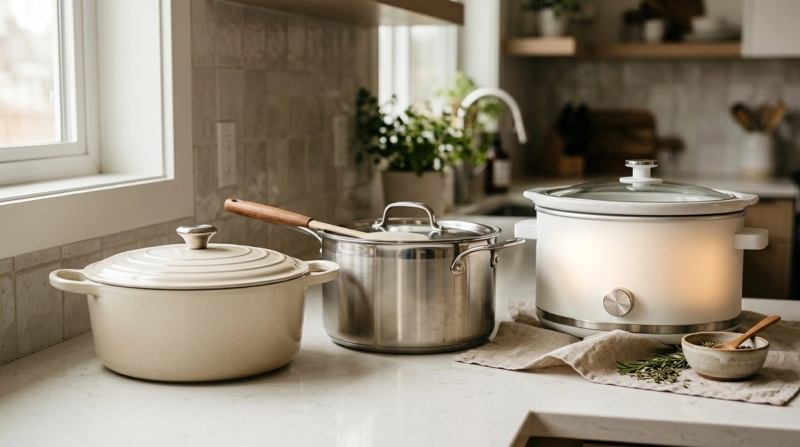
If I could only choose one, I’d buy an enameled Dutch oven for the best mix of flavor, flexibility, and stove-to-oven cooking.
But that does not mean it is the right choice for everyone.
If you mostly cook quick weeknight meals, a stainless steel pot may be the one you reach for more often. If you want dinner to slowly cook while you do something else, a slow cooker might make your life easier than either pot.
So the real question is not, “Which one is best?”
It’s: Which one fits the way you actually cook?
Short Answer
#Choose an enameled Dutch oven if you want the most flavor and versatility.It is best for braises, stews, soups, sauces, oven cooking, and meals where you want to sear, deglaze, and slowly build flavor in one pot.
Choose a stainless steel pot if you want the most practical everyday option.It is best for boiling, simmering, quick soups, sauces, grains, pasta, and normal weeknight cooking.
Choose a slow cooker if you want the easiest hands-off cooking.It is best for long, low cooking when you want to start dinner earlier in the day and mostly leave it alone.
If you enjoy cooking actively: get a Dutch oven or stainless steel pot.If you want convenience and can plan ahead: get a slow cooker.If you hate heavy cookware: think twice before buying a large Dutch oven.
Choosing between an enameled Dutch oven vs stainless steel pot vs slow cooker can feel more confusing than it should. They all make soups. They all make stews. They all seem useful. And if you read enough kitchen advice, you’ll probably be told you “need” all three.
Maybe someday you will want all three.
But if you are buying one first, it helps to be honest about your real cooking life.
Not your fantasy cooking life where you spend Sunday afternoon making perfect short ribs with music playing and a clean kitchen.
Your real cooking life. The one where you are tired, hungry, and trying to figure out if you can make dinner without using every pan you own.
That is what this guide is for.
No brand rankings. No fake urgency. No “we tested 47 pots” claims. Just a practical look at what each one does well, what each one does badly, and who should buy which.
Quick Comparison: Enameled Dutch Oven vs Stainless Steel Pot vs Slow Cooker
#Enameled Dutch oven
#- Best for: braises, stews, soups, oven cooking and deep flavor.
- Cooking style: active cooking first, then slow cooking.
- Browning and searing: very good.
- Heat retention: excellent.
- Ease of handling: heavy, especially when full.
- Cleanup: manageable, but it needs some care.
- Stove-to-oven use: usually yes, if the pot, lid and knob are oven-safe.
- Best fit: flavor-focused cooks.
Stainless steel pot
#- Best for: weeknight meals, boiling, simmering, sauces, grains and pasta.
- Cooking style: active, responsive cooking.
- Browning and searing: very good if the pot has a heavy base.
- Heat retention: moderate to good.
- Ease of handling: usually easier to lift than a Dutch oven.
- Cleanup: usually straightforward.
- Stove-to-oven use: depends on the pot and handles.
- Best fit: practical everyday cooks.
Slow cooker
#- Best for: long, low, hands-off cooking.
- Cooking style: set it up and let it go.
- Browning and searing: poor unless you sear separately.
- Heat retention: steady electric heat.
- Ease of handling: bulky, but usually stays put.
- Cleanup: the insert may be easy to clean, but the appliance is bulky.
- Stove-to-oven use: no.
- Best fit: busy planners.
1. Enameled Dutch Oven: Best for Deep Flavor and Stove-to-Oven Cooking
#An enameled Dutch oven is a heavy cast-iron pot coated with porcelain enamel. The enamel matters because it creates a smooth, non-reactive cooking surface when it is in good condition. That means you can cook tomato sauces, wine braises, stews, and other acidic foods without exposing the food to bare cast iron.
But the real reason people love Dutch ovens is flavor.
A Dutch oven lets you do the whole flavor-building process in one pot:
- Brown the meat or vegetables.
- Add aromatics like onion, garlic, or spices.
- Pour in wine, broth, tomatoes, or another liquid.
- Scrape up the browned bits from the bottom.
- Cover the pot and let everything slowly cook together.
That sequence is where a Dutch oven shines.
It is not just holding your food. It is helping you create the kind of rich, layered flavor that is hard to get from a plug-in appliance or a thin pot.
Where an enameled Dutch oven works best
#An enameled Dutch oven is a great choice if you often make:
- Braised meats
- Braised vegetables
- Stews
- Curries
- Chili
- Tomato sauces
- Soups that start with browning
- Oven-finished meals
- No-knead bread, if your specific pot and lid are oven-safe at the required temperature
It is especially useful when you want to start cooking on the stovetop and finish in the oven without changing pans.
The downside of an enameled Dutch oven
#A Dutch oven is wonderful, but it is not effortless.
It is heavy. And when it is full of stew, it can be very heavy.
It also takes up space, can be awkward to wash, and needs a little care. The enamel can chip if you bang it against the sink, drop it, or stack things carelessly inside it. It also holds heat extremely well, which is usually a benefit, but it means food can scorch if you crank the burner too high and walk away.
So yes, a Dutch oven can make beautiful food.
But if you want something light, quick, and easy to toss around, this may not be your favorite everyday pot.
Who should buy an enameled Dutch oven?
#Buy an enameled Dutch oven if:
- You care about browning and deep flavor.
- You enjoy the actual process of cooking.
- You make stews, braises, soups, or sauces often.
- You want a pot that can go from stovetop to oven.
- You do not mind heavy cookware.
- You want something that feels like a true “cook’s pot.”
Skip it if:
- You have wrist, hand, shoulder, or mobility issues.
- You want the easiest possible cleanup.
- You mostly boil pasta or make quick meals.
- You want dinner to cook while you are away with almost no attention.
- You tend to be rough with cookware in the sink or cabinet.
2. Stainless Steel Pot: Best Everyday Workhorse
#A stainless steel pot may not feel as exciting as a Dutch oven. It does not have the same cozy, slow-cooked image. It probably will not make you feel like you are about to spend a rainy afternoon making beef stew.
But in many kitchens, it is the pot that gets used the most.
A good stainless steel pot is practical. It heats faster than a heavy Dutch oven, cools down faster when you lower the burner, and is usually easier to lift, wash, and store.
That responsiveness is a big deal for everyday cooking.
If you are boiling pasta, simmering soup, making rice, cooking lentils, warming sauce, or throwing together a weeknight meal, stainless steel is often the easiest choice.
Where a stainless steel pot works best
#A stainless steel pot is great for:
- Pasta
- Rice and grains
- Lentils and beans
- Quick soups
- Brothy stews
- Sauces
- Boiled vegetables
- Simmered dishes
- Weeknight one-pot meals
A heavy-bottomed stainless steel pot can also brown and sear well. The key is construction. A thin, flimsy pot may develop hot spots and scorch food. A sturdy pot with a thick base or layered construction will usually be much more pleasant to cook with.
The downside of a stainless steel pot
#Stainless steel usually does not hold heat like cast iron. That matters most for long, slow cooking.
You can absolutely make great soups, stews, and sauces in stainless steel. But it will not behave exactly like a Dutch oven during a long braise, especially in the oven. It does not have the same heavy, steady heat retention.
The other issue is quality. Cheap stainless steel can look nice on the shelf but perform badly on the stove. If it is too thin, food may scorch in some areas while barely simmering in others.
So if this is going to be your main pot, choose something with a solid base and comfortable handles. Do not buy based on shine alone.
Who should buy a stainless steel pot?
#Buy a stainless steel pot if:
- You want one practical pot for daily cooking.
- You make fast meals more often than slow braises.
- You want something easier to lift than cast iron.
- You boil, simmer, and make sauces regularly.
- You want durable cookware that is not too fussy.
- You like having more control over heat changes.
Skip it if:
- Your main goal is oven braising.
- You want maximum heat retention.
- You often bake bread in a covered pot.
- You want a hands-off appliance for long cooking.
- You are only looking at very thin, lightweight stainless steel pots.
3. Slow Cooker: Best for Hands-Off Cooking
#The choice between a slow cooker vs Dutch oven usually comes down to one thing:
Do you want to cook dinner, or do you want dinner to cook while you do something else?
A slow cooker is an electric countertop appliance that cooks food slowly over several hours. You add the ingredients, choose a setting, put the lid on, and let it go.
That convenience is the point.
A slow cooker is not trying to be a better Dutch oven. It is solving a different problem. It helps when you want a meal to be ready later without standing at the stove.
Where a slow cooker works best
#A slow cooker is useful for:
- Long-cooked soups
- Stews
- Beans
- Lentils
- Shredded chicken, pork, or beef
- Batch cooking
- Meal prep
- Dinners started in the morning or afternoon
If your biggest cooking problem is time, attention, or energy, a slow cooker can be genuinely helpful.
The downside of a slow cooker
#A slow cooker does not brown food well.
That is the biggest tradeoff.
If you want rich, caramelized flavor, you usually need to sear meat or vegetables in a separate pan before adding them to the slow cooker. If you skip that step, the food can still taste good, but it often has a softer, less developed flavor.
Slow cookers also trap moisture. That is great for keeping food tender, but it means sauces usually do not reduce and concentrate the way they do in a pot on the stove or in the oven.
There is also less room for adjustment. With a pot on the stove, you can taste, stir, reduce, season, add acid, and tweak as you go. With a slow cooker, the whole idea is to leave it alone.
And, of course, always follow the manufacturer’s safety instructions, especially if you plan to leave it running while you are out.
Who should buy a slow cooker?
#Buy a slow cooker if:
- You want long cooking with less active effort.
- You like planning meals ahead.
- You batch cook or meal prep.
- You make soups, stews, beans, or shredded meats often.
- You are willing to trade some browning and control for convenience.
- You want food ready after several hours of slow cooking.
Skip it if:
- You want to sear, deglaze, and cook in one vessel.
- You like adjusting flavor throughout the cooking process.
- You prefer thick, reduced sauces.
- You have limited counter or storage space.
- You expect it to replace all stovetop cooking.
What to Check Before Buying
#Before you buy any of these, look past the pretty photos and product descriptions. Materials, oven limits, warranties, accessories, and prices can change, so always check the current details from the retailer or manufacturer.
If you are buying an enameled Dutch oven
#Check:
- Weight: If possible, lift it in person. Then imagine it full of stew.
- Handle size: Make sure the handles are easy to grab with oven mitts.
- Lid fit: A snug lid helps hold moisture during long cooking.
- Enamel finish: Look for a smooth, even coating with no visible chips.
- Care instructions: Some enamel needs gentler cleaning and utensil care.
- Oven limits: Confirm the oven-safe temperature for the pot, lid, and knob.
The best enameled Dutch oven is not automatically the heaviest, most expensive, or prettiest one. It is the one you can actually lift, clean, store, and use without dreading it.
If you are buying a stainless steel pot
#Check:
- Bottom thickness: A thin base is more likely to heat unevenly.
- Construction: Heavy-bottomed or multi-layer construction usually performs better.
- Handle comfort: Handles should feel secure and comfortable.
- Lid fit: A good lid matters for simmering.
- Capacity: Choose a size that matches how much you normally cook.
- Cleaning guidance: Some stainless steel is dishwasher-safe, but check the manufacturer’s instructions.
For many home cooks, a sturdy stainless steel pot is the safest first choice because it fits so many everyday meals.
If you are buying a slow cooker
#Check:
- Capacity: Match the size to your household, not your fantasy dinner party.
- Insert weight: Removable inserts can still be heavy when full.
- Controls: Simple controls are fine if they fit your needs.
- Lid fit: A well-fitting lid helps keep cooking steady.
- Storage space: Slow cookers take up real cabinet or counter space.
- Safety guidance: Read the manufacturer’s instructions before using it unattended.
A slow cooker is only convenient if it fits both your routine and your kitchen.
Common Mistakes to Avoid
#1. Buying for the cook you wish you were
#This is probably the biggest mistake.
A gorgeous Dutch oven is not useful if you mostly make quick pasta and scrambled eggs. A slow cooker is not useful if you never remember to start dinner early. A stainless steel pot may disappoint you if you expected it to act like a heavy braising pot.
Be honest about your habits.
Do you cook fast? Slow? Ahead? At the last minute?
Buy for that person.
2. Expecting a slow cooker to brown food
#Slow cookers are not designed for strong browning. If browned flavor matters to you, sear the ingredients in another pan first.
If you do not want that extra step, that is fine. Just know the finished dish may taste softer and less caramelized.
3. Treating enamel like bare metal
#Enameled Dutch ovens are durable, but they are not indestructible.
Avoid banging them against hard surfaces. Be careful with metal utensils. Do not stack heavy items inside without protection. And if the manufacturer warns against sudden temperature changes, let the pot cool before washing it.
The enamel is part of what makes the pot useful, so it is worth protecting.
4. Buying stainless steel that is too thin
#A very thin stainless steel pot may be cheaper, but it can be frustrating to use. Thin pots often heat unevenly, scorch food, and make cooking feel harder than it needs to be.
If stainless steel will be your main pot, look for a sturdy base and solid construction.
5. Automatically choosing the biggest size
#Bigger is not always better.
A huge Dutch oven is harder to lift and wash. A huge slow cooker is bulky to store. A large stainless steel pot can feel silly when you are making a small amount of soup or sauce.
Buy for the amount of food you usually cook, not the holiday meal you imagine making once a year.
So, Which One Should You Buy?
#Here is the simplest way to decide.
Choose an enameled Dutch oven if you want flavor and flexibility
#This is the best choice if you enjoy the cooking process and want to build flavor in one pot. It is excellent for browning, deglazing, simmering, braising, and oven finishing.
Best for: active cooks, braises, stews, soups, sauces, and oven cooking.
Choose a stainless steel pot if you want a practical daily pot
#This is the most useful choice for many home kitchens. It handles everyday cooking without much fuss and is usually easier to lift, wash, and manage than a Dutch oven.
Best for: daily meals, boiling, simmering, quick soups, sauces, grains, pasta, and weeknight cooking.
Choose a slow cooker if convenience matters most
#This is the right choice if your biggest problem is time or attention. You give up browning and some control, but you gain a meal that can cook slowly while you do other things.
Best for: busy schedules, meal prep, long-cooked soups, stews, beans, shredded meats, and batch cooking.
Final Takeaway
#The choice between an enameled Dutch oven vs stainless steel pot vs slow cooker is really a choice between flavor control, everyday practicality, and convenience.
Choose the enameled Dutch oven if you want rich flavor, stove-to-oven cooking, and slow braises.
Choose the stainless steel pot if you want a reliable daily workhorse for quick meals, boiling, soups, sauces, and simmering.
Choose the slow cooker if you want long, low cooking with less active attention.
Do not buy the tool that looks most impressive.
Buy the one that matches how you actually cook.