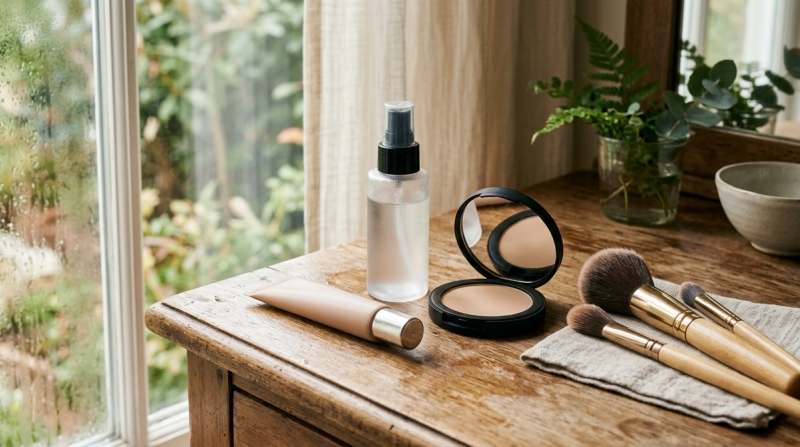
If you’ve ever done your makeup, left the house feeling great, and then checked your face a few hours later only to find shine, patchiness, or foundation sliding around, you already know how annoying humid weather can be.
And then comes the confusing part: should you buy a primer? A setting spray? A fixing spray? Are setting spray and fixing spray the same thing? Do you need all three?
Short answer: probably not.
The easiest way to understand it is this:
- Primer goes under your makeup and helps it apply better.
- Setting spray helps your makeup look more blended and less powdery.
- Fixing spray goes on at the end and helps your makeup last longer.
For humid weather, primer is usually the best place to start. If your makeup still fades, transfers, or melts later in the day, then a fixing spray is worth adding.
Quick Answer
#Primer preps your skin before makeup. Setting spray helps powders and base products melt together so your makeup looks smoother and less cakey. Fixing spray is the final step that helps makeup resist humidity, sweat, fading, and transfer.
If you’re shopping for humid weather, start with a makeup primer for humid weather that suits your skin type. If your makeup still slips or disappears by midday, add a fixing spray for makeup.
You do not need to buy every product at once.
Why This Gets So Confusing
#A lot of the confusion comes from product names. Brands do not always use “setting spray” and “fixing spray” correctly.
Some products are called setting sprays but behave more like fixing sprays. Some are marketed as long-wear sprays but are really just refreshing mists. Some make your makeup look beautiful for five minutes but do almost nothing for longevity.
So when people compare setting spray vs fixing spray, they’re often comparing products that are labelled badly in the first place.
Also, let’s be honest, makeup shopping is overwhelming now. You check reviews, compare ingredients, watch tutorials, ask friends, maybe ask AI, and somehow still end up wondering if you need three sprays and two primers just to survive a normal workday.
You don’t.
You just need to know what problem you’re trying to solve.
Primer vs Setting Spray vs Fixing Spray: Simple Comparison
#What Primer Actually Does
#Primer is the step between skincare and makeup. It goes on after moisturizer and sunscreen, but before foundation, concealer, skin tint, or any base product.
Think of primer like prepping a surface before painting. It is not the most exciting step, but it can make everything that comes after look better and last longer.
A good makeup primer for humid weather can help your base grip the skin, smooth over texture, control oil, or add hydration where your skin needs it.
The right primer depends on your skin type:
- If your skin gets oily, especially around the nose, forehead, and chin, try a mattifying or oil-control primer.
- If your foundation clings to dry patches, use a hydrating primer.
- If you have visible pores or uneven texture, a smoothing primer can help your base look more even.
- If your makeup tends to separate, a gripping primer may help it stay in place better.
Primer does not seal your makeup from the top. It works underneath everything. So if your foundation starts breaking apart early in the day, primer can help solve the problem from the beginning.
What Setting Spray Actually Does
#Setting spray is probably the most misunderstood product in this whole category.
A true setting spray is usually more about the finish than the wear time. It helps the layers of makeup settle into each other so your face looks less powdery, dry, or heavy.
You know that moment after powder when your makeup looks technically done, but also a little flat or chalky? That is where setting spray can help. It can make powder blush, bronzer, foundation, and setting powder look softer and more skin-like.
But here’s the thing: in humid weather, setting spray is not always necessary.
If your skin is already oily or the air is extremely damp, adding a dewy or hydrating mist can sometimes make your makeup feel heavier. It may look nice at first, but it might not help your makeup stay on longer.
So use setting spray when your makeup looks too powdery or dry. Don’t use it just because you feel like every routine needs one.
What Fixing Spray Actually Does
#Fixing spray is what most people are thinking of when they say, “I need my makeup to stay.”
A fixing spray for makeup is used as the very last step. Its job is to help hold your makeup in place. Many fixing sprays contain film-forming ingredients that create a thin, flexible layer over the makeup. This can help reduce fading, transfer, sweat breakdown, and humidity-related sliding.
Fixing spray is especially useful for:
- Long commutes
- Outdoor events
- Weddings and functions
- Office days
- College days
- Hot and humid weather
- Makeup that looks good at first but disappears later
Some fixing sprays contain cosmetic alcohol. Alcohol can help the product dry faster and improve longevity, but it does not suit everyone. If your skin is sensitive, dry, or easily irritated, check the ingredient list before buying.
The simplest way to remember the difference:
- Primer helps makeup grip from underneath.
- Setting spray helps makeup look blended.
- Fixing spray helps makeup stay put from the top.
What Should You Buy First?
#If you are new to makeup, please do not buy everything at once. It gets expensive, and you may not even need half of it.
Start with the product that matches your actual problem.
- Buy primer first if your makeup separates, gets oily, clings to dry patches, or applies unevenly.
- Buy fixing spray next if your makeup looks good at first but fades, transfers, or melts later.
- Buy setting spray only if needed if your makeup looks powdery, dry, flat, or heavy after application.
For humid weather, primer plus fixing spray is usually more useful than owning every mist on the market.
If your makeup lasts well but looks dry, a setting spray may be enough. But if your makeup looks fresh in the mirror and then disappears by the time you reach college, office, or an event, you probably want fixing spray.
Step-by-Step Makeup Routine for Humid Weather
#Here is how to make your makeup last in humid weather without piling on too many products.
Step 1: Let Skincare and Sunscreen Settle
#Apply your skincare and sunscreen first, then give them a few minutes to settle.
This sounds like a small thing, but it makes a big difference. If your sunscreen or moisturizer is still slippery when you start makeup, your primer and foundation may not grip properly. Your base can start moving before you even leave the house.
If you are in a rush, gently press a tissue over your face after sunscreen has settled to remove extra shine before primer.
Step 2: Apply Primer Only Where You Need It
#You do not always need primer all over your face. In fact, using too much can sometimes make makeup feel heavy or cause pilling.
Apply a small amount only where your makeup usually struggles.
For oily skin, focus on:
- Forehead
- Nose
- Sides of the nose
- Chin
For dry skin, apply hydrating primer where foundation clings or flakes.
For combination skin, you can use different approaches on different areas. A mattifying primer on the T-zone and a hydrating primer on dry patches often works better than one thick layer everywhere.
Step 3: Keep Your Base Thin
#Humidity and thick foundation are not the best combination.
Use foundation, concealer, or skin tint in light layers. Add coverage only where you need it instead of applying a heavy layer all over your face.
A thinner base usually lasts better, feels more comfortable, and is easier to touch up. A thick base may look flawless at first, but once it starts cracking or sliding, it is much harder to fix.
Step 4: Use Powder Strategically
#Powder can help in humid weather, but you do not need to bake your whole face unless that works for your skin.
Use a light layer of powder on areas that get oily or crease easily, such as:
- Under the eyes
- Around the nose
- T-zone
- Smile lines
- Chin
If you have dry skin, be careful with powder. Too much can make your base look textured or cakey.
Step 5: Use Setting Spray Only If Your Makeup Looks Powdery
#If your makeup looks dry, flat, or too powdery after setting it, use a light mist of setting spray.
Do not soak your face. A few gentle sprays are enough.
Let it settle naturally instead of rubbing or touching your face. If your makeup already looks fresh and smooth, you can skip this step.
In humid weather, more moisture is not always better.
Step 6: Finish With Fixing Spray
#Once your full makeup is done, use fixing spray as the final step.
Hold the bottle away from your face, close your eyes, and spray evenly. Let it air dry fully. Do not spray too close, because that can leave wet dots or disturb the makeup you just applied.
This final step is often the most helpful if you are dealing with sweat, humidity, long days, travel, or events.
Buying Checklist by Skin Type
#For Oily Skin
#Choose:
- Mattifying or oil-control primer
- Lightweight fixing spray
- Oil-free or non-greasy base products
- Light layers of powder where needed
Be careful with:
- Very dewy setting sprays
- Heavy hydrating mists
- Too many cream products layered together
- Thick foundation in humid weather
Best first buy: Mattifying primer
Best second buy: Fixing spray
For Dry Skin
#Choose:
- Hydrating primer
- Setting spray that softens a powdery finish
- Comfortable, flexible base products
- Minimal powder
Be careful with:
- Strong alcohol-heavy fixing sprays if they make your skin feel tight
- Too much powder
- Very matte primers all over the face
- Long-wear products that feel drying
Best first buy: Hydrating primer
Best second buy: Setting spray
Use fixing spray when you need extra hold for a long day, wedding, outdoor event, or humid commute.
For Combination Skin
#Choose:
- Mattifying primer for oily areas
- Hydrating or smoothing primer for dry areas
- Lightweight fixing spray at the end
- Powder only where you need it
Be careful with:
- Applying one very matte product everywhere
- Using too much setting spray on oily areas
- Layering primer, setting spray, and fixing spray heavily every day
Best first buy: Targeted primer
Best second buy: Fixing spray
For Sensitive Skin
#Choose:
- Fragrance-free options when possible
- Alcohol-free or lower-fragrance sprays
- Simple formulas
- Products you can patch test easily
Be careful with:
- Strong fragrance
- Denatured alcohol if it bothers your skin
- Spraying too close to the eyes
- Essential oils or strong botanical extracts if your skin reacts easily
Best first buy: Gentle primer
Best second buy: Only add a spray after patch testing
Safety Notes Before Trying a New Product
#Makeup can be fun and useful, but it still sits on your skin for hours. A little caution is worth it, especially if your skin is sensitive.
- Patch test a new primer or spray before using it on your whole face.
- Keep sprays away from open eyes.
- Always close your eyes before misting.
- If you are sensitive to fragrance or alcohol, read the ingredient list.
- Stop using the product if you feel burning, itching, swelling, rash, or strong irritation.
- Rinse gently if a product feels uncomfortable.
- Do not keep using something just because it is popular online.
Quick Decision Guide
#Choose primer if:
- Your foundation separates
- Your skin gets oily quickly
- Makeup clings to dry patches
- Your base applies unevenly
- You want smoother makeup before foundation
Choose setting spray if:
- Your makeup looks powdery
- Your base looks dry or flat
- You use setting powder often
- Your makeup looks heavy after application
- You want a softer, more skin-like finish
Choose fixing spray if:
- Your makeup fades during the day
- You commute in humid weather
- You need makeup to last for an event
- Your base transfers easily
- Your makeup slides or melts after a few hours
Choose primer plus fixing spray if:
- You live in a humid place
- You have long office or college days
- Your makeup looks good at first but does not stay
- You want better wear without buying too many products
Final Takeaway
#In the primer vs setting spray decision, primer usually comes first because it prepares your skin before makeup. Setting spray is mainly for the finish, especially when makeup looks powdery or cakey. Fixing spray is for final hold, which makes it especially helpful in humid weather.
If you are shopping smart, do not buy everything at once. Start with the product that solves your actual problem.
For humid commutes, college days, office makeup, weddings, and long events, the most practical routine is often simple: prep with the right primer, keep your base thin, powder only where needed, and finish with fixing spray when you need extra hold.