Reverse creaming is a cake mixing method that starts by blending softened butter into the dry ingredients, including the flour. Liquids and eggs follow in the order specified by the recipe. It is useful for butter cakes with a fine, tender crumb, especially when you want neat slices or layers that can hold frosting.
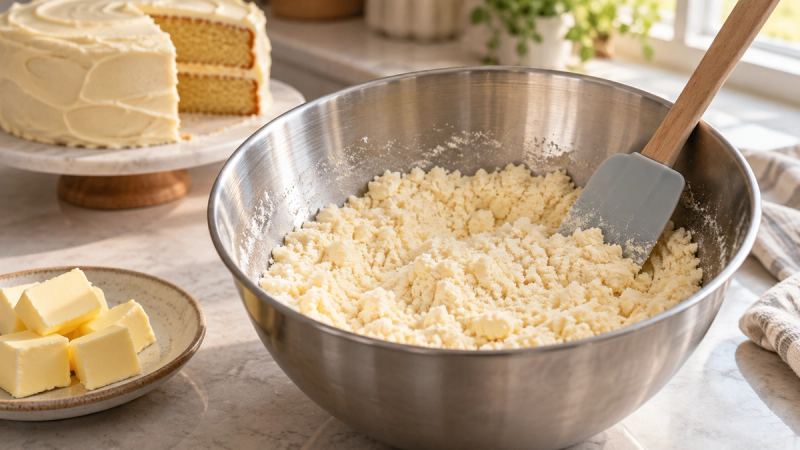
The first mixture can look like damp sand. That is expected. You are not trying to whip butter and sugar into a fluffy cream at this stage.
The important part is choosing a recipe written for this method. “Reverse creaming” describes a family of mixing instructions, not one universal sequence that you can apply to every cake.
What changes when flour meets butter first?
#In conventional creaming, butter and sugar are beaten together before the flour is added. This introduces air into the butter mixture. Eggs follow, then the dry ingredients and liquids, often in alternating additions.
Reverse creaming changes that starting point. The butter is worked into a mixture that already contains flour. Coating the flour with fat limits gluten development when liquid arrives, helping the cake stay tender.
King Arthur Baking's explanation of reverse creaming describes cakes that tend to have a closer crumb and less doming than traditionally creamed cakes. “Crumb” means the texture inside the cake: the size and arrangement of the small air pockets you see in a cut slice.
A closer crumb is a texture choice. It can still be soft and moist. It also does not mean that every cake made this way will be sturdy enough for any filling or number of tiers. The recipe's ingredients matter alongside its mixing method.
Reverse creaming versus conventional creaming
#| Point to compare | Conventional creaming | Reverse creaming |
|---|---|---|
| Starting mixture | Butter and sugar | Dry ingredients, including flour, mixed with softened butter |
| Early visual cue | A lighter, fluffy butter mixture | Even crumbs or a paste, depending on the recipe |
| Flour's role | Added after the initial aeration | Present while the butter is incorporated |
| Typical result | Soft cake with aeration from the creaming stage | Fine, close crumb; often useful for clean slices and layers |
| Main instruction to follow | Creaming endpoint, then the recipe's additions | Butter incorporation, then the recipe's specific liquid and egg sequence |
Neither column is a ranking. A familiar lemon butter cake can work well with conventional creaming; an airy sponge relies on a different approach again. Changing the method because another cake looked smoother in a video is not a reliable improvement.
For a hypothetical birthday cake, start with the texture you want. If you prefer a close-grained vanilla cake for stacking and frosting, a reverse-creamed butter cake is a reasonable recipe to explore. If you want a very light sponge, choose a sponge recipe and preserve its egg-foaming instructions.
Two real recipes show why the order matters
#This is where short tutorials can cause confusion. One tells you to add milk before the eggs. Another adds eggs before the milk. Both can describe reverse creaming correctly.
Golden Vanilla Cake: milk before eggs
#King Arthur's Golden Vanilla Cake combines the dry ingredients, then mixes in softened butter until sandy. Milk and vanilla are added together next. Eggs are then incorporated individually, with scraping between additions.
The recipe includes timed mixing stages. Those instructions belong to that formula. They are not a timer chart for every reverse-creamed cake.
Golden Vanilla Cake uses all-purpose flour and whole eggs. Its published description emphasizes a close-grained cake suitable for stacking. If you choose it, keep its ingredient quantities, pans and mixing instructions together.
Tender White Cake: eggs before the milk mixture
#King Arthur's Tender White Cake also starts with dry ingredients and soft butter, but the next steps differ. Egg whites and a whole egg go in before the milk or yogurt mixture. That final mixture is added in thirds, with beating and scraping between additions.
This formula uses cake flour. The publisher also warns that the finished layers are delicate and need care when turned out. So even within reverse creaming, “good for layer cake” does not mean “impossible to break.”
The practical lesson is to follow one complete recipe. Combining Golden Vanilla Cake's ingredients with Tender White Cake's egg sequence creates a new experiment. It is no longer either publisher's documented method.
Read the recipe before starting the mixer
#Before measuring, mark three things: which ingredients form the initial dry mixture, what goes in immediately after the butter, and where the recipe asks for sustained beating.
Put ingredients into separate bowls according to those stages. If a recipe wants vanilla mixed with milk, keep them together. If eggs go in individually, arrange them so you can add one at a time. This simple setup reduces the temptation to empty every wet ingredient into the mixer at once.
Also note when the bowl needs scraping. Material can remain on the sides and bottom while the visible surface appears combined. Scraping is part of these published methods, rather than an optional cleanup step.
Do the pan preparation and oven setup from the chosen recipe too. Understanding reverse creaming does not supply missing pan sizes, baking temperatures or doneness checks. Those details still come from the cake formula you are making.
Butter should be pliable and cool
#“Softened” does not mean melted. A useful check is whether a finger can leave an indentation while the butter still offers a little resistance. It should retain its shape rather than look oily or slump into a puddle.
King Arthur's guide to butter and sugar creaming explains this physical cue clearly. Rose Levy Beranbaum, who adapted the industry's two-stage method for butter cakes, likewise emphasizes cool, pliable butter in her own account of the method.
This matters in a warm kitchen. Butter left out for a fixed number of minutes may behave differently on a hot afternoon and a cool morning. Check its condition against the recipe instead of treating the clock as proof that it is ready.
If it is already melted, use the butter condition the recipe requests before starting. Do not assume that replacing softened butter with the same weight of liquid butter preserves the method.
Which mixing cues should you trust?
#Sandy crumbs can be the right starting point
#An evenly crumbly butter-and-flour mixture is expected in many reverse-creaming recipes. Tender White Cake's instructions explicitly allow that mixture to become a paste depending on butter temperature, mixing and sugar granulation.
That is a useful boundary: a recipe can permit more than one appearance. Compare your bowl with its instructions before adding extra liquid to make it resemble an unrelated demonstration.
Beating after flour is added can be intentional
#Many bakers learn to stop mixing once flour enters a cake batter. That habit needs context here. Tender White Cake specifies further beating after its liquid additions; Golden Vanilla Cake has its own timed stages.
Do not remove those stages just because flour is already in the bowl. Equally, the flour's fat coating is not permission to beat indefinitely. Follow the recipe's speed, duration and texture cues together.
A close crumb is different from an unexplained dense cake
#Judge the finished cake against the publisher's description. Golden Vanilla Cake is intentionally close-grained. A cake that fails to rise as expected cannot be diagnosed from the phrase “reverse creaming” alone.
For the next bake, keep a short factual record: the recipe, flour used, butter condition, ingredient substitutions and any mixing stage skipped. That makes a question to the recipe publisher more useful than simply reporting “my cake was dense.” Avoid changing several variables at once if you want to understand what happened.
When should you use this method?
#Use reverse creaming when you have a butter-cake recipe designed for it and want its documented texture. Keep conventional creaming when your chosen recipe relies on that sequence. Keep the foaming method for a cake whose structure comes from whipped eggs.
For a first attempt, choose one published reverse-creaming recipe and make it as written. Learn what its early crumbs, final batter and cooled slice should look like. That gives you a useful reference before experimenting with another formula.
This source-based article was prepared with AI assistance. It explains published baking methods; the recipes were not tested by Allblogs for this article.