When an RO water purifier becomes slow, don’t panic and don’t open the machine immediately. Start with the simple things first.
Check whether the inlet valve is fully open, water is actually coming from the supply line, and the pipe behind the purifier is not bent, crushed, or pressed against the wall. These small issues are more common than people think.
If the tank is taking too long to fill, the sediment filter, carbon filter, or RO membrane may be clogged. If the tank feels full but water comes from the tap only as a thin trickle, the storage tank may have lost air pressure.
And if there is leakage, pump noise, wiring trouble, bad smell, strange taste, or any contamination doubt, don’t experiment. Call authorised service.
A slow RO tap is genuinely annoying. One bottle takes forever. The tank never seems full. Someone in the house will definitely say, “Filter kharab ho gaya kya?”
Most slow-flow problems come from a few usual suspects:
- Low inlet water pressure
- Dirty pre-filters
- Choked RO membrane
- Low storage tank air pressure
- Pump or internal service issue
- Source water changes during monsoon, tanker use, or water cuts
This guide is for Indian homes, flats, rented apartments, and families using RO, UV, UF, or mixed water purifier systems.
Quick Low-Flow Checklist
#First, Identify the Type of Slow Flow
#Not every “RO slow hai” problem is the same. Try to figure out which of these two situations matches your home.
1. The Tank Is Filling Slowly
#If the tank itself is taking too long to fill, the purifier is struggling to make purified water.
Common reasons include low inlet water pressure, a partly closed inlet valve, bent or pressed tubing, clogged sediment or carbon filters, a fouled RO membrane, or an internal pump/flow issue.
2. The Tank Is Full, But Tap Flow Is Weak
#Many RO purifiers have a storage tank. That tank does not just store water. It also uses air pressure to push water out through the tap.
So if the tank feels heavy or full, but the tap gives only a thin stream, the tank may have lost air pressure. This is not something you should fix at home. Tank pressure and bladder condition should be checked by an authorised technician.
Check 1: Water Supply and Inlet Pressure
#RO purifiers need enough incoming water pressure. In Indian apartments, this pressure can change during the day because of higher floors, shared tanks, water cuts, tanker supply, pipeline repair or low municipal pressure.
Safe checks: confirm water is coming from the kitchen tap, make sure the purifier inlet valve is fully open, look for a bent external pipe and notice whether the problem happens only at certain times. Do not open the purifier body or adjust internal parts.
Check 2: Sediment Filter
#The sediment filter catches sand, mud, rust, silt and other particles before they reach sensitive parts of the purifier. It can get dirty faster after municipal pipeline repair, apartment tank cleaning, heavy monsoon rain, borewell water, tanker water or brown first-flow water after a cut.
Signs include a muddy external filter housing, slow tank filling, changed pump sound, or slow flow after dirty tap water. Do not open and wash the filter yourself; call authorised service for inspection and replacement.
Check 3: Carbon Filter
#The carbon filter helps improve taste and smell and can protect the RO membrane. When it becomes exhausted or blocked, water flow may slow and taste or smell may change. This is especially common when homes shift between municipal and tanker water.
If purified water smells bad or tastes unusual, stop using it for drinking and call authorised service.
Check 4: RO Membrane
#The RO membrane is the main part that reduces dissolved salts and lowers TDS. Hard borewell water, high TDS, tanker water, muddy supply and poor pre-filter condition can put extra load on it. If the purifier runs for long periods, output stays low, TDS reduction changes or slow flow returns after basic filter service, ask the technician to inspect the membrane.
Do not open the membrane housing yourself.
Check 5: Storage Tank
#A common complaint is: “Tank full lag raha hai, but tap se paani bahut slow aa raha hai.” If the tank feels heavy or full but flow is weak, storage tank pressure may be the issue.
Do not try to pump air into the tank yourself. Wrong pressure can damage the internal bladder or tank assembly. Tank pressure checking, repressurising and tank replacement should be done by authorised service.
Why RO Flow Often Gets Worse During Monsoon
#Heavy rain can increase mud, silt and suspended particles in water. Water quality may also change after flooding, pipeline repair, storage tank cleaning or source-water changes. Apartment residents may face shared tank sediment, floor-to-floor pressure variation, tanker water, harder borewell water and rusty first-flow water after cuts.
If your purifier slows down after rain, tanker supply, water cuts or dirty tap water, mention this when booking service.
Using a TDS Meter Without Getting Confused
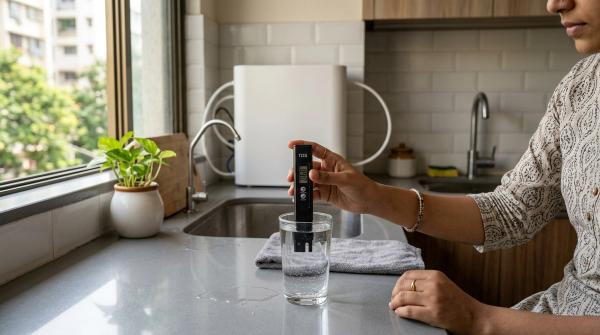
#A TDS meter is useful, but it does not tell the full story. TDS means Total Dissolved Solids. A basic home TDS meter estimates dissolved salts and minerals by measuring electrical conductivity.
It can help compare raw water and purified water, track whether RO performance has changed and show whether source water quality has shifted. But it cannot prove water is free from bacteria, viruses, biofilm, pesticides, smell issues, taste problems, tank contamination or all chemical contaminants.
Low TDS does not automatically mean the water is safe. If the water smells bad, tastes strange, looks cloudy or makes you uncomfortable, do not depend only on the TDS number. Stop using it for drinking and call authorised service.
A Quick Note on NSF/ANSI 58
#NSF/ANSI 58 is related to RO system material safety, structural integrity, TDS reduction, efficiency, recovery and user information. In simple words, RO performance is not only about a low TDS number. A good RO system also needs safe materials, proper pressure handling, reliable construction, realistic recovery claims and clear user guidance.
What to Tell the Technician
#Share whether the tank is filling slowly or the tank is full but tap flow is slow. Mention recent monsoon rain, water cuts, tanker supply, kitchen-tap pressure, smell or taste changes, cloudy water, unusual pump noise, leakage, TDS changes and whether your unit is RO only or RO plus UV/UF.
What Not to Do
#Do not open the purifier body, remove and wash internal filters, puncture or modify the storage tank, repressurise the tank yourself, bypass filters, ignore bad smell because TDS looks low, use water from a leaking purifier, or run a purifier that may have an electrical fault.
Practical Diagnosis Summary
#- Check water supply and inlet valve.
- Observe whether the tank fills slowly or is full with weak tap flow.
- Look for source-water clues such as muddy supply, tanker water, water cuts, monsoon rain or recent tank cleaning.
- Use TDS as one clue only.
- Call authorised service for internal work.