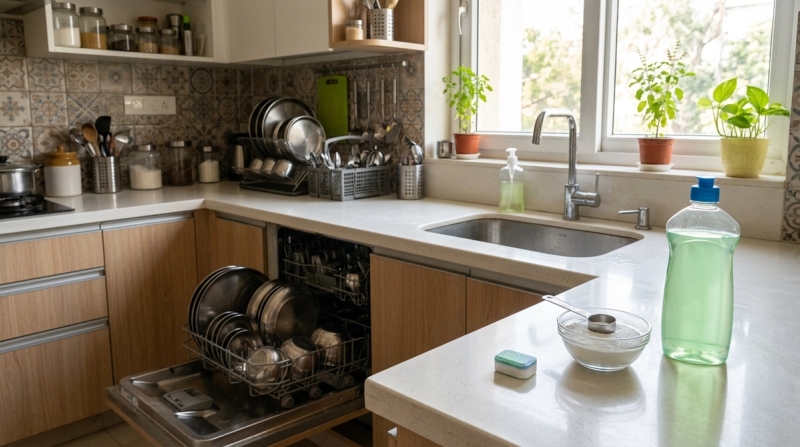
For most Indian apartments, dishwasher powder is the best everyday starting point because it gives you dose control for full and half loads. Dishwasher tablets are easiest for full loads. Dishwasher liquid detergent suits lighter loads, but it may struggle with hard water or greasy Indian cooking residue.
If you’ve just bought a dishwasher, or you’re still figuring out why your dishes don’t come out as clean as expected, you’ve probably asked this at least once: should I use dishwasher tablets, powder, or liquid?
Indian kitchens are not exactly “easy mode” for dishwashers. We’re talking hard water, oily kadhais, turmeric stains, dal stuck to bowls, tea marks, rice starch on plates, milk residue, and glasses that can come out cloudy if the setup is wrong.
There is no one perfect detergent for every home. The right choice depends on your water, your dishes, how greasy your cooking is, and how often you run the dishwasher.
Why Indian Apartments Need a Different Dishwasher Detergent Approach
#A lot of dishwasher advice online is written for homes where water is softer and cooking residue is lighter. That advice does not always work perfectly in Indian apartments.
In many Indian cities, water can come from municipal supply, borewell, tankers, or a mix of all three. Sometimes it is stored in overhead tanks too. This water is often hard, which means it contains minerals like calcium and magnesium.
Hard water can make detergent less effective. It can also leave behind:
- White marks on dishes
- Cloudy glasses
- Chalky buildup inside the dishwasher
- Water spots
- Dull-looking steel plates
- Detergent residue
Then there’s Indian food. Oil, ghee, masala, turmeric, dal, rice starch, tea, milk, pressure cooker residue, and kadai grease are all common in daily cooking. A lightly used coffee mug and a kadai after tadka are not the same washing challenge.
So the better question is not just, “Which dishwasher detergent is best?” It is: which detergent works best for my water, my cooking, my load size, and my dishwasher settings?
Dishwasher Tablet vs Powder vs Liquid: Quick Comparison
#Dishwasher Powder: The Most Practical Everyday Option
#For many Indian apartments, dishwasher powder is the most sensible choice for daily use.
The main reason is control.
If your dishwasher is only half full, you can use less powder. If the load is greasy, you can use the recommended amount, as long as you don’t cross the dispenser fill line. This flexibility is useful for couples, renters, small families, and homes where the number of dishes changes every day.
Powder is also usually more cost-effective. You are not forced to use one fixed dose every time, unlike a tablet. If you run quick cycles for cups, plates, spoons, or breakfast dishes, this can save money over time.
But powder is not foolproof.
Using more powder does not automatically mean cleaner dishes. Too much powder can leave gritty residue on steel plates, glasses, bowls, and plastic containers.
If your detergent compartment has a fill line, follow it. Don’t keep adding extra powder just because yesterday’s load was very oily.
Humidity can also be a small problem. During monsoon, or in damp kitchens, dishwasher powder can clump if the pack is not closed properly. Keep it sealed, store it in a dry place, and don’t use a wet spoon to scoop it.
Use dishwasher powder if:
- Your load size changes often.
- You sometimes run half-loads.
- You want better control over detergent quantity.
- You want to reduce cost per wash.
- You don’t mind measuring detergent.
Dishwasher Tablets: Very Convenient, But Less Flexible
#Dishwasher tablets are popular for a reason. They’re simple.
Take one tablet, place it in the detergent compartment, close the flap, start the cycle. That’s it.
They are especially useful when different people at home use the dishwasher and you don’t want anyone guessing the detergent quantity. Tablets also work well for full loads with oily plates, masala bowls, rice plates, spoons, milk-film utensils, and greasy cookware.
They usually perform best on proper full cycles because the tablet gets enough time to dissolve and release its ingredients.
The downside is flexibility.
If you are washing only a few cups and plates, one full tablet may be more detergent than you need. That can increase your cost per wash and may sometimes leave residue if the cycle is short or the load is too small.
Cutting tablets in half is also not ideal. Many tablets have layers or gel sections that are designed to dissolve at different stages of the wash. Cutting them can affect how they work.
Also, don’t rely too much on “all-in-one” claims. Some tablets say they include salt or rinse aid benefits, but that does not always mean you can ignore your dishwasher salt and rinse aid compartments, especially if your apartment has hard water.
Your dishwasher’s water softener still needs dishwasher salt if your water hardness level requires it.
Use dishwasher tablets if:
- You usually run full loads.
- You want the easiest option.
- Your family does not want to measure powder.
- You use longer wash cycles.
- Your dishes are usually greasy or heavily soiled.
Dishwasher Liquid Detergent: Easy to Use, But Often Milder
#Dishwasher liquid detergent, also called dishwasher gel, is not the same as regular hand dishwashing liquid.
This is important.
Dishwasher liquid detergent is made for low foam. Regular hand dishwashing liquid creates a lot of foam and should never be used in a dishwasher.
Dishwasher liquid is convenient. It pours easily, does not clump in humid weather, and dissolves quickly. It can work well for lighter loads like cups, breakfast plates, spoons, and less greasy dishes.
But in many Indian homes, liquid detergent can feel a bit weak.
It may struggle with:
- Hard water
- Oily kadhais
- Dal stuck to bowls
- Turmeric stains
- Greasy plastic containers
- Heavy masala residue
If your main problems are cloudy glasses, white marks, or oily residue after a wash, liquid detergent may not be the best first choice.
It is not useless. It just suits lighter dishwashing needs better.
Use dishwasher liquid detergent if:
- Your loads are mostly light.
- You use quick cycles often.
- You want something easy to pour.
- Your water is not very hard.
- Your dishwasher manual allows liquid detergent.
Hard Water May Be the Real Reason Your Detergent Is Failing
#Sometimes the detergent is not the main problem at all.
In many Indian apartments, poor dishwasher results are caused by hard water, wrong settings, or basic maintenance issues.
Hard water can lead to:
- Cloudy glasses
- White marks on steel plates
- Chalky buildup inside the machine
- Poor cleaning
- Water spots after drying
- Detergent residue on dishes
This is where dishwasher salt and rinse aid become important.
When Should You Use Dishwasher Salt?
#Use dishwasher salt if your dishwasher has a salt reservoir and your water hardness level requires it. In many Indian apartments, it usually does.
Dishwasher salt does not directly clean your dishes. Its job is to help the dishwasher’s internal water softener work properly. The softener reduces the effect of hard minerals before the water touches your dishes.
Do not put table salt, rock salt, sendha namak, or cooking salt into the dishwasher salt compartment. Use only salt made specifically for dishwashers.
Check your dishwasher salt if:
- Glasses look cloudy.
- White scale appears often.
- Dishes look dull after washing.
- The salt indicator light is on.
- You recently shifted to a new apartment.
- Your water supply changed from municipal water to borewell or tanker water.
Also, check your dishwasher manual and set the water hardness level correctly. Many people fill the salt compartment but never adjust the hardness setting. Then they wonder why the results are still poor.
Both things matter.
When Should You Use Rinse Aid?
#Use rinse aid if dishes come out wet, spotty, or streaked.
Rinse aid helps water slide off the dishes instead of drying in droplets. This gives you fewer water spots and better drying, especially on glasses, plastic containers, and stainless steel items.
Check rinse aid if:
- Glasses have spots.
- Plastic containers stay wet.
- Steel plates have drying marks.
- Dishes look clean but not shiny.
- The rinse aid indicator light is on.
Even if you use dishwasher tablets, rinse aid can still help a lot in Indian apartments with hard water.
Before Changing Detergent, Check These Things First
#Before you decide your dishwasher powder, tablet, or liquid is useless, do a quick check. Very often, the detergent is fine but something else is causing the problem.
1. Read your dishwasher manual
#Your manual will tell you which detergent formats your machine supports, how much detergent to use, how to fill dishwasher salt, and how to adjust the water hardness setting.
Look for:
- Detergent type guidance
- Salt reservoir instructions
- Rinse aid settings
- Water hardness adjustment
- Heavy load cycle recommendations
2. Check your water hardness
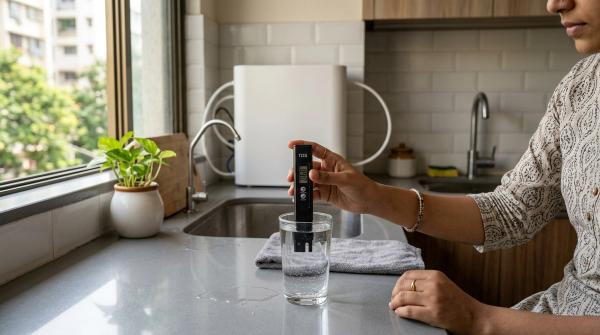
#If possible, use a simple water hardness test strip. You can also ask your apartment maintenance team what kind of water supply your building uses.
Borewell and tanker water are often harder, but not always. Once you know the hardness level, set your dishwasher accordingly.
3. Don’t cross the detergent fill line
#For powder and liquid detergent, don’t guess randomly. Open the detergent compartment and check the fill line.
Too little detergent may leave grease behind. Too much detergent can leave residue, foam, or a gritty feeling on dishes.
More detergent is not always better.
4. Clean the filter
#A dirty filter can ruin washing results even if you use the best detergent.
Food particles stuck in the filter can block drainage and make dirty water circulate again. Remove and clean the filter as per your dishwasher manual.
If you’re not sure how to remove it, don’t force anything. Check the manual or call service support.
5. Check the spray arms
#Spray arms need clear holes to push water properly. Rice grains, seeds, lemon seeds, or small food particles can block them.
If your manual says the spray arms are removable, clean them gently and fit them back correctly. If they are not removable, just clean what you can safely reach.
6. Match detergent to your load size
#Use powder if your load size keeps changing.
Use tablets if you run full loads regularly.
Use liquid if your loads are light and your current results are already decent.
Never Use Hand Dish Soap in a Dishwasher
#Please don’t put regular hand dishwashing liquid into your dishwasher.
Hand dish soap is designed to create foam. Dishwasher detergent is designed to clean with very low foam.
Even a small amount of regular dish soap can create too much foam, leak from the dishwasher door, and turn your kitchen floor into a soap party.
Always use detergent made specifically for dishwashers, whether it is powder, tablet, or liquid.
Related AllBlogs Guides
#If you are still setting up your dishwasher routine, these existing AllBlogs guides can help next:
- Dishwasher Salt vs Rinse Aid vs Detergent: Beginner Guide — useful if you are confused about what each compartment does.
- Dishwasher Smell Checklist: Filter, Drain, Rinse Aid and Apartment Fixes — useful if dishes clean properly but the machine smells stale.
- Dishwasher for Indian Apartments: Hand Washing vs Countertop vs Full-Size — useful if you are still deciding whether a dishwasher suits your home.
Final Takeaway
#For most Indian apartments, the best starting point is:
Dishwasher powder + dishwasher salt + rinse aid.
Powder gives you the best balance of control, cost, and everyday cleaning. It works especially well when your dishwasher loads are mixed: sometimes full, sometimes half, sometimes greasy, sometimes light.
Choose dishwasher tablets if convenience matters more, your dishwasher is usually full, and you don’t want to think about dosing.
Choose dishwasher liquid detergent if your loads are light, your water is manageable, and your dishwasher manual allows it.
But if you are dealing with hard water, cloudy glasses, greasy residue, or white marks, liquid detergent probably should not be your first choice.
The best dishwasher setup is not always the fanciest one. It is the one that matches your water, your dishes, and your daily routine.