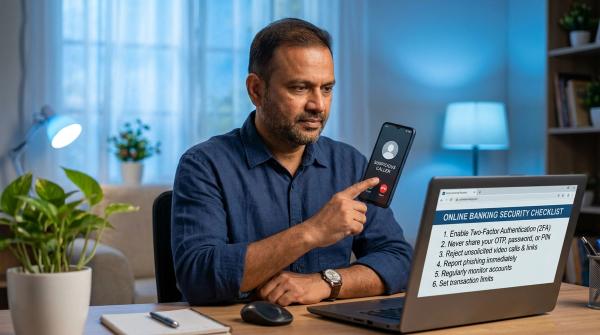
Getting your first credit card in India can feel frustrating if you have a low CIBIL score, no credit history, irregular income, or limited salary proof. Banks often prefer applicants who already have a clean repayment record, which is difficult when you are just starting out.
That is where a secured credit card against FD can help.
It is not a premium card. It may not come with exciting rewards, airport lounge access, or big cashback offers. But it can do something more important: help you enter the credit system safely and build a repayment history over time.
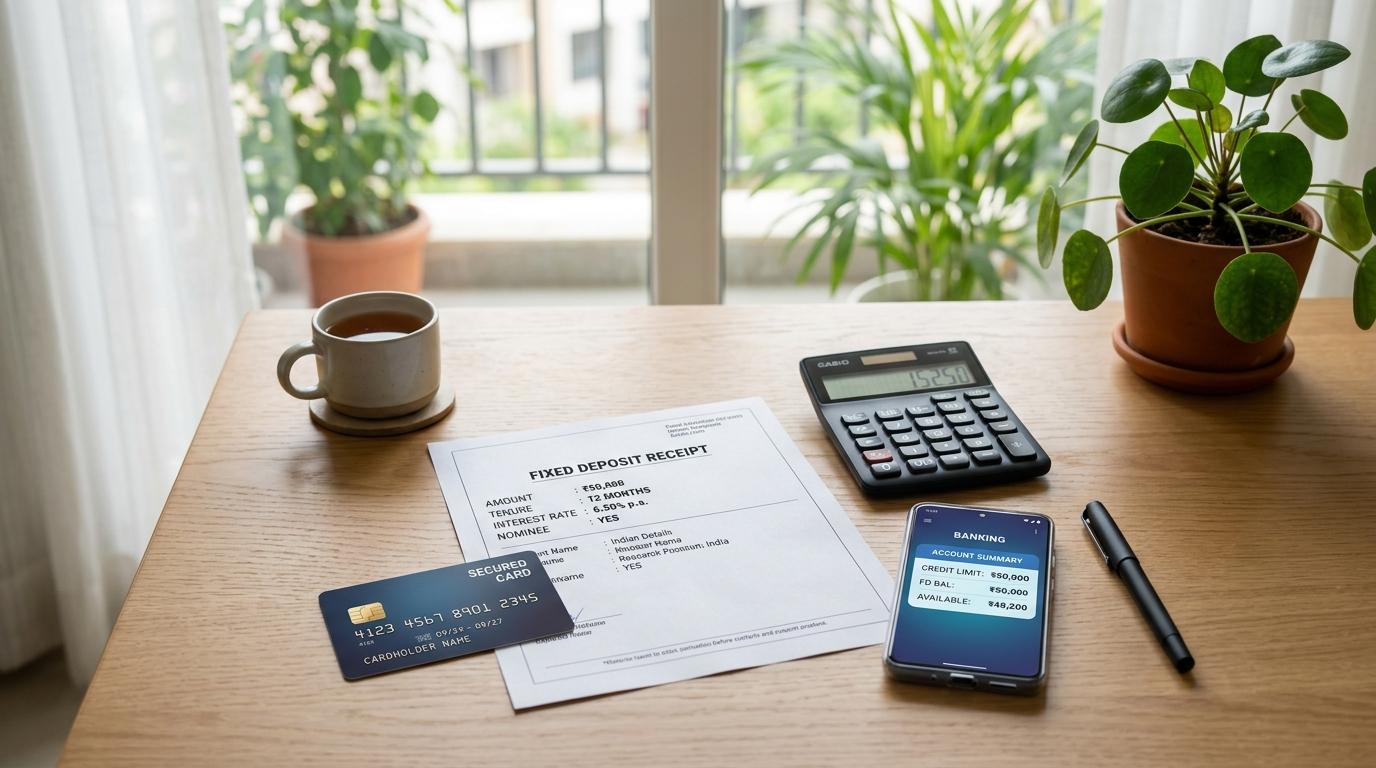
The concept is simple. You open a fixed deposit with a bank, the bank keeps that FD as security, and then gives you a credit card against it. If you use the card carefully and pay the full bill on time, it may help you build or rebuild your credit profile.
What is a secured credit card against FD?
#A secured credit card is a credit card backed by your own fixed deposit.
You place money in an FD with the bank. The bank marks a lien on that FD, which means you cannot freely withdraw or close it while the credit card is active. In return, the bank issues you a credit card.
Because the bank already has your FD as security, approval is usually easier than a regular unsecured credit card.
An FD-backed credit card can be useful for:
- First-time credit card users
- Students and young earners
- Freelancers and self-employed people
- People with low CIBIL scores
- People with no credit history
- People who were rejected for a regular credit card
- People without strong income documents
The good part is that your FD usually continues to earn interest as per the bank’s FD terms. The only catch is that the FD remains locked as long as it is linked to your card.
How does a credit card against FD work?
#The process is usually straightforward.
- You open a fixed deposit with the bank.
- The bank places a lien on the FD.
- The bank issues a credit card against that FD.
- Your credit limit is decided based on the FD amount.
- You use the card like a normal credit card.
- The bank generates a monthly statement.
- You pay the bill on or before the due date.
The credit card limit against FD is usually a percentage of your FD value. Many banks offer around 80% to 90% of the FD amount as the card limit, but the exact percentage depends on the bank.
For example, if you open an FD of ₹20,000, your credit card limit may be around ₹16,000 to ₹18,000.
One thing is important to remember: this is not extra money. It is still credit. Whatever you spend has to be paid back.
Secured credit card vs regular credit card
#A secured card is not automatically better than a regular card. It is better only when getting a regular card is difficult or when you want to build credit slowly and safely.
Why banks approve FD-backed cards more easily
#With a normal credit card, the bank is giving you unsecured credit. So it checks your salary, employer profile, repayment history, CIBIL score, existing loans, and overall risk.
With a credit card against FD, the bank already has your fixed deposit as security. If you do not repay for a long time, the bank can recover dues from your FD as per the agreed terms.
That is why an FD-backed card is often considered a practical low CIBIL credit card option.
But easier approval does not mean you can be careless. Late payments can still be reported to credit bureaus and can still damage your credit score.
Checklist before applying for an FD-backed credit card
#Before you open an FD just to get a card, take a little time to check the details. A secured card is simple, but your own money is locked, so you should know the rules clearly.
1. Check the minimum FD amount
#Every bank has its own minimum FD requirement. Some banks may allow a smaller deposit, while others may ask for a higher amount.
Choose an FD amount you can comfortably lock. Do not use your emergency fund for this, especially if you may need that money suddenly.
2. Check the credit limit offered
#Ask the bank how much credit limit you will get against your FD.
If the bank offers 80% to 90% of the FD amount, your limit will be lower than the deposit value.
For example:
- FD amount: ₹10,000
- Possible card limit: ₹8,000 to ₹9,000
If the limit is too small, it can become difficult to manage. Also, avoid using the full limit every month.
3. Confirm credit bureau reporting
#This is one of the most important checks.
If your goal is to build credit history, ask whether the bank reports your repayment activity to credit bureaus such as CIBIL and other recognised bureaus.
Your good repayment behaviour helps your credit profile only if it is reported. Do not assume this automatically. Check the terms or ask the bank directly.
4. Understand the FD lien and lock-in rules
#Your FD will not be freely available while the card is active.
If you want to close or withdraw the FD, you will usually need to:
- Clear all credit card dues
- Request credit card closure
- Wait for the bank to remove the lien
- Then withdraw or close the FD as per the bank’s process
The exact steps and timelines can vary from bank to bank.
5. Compare joining fee and annual fee
#Some secured credit cards are lifetime free. Some charge a joining fee, annual fee, or renewal fee.
Before applying, check:
- Joining fee
- Annual fee
- Annual fee waiver conditions
- Renewal charges
- Card replacement charges
- Other maintenance charges
Since this card is mainly for credit-building, paying a high fee usually does not make sense unless the benefits are genuinely useful.
6. Check interest charges
#Credit card interest can be very high if you do not pay the full bill by the due date.
Check the bank’s latest schedule of charges for monthly and annual finance charges. Do not rely only on advertisements or sales calls.
The safest rule is simple: pay the full statement amount every month.
7. Check late payment charges
#Late payment fees are separate from interest charges. If you miss the due date, the bank may charge a late fee based on the outstanding amount.
Check the latest charges for:
- Late payment fee slabs
- Finance charges
- Overlimit fee, if applicable
- Cash withdrawal charges, if applicable
A small missed payment can become expensive very quickly.
8. Avoid cash withdrawals
#Using a credit card to withdraw cash is usually costly.
Cash advance fees may apply, and interest may start immediately. There is often no interest-free period on cash withdrawals.
If this is your first credit card in India, use it only for planned purchases and bills that you can repay fully.
9. Check how FD interest will be paid
#Your FD usually continues to earn interest as per the FD terms.
Ask the bank:
- Will interest be paid monthly, quarterly, or on maturity?
- What happens if the FD matures while the card is still active?
- Will the FD be renewed automatically?
- Do you need to give separate instructions?
These small details matter because your FD is linked to the card.
10. Understand closure rules
#Before applying, also ask how to close the card later.
Check:
- Can the card be closed online?
- Is branch visit required?
- How long does lien removal take?
- What happens to pending transactions?
- What happens if a refund comes after closure?
- Will a final statement be generated?
Do not ignore the closure process. Your FD can be released only after the bank completes the required steps.
Credit card fees in India: what should you check?
#A secured credit card can be low-cost if used properly. But it can become expensive if you miss payments, withdraw cash, or ignore charges.
For beginners, the best approach is boring but effective: use the card for small planned expenses and pay the full bill before the due date.
How a secured credit card affects your CIBIL score
#A secured credit card can help your CIBIL profile if two things happen:
- The bank reports your card activity to credit bureaus.
- You use the card responsibly.
Good habits that may help your credit profile include:
- Paying the full bill on time
- Keeping credit utilisation low
- Avoiding missed due dates
- Not applying for too many cards quickly
- Keeping the account clean for several months
Bad habits that can hurt your credit profile include:
- Paying late
- Paying only the minimum due repeatedly
- Using almost the full credit limit every month
- Defaulting on payments
- Letting the bank recover dues from the FD
The card may be backed by an FD, but your repayment behaviour still matters a lot.
The one rule beginners should follow: pay in full
#Every credit card bill has two important amounts:
- Minimum Amount Due
- Total Amount Due
The minimum amount due is only the small amount you need to pay to avoid being treated as unpaid for that billing cycle. It does not mean the remaining amount is free.
If you pay only the minimum due, interest may apply on the unpaid balance as per the card terms.
The better habit is to pay the Total Amount Due every month.
For example, if your bill is ₹4,000, pay ₹4,000. Not ₹500. Not just the minimum due.
Full payment keeps the card useful and prevents interest from piling up.
Keep your credit utilisation low
#Credit utilisation means how much of your available limit you use.
If your card limit is ₹10,000 and you spend ₹9,500 every month, your utilisation is very high. Even if you pay on time, it may look like you are depending too much on credit.
A common credit discipline practice is to keep usage around 30% of the limit or lower.
Example:
- Card limit: ₹20,000
- Safer monthly usage: around ₹6,000 or less
This is not a legal rule, but it is a useful habit.
The best rule is even simpler: spend only what you can repay fully.
What happens if you miss payments?
#Missing payments on an FD-backed credit card is not harmless. Your FD does not protect your CIBIL score from damage.
Here is what can happen.
1. Late fee may be charged
#If you miss the due date, the bank may add a late payment fee as per its schedule of charges.
2. Interest may start applying
#If you do not pay the full amount by the due date, finance charges may apply on the unpaid balance.
3. Your credit record may be affected
#Late or missed payments may be reported to credit bureaus. This can hurt your CIBIL score and make future loans or credit cards harder to get.
4. Your card may be blocked
#The bank may restrict or block your card if dues remain unpaid.
5. The bank may recover dues from your FD
#If you continue to default, the bank may invoke the lien on your FD and adjust the outstanding dues, fees, and charges as per the agreed terms.
This is something many beginners misunderstand. The FD is not a backup you should casually depend on. If the bank has to recover money from it, your credit profile may still suffer.
Who should consider a secured credit card in India?
#A secured credit card India option may suit you if:
- You are applying for your first credit card
- You have no CIBIL history
- Your CIBIL score is low
- You do not have regular salary proof
- You want to build repayment discipline
- You can lock an FD without affecting your emergency fund
- You are ready to pay the full bill every month
It may not be suitable if:
- You cannot afford to lock money in an FD
- You are already struggling with repayments
- You plan to use it for cash withdrawals
- You may pay only the minimum due
- You want premium rewards and benefits
- You are getting it only because someone told you to get a credit card
A secured card is best seen as a credit-building tool, not a lifestyle product.
Safe usage plan for first-time credit card users
#If this is your first credit card, keep it simple.
Use the card for fixed, small expenses such as:
- Mobile bill
- Internet bill
- Groceries
- Fuel or transport spending
- Small online purchases
Avoid using it for:
- Impulse shopping
- Cash withdrawals
- Large purchases you cannot repay immediately
- Spending only to earn rewards
- Managing one debt with another
A simple monthly routine can work well:
- Spend only what you already have in your bank account.
- Keep usage low.
- Check the statement when it is generated.
- Pay the total amount due before the due date.
- Keep payment confirmation for your records.
Do this consistently for a few months. That is where the real benefit comes from.
Common mistakes to avoid
#Mistake 1: Thinking the FD will handle everything
#Yes, the FD is security. But if the bank uses it to recover dues, your credit record can still be affected. Your goal should be to never reach that stage.
Mistake 2: Paying only the minimum due
#Minimum due is not a proper repayment plan. It can lead to interest charges and a growing outstanding balance.
Mistake 3: Using the full credit limit
#Using almost the full limit every month may not look healthy. Keep your spending moderate and manageable.
Mistake 4: Ignoring fees
#Even a basic card can have charges. Always read the schedule of charges before applying.
Mistake 5: Closing the card without checking dues
#Before closing the card, clear all dues, wait for pending transactions, check refunds, redeem usable benefits if any, and follow the bank’s closure process.
Mistake 6: Applying for too many cards too quickly
#Once your CIBIL starts improving, you may feel tempted to apply for more cards. But too many applications in a short time can make you look credit hungry. Go slow.
Should you move to a regular credit card later?
#After several months of disciplined usage, you may become eligible for a regular unsecured credit card. This depends on your credit profile and the bank’s policy.
Do not rush into it. First check:
- Your repayment history
- Your CIBIL score trend
- Whether you actually need another card
- Fees on the new card
- Your ability to manage multiple due dates
If you close the secured card later, make sure all dues are cleared and the FD lien is removed properly.
A regular credit card may offer better rewards and higher limits, but take one only if you can manage it responsibly.
Final take
#A secured credit card against FD is one of the simpler ways to start your credit journey when regular card approval is difficult. It gives you access to a credit card, may help build repayment history if reported, and allows your FD to continue earning interest.
But it is not free money.
The safe formula is clear: choose a low-cost card, keep your spending small, pay the total amount due every month, and never let the bank recover dues from your FD.
Used calmly, it can be a useful first step. Used carelessly, it can create fees, stress, and credit damage.