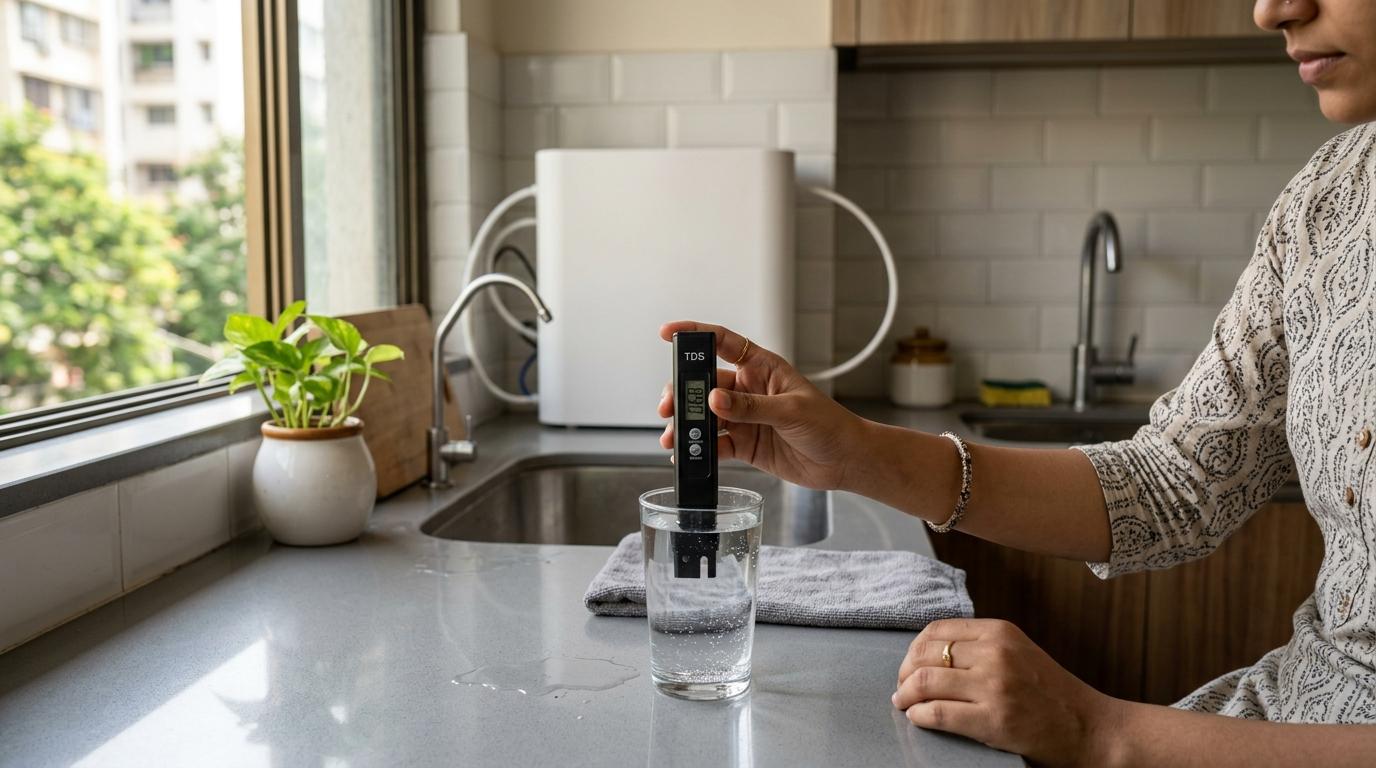
A TDS meter for drinking water is a useful first check before buying a water purifier. It estimates dissolved minerals and salts, which can help you decide whether RO is needed or whether UV, UF, sediment and carbon filtration may be enough. But it cannot prove water is safe from bacteria, viruses, pesticides or heavy metals.
What is TDS in drinking water?
#TDS stands for Total Dissolved Solids: an estimate of dissolved substances in water, usually minerals and salts such as calcium, magnesium, sodium, potassium, chlorides, bicarbonates and sulphates.
High TDS water may taste salty, bitter, heavy or metallic. It may also leave scaling on taps, kettles, geysers and kitchen fittings. Very low TDS water can taste flat because it has little mineral content.
What a TDS meter actually measures
#A home water TDS meter measures electrical conductivity and converts that into an estimated TDS number. Water with more dissolved charged particles conducts electricity better, so the meter reports a ppm or mg/L estimate.
A TDS meter can help you understand whether your water has low, medium or high dissolved mineral content, whether RO may be useful, and whether your RO output is changing over time.
What a TDS meter cannot tell you
#A TDS meter cannot confirm that drinking water is safe. It cannot detect bacteria, viruses, pesticides, microplastics or specific heavy metals such as lead or arsenic. It also cannot prove that a UV purifier is working, because UV treatment does not normally change TDS.
Use the number as a decision aid, not a safety certificate.
Source-aware TDS context
#For India, BIS IS 10500 lists 500 mg/L as the acceptable TDS limit for drinking water and 2000 mg/L as the permissible limit when no alternate source is available. WHO discusses TDS mainly in terms of taste and acceptability. The US EPA treats TDS as a secondary drinking water standard related to taste, colour, odour and scaling, not as a primary health-risk measure.
RO vs UV vs UF: simple decision table
#India-aware water source examples
#Mumbai municipal-supply homes may not always need RO if TDS is low, but tank hygiene and old pipelines can still matter. Delhi NCR and Noida homes using hard groundwater may see much higher readings where RO becomes more relevant. Bengaluru apartments can vary sharply depending on Cauvery supply, borewell water, tanker water or seasonal mixing.
Tanker water is especially variable. If your building depends on tankers, test more than once and retest when the taste changes.
How to use a TDS meter at home
#- Take water in a clean glass.
- Let it reach room temperature.
- Switch on the meter.
- Dip the probe into the water.
- Wait for the reading to stabilise.
- Note the ppm or mg/L reading.
- Rinse and dry the probe after use.
- Test both tap water and purifier output if you already use a purifier.
Avoid testing hot water or using soapy containers, because both can distort the reading.
How to check RO purifier performance
#Test raw water and RO output separately. If raw water is 800 ppm and RO output is much lower, the membrane is reducing dissolved solids. If RO output slowly rises over time, the membrane or filters may need service.
Some RO purifiers use mineralisers or TDS controllers, so output TDS can vary by model. Do not panic over one reading. Retest, check taste and service history, then call service if the rise continues.
When a TDS meter is not enough
#Consider lab testing if you use untreated borewell water, live near industrial or heavy agricultural areas, notice chemical smell or unusual colour, see oily water, or have repeated stomach-infection concerns at home.
A TDS meter cannot separate harmless hardness minerals from specific contaminants. For fluoride, nitrate, arsenic, lead, microbial contamination or pesticides, you need proper water testing.
Maintenance and retesting checklist
#- Test raw water first to create a baseline.
- Test purifier output after installation.
- Retest monthly if you use RO.
- Retest after filter changes.
- Retest when your water source changes.
- Retest across summer and monsoon if tanker or borewell use changes.
- Do not use TDS to judge UV performance.
- Call service if RO output TDS rises sharply.
- Consider lab testing if smell, colour or illness concerns continue.
Practical buying rule
#If your TDS is low and your water comes from a treated municipal source, do not rush into buying RO. First check whether the real problem is tank hygiene, old pipes, suspended particles or microbial risk.
If your TDS is high, especially above 500 ppm, and the water tastes salty, bitter or very hard, RO becomes more relevant.
If your TDS is low but safety is uncertain, a TDS meter will not answer that question. You may need UV treatment, safer storage, purifier servicing or lab testing.
Sources checked
#This guide was reviewed against BIS IS 10500 drinking water limits, WHO material on total dissolved solids and palatability, and US EPA secondary drinking water standards for TDS. These references support the article’s source-aware wording: TDS is useful for taste, dissolved solids and purifier selection, but not a complete safety test.