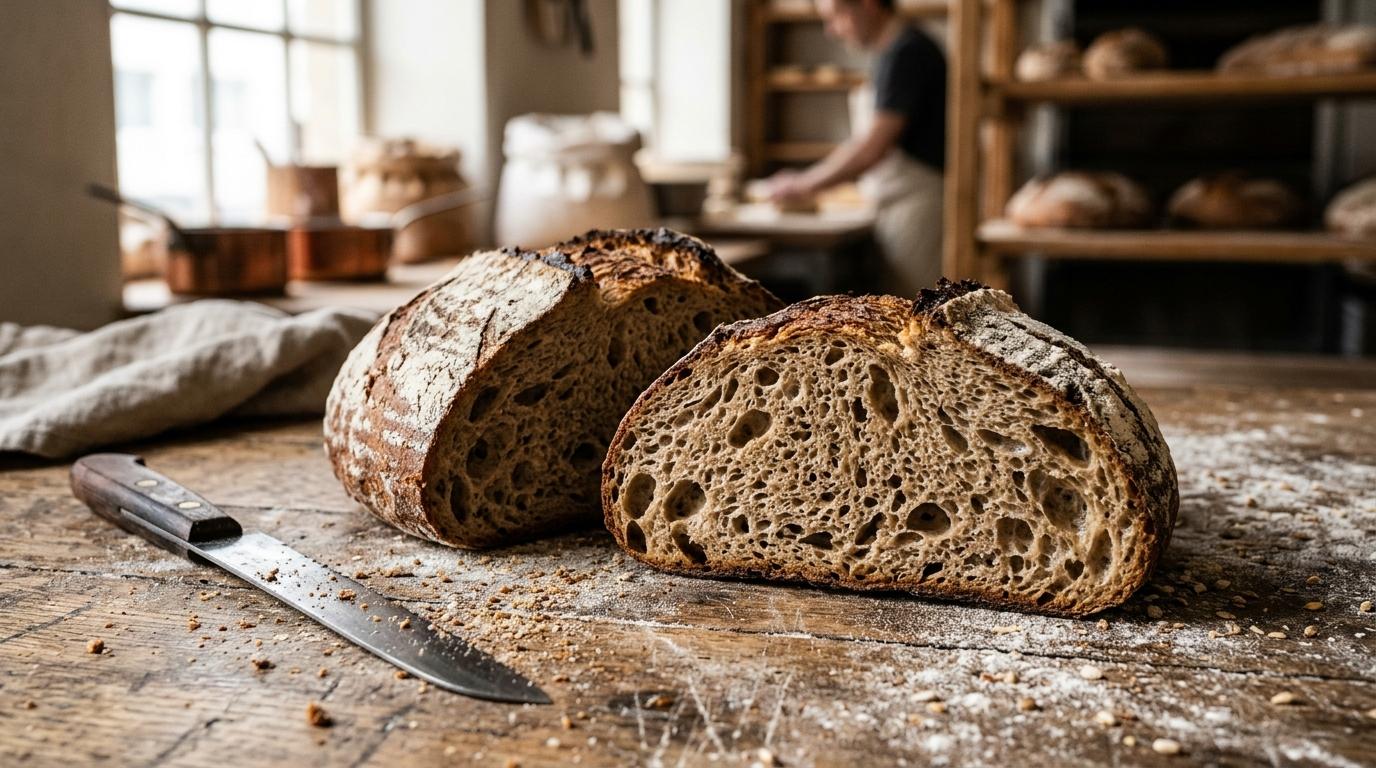
Few culinary experiences rival a loaf of artisan bread pulled fresh from the oven: a brittle, crackling crust encasing a crumb that is soft, airy, and delicately springy to the touch. Yet leave that same loaf on your counter for forty-eight hours, and an unwelcome transformation unfolds. The crust turns soft and leathery, the interior crumb hardens into a dense, chalky, crumbly block, and that lively springiness vanishes completely.
Ask most people why bread goes stale, and they will give you a seemingly obvious answer: the bread simply dried out.
Believing this myth, millions of well-intentioned home cooks seal their fresh loaves tightly inside plastic bags and tuck them into the refrigerator, confident that cold temperatures and airtight packaging will keep the bread fresh for weeks. In reality, that refrigerator habit commits culinary sabotage: it causes the bread to go stale up to six times faster than if it had been left sitting out at room temperature.
Bread staling is not dehydration. You can seal a loaf in an impermeable vapor barrier at 100 percent humidity with zero moisture loss to the outside air, and it will still turn stone-hard right on schedule.
Staling is a complex physicochemical process called starch retrogradation: a slow, inexorable recrystallization of carbohydrate polymers that reallocates moisture inside the crumb, turns flexible polymers into rigid crystalline lattices, and obeys precise thermal kinetics that peak right at the temperature of a household refrigerator.
The Raw Materials: What Wheat Flour Really Is
#To understand why bread hardens over time, one must examine the molecular architecture of wheat flour. Standard bread flour is composed primarily of two macro-components: proteins (roughly 11 to 14 percent by weight) and starch (approximately 70 to 75 percent).
While the proteins glutenin and gliadin combine with water to form the elastic gluten network that traps carbon dioxide bubbles produced by fermenting yeast, starch is the silent giant that forms the actual physical structure of the loaf.
Wheat starch is made of two distinct glucose polymers:
Amylose: A largely linear, unbranched chain of alpha-D-glucose units connected by alpha-(1,4)-glycosidic bonds. Amylose molecules typically comprise about 20 to 25 percent of wheat starch, with molecular weights ranging from several thousand to hundreds of thousands of glucose units.
Amylopectin: A colossal, highly branched polymer of glucose units linked by alpha-(1,4) bonds in linear sections and alpha-(1,6) bonds at frequent branch points, occurring roughly every 24 to 30 glucose residues. Amylopectin makes up the remaining 75 to 80 percent of wheat starch, forming enormous macromolecular clusters with molecular weights extending into the millions.
Inside a raw wheat grain, these long carbohydrate chains are tightly wound together into dense, semi-crystalline microscopic structures called starch granules. At room temperature, starch granules are insoluble in water; they sit inertly inside the dough, suspended within the wet gluten web like bricks waiting for mortar.
The Crucible of Baking: Starch Gelatinization
#When bread dough enters a scorching oven at 220 degrees Celsius (428 degrees Fahrenheit), a transformative phase change takes place.
As the internal temperature of the dough rises past 55 degrees Celsius (131 degrees Fahrenheit), thermal energy begins disrupting the intermolecular hydrogen bonds holding the starch granules together. Water in the dough begins penetrating into the interior of the granules.
Between 60 and 65 degrees Celsius (140 to 149 degrees Fahrenheit), the granules undergo starch gelatinization:
The granules absorb massive quantities of water and swell to several times their original volume.
The ordered, crystalline regions inside the granules melt and dissolve.
Linear amylose molecules, uncoiled by heat and water, leach out of the swollen granules into the interstitial space between cells, forming a continuous, hydrated, disordered gel.
The swollen, gelatinized granules and leached amylose weld together with the coagulating gluten protein matrix to create the soft, flexible, aerated crumb of fresh bread.
In fresh-baked bread, starch exists in a completely amorphous, disordered, non-crystalline state. The water molecules in the crumb are bound closely to the glucose chains through extensive hydrogen bonding, keeping the cellular walls flexible and elastic.
| Starch Phase | Physical State | Temperature Threshold | Texture Impact |
|---|---|---|---|
| Raw Flour Granule | Dense Semi-Crystalline | Room Temperature | Dry, Insoluble Granules |
| Early Gelatinization | Swelling and Water Uptake | 55°C to 65°C (131°F–149°F) | Thickening Dough Matrix |
| Full Gelatinization | Melted Amorphous Gel | 85°C to 95°C (185°F–203°F) | Soft, Springy, Elastic Crumb |
| Early Retrogradation | Rapid Amylose Realignment | First 2 to 4 Hours Cooling | Crumb Sets and Stabilizes |
| Late Retrogradation | Slow Amylopectin Recrystallization | Days at 0°C to 20°C (32°F–68°F) | Hard, Chalky, Crumbly Stale Bread |
The Reversal: What Starch Retrogradation Actually Is
#Thermochemically, the amorphous, disordered state of gelatinized starch in fresh bread is thermodynamically unstable. The universe favors lower energy states, and for long carbohydrate chains, a tightly ordered crystalline configuration is energetically far more stable than a disordered, swollen gel.
As soon as bread finishes baking and cools down, the molecules immediately begin striving to return to their original crystalline state. This spontaneous reorganization is called starch retrogradation.
Retrogradation unfolds in two distinct temporal stages driven by the different structures of amylose and amylopectin:
Short-term retrogradation (amylose): Because amylose is a linear chain, its molecules encounter little steric hindrance. As the loaf cools from 95 degrees Celsius down to room temperature over the first few hours, adjacent amylose chains rapidly align parallel to one another, cross-linking through hydrogen bonds to form a firm network. This initial retrogradation is actually desirable: it is what allows a warm loaf to transition from a gummy, wet interior into a sliceable, stable crumb.
Long-term retrogradation (amylopectin): Unlike linear amylose, amylopectin is heavily branched like the boughs of a dense tree. Its branch points prevent rapid alignment. However, over days, the shorter linear outer branches of adjacent amylopectin molecules slowly, steadily creep toward each other, intertwining and folding back into ordered, rigid double-helical crystal structures (a process known as re-crystallization).
As these crystalline domains grow and spread across the crumb, they transform soft, pliable cell walls into rigid, brittle struts. The crumb loses its ability to deform elastically when compressed, taking on the stiff, brittle, crumbling mouthfeel characteristic of stale bread.
The Water Migration Myth: Where Does the Moisture Go?
#If bread staling is not caused by water evaporating into the air, what happens to the water inside a stale loaf?
The water is still inside the bread—it has simply changed molecular addresses.
In fresh bread, water is distributed fairly evenly throughout the crumb, with a significant fraction bound to the gluten protein matrix. Gluten is highly hydrophilic and requires substantial water to maintain its soft, pliable, rubbery texture.
As amylopectin retrogrades and forms tight crystalline lattices, the emerging starch crystals incorporate water molecules directly into their crystal structure as crystal hydrates. To satisfy this crystallization, starch literally steals water from the surrounding gluten network.
Deprived of its hydrating water molecules, the gluten matrix dries out internally, becoming rigid, brittle, and glassy. 
Simultaneously, moisture migrates along a steep concentration gradient from the wet interior crumb (which has a moisture content around 40 to 45 percent) outward toward the dry crust (which initially has a moisture content around 10 to 15 percent). This migration causes the once-crisp crust to turn soft, tough, and unpleasantly leathery.
The total mass of water in a sealed stale loaf may remain virtually identical to that of a fresh loaf, but because that water is now trapped inside starch crystals or absorbed into the crust, the sensory experience is one of complete dryness.
Understanding how microscopic cellular structures dictate macroscopic culinary changes is a central theme across culinary physics. Readers fascinated by structural food transformations can examine the cellular and volatile chemistry of alliums, which details how cell-wall integrity and enzyme compartments control physical and sensory kitchen outcomes.
The Refrigerator Trap: Why Cold Accelerates Staling
#The most counter-intuitive aspect of bread chemistry is the effect of storage temperature on retrogradation kinetics.
For almost every other perishable food—milk, meat, vegetables, and cooked grains—cold temperatures slow down chemical reactions and retard spoilage according to the Arrhenius equation. Naturally, consumers assume the refrigerator will preserve bread as well.
However, crystallization is not a simple chemical degradation; it is a physical phase transition governed by two opposing thermodynamic forces:
Nucleation rate: The rate at which microscopic crystal nuclei form. Nucleation requires low thermal kinetic energy, meaning it accelerates dramatically at lower temperatures.
Crystal growth rate: The rate at which additional molecules join an existing crystal nucleus. Crystal growth requires molecular mobility, meaning it accelerates at higher temperatures where molecules diffuse more freely.
When you plot nucleation against growth rate across a temperature spectrum, you produce a bell-shaped curve. For wheat starch retrogradation, the peak crystallization velocity occurs between 0 degrees Celsius and 4 degrees Celsius (32 degrees Fahrenheit to 40 degrees Fahrenheit).
Standard domestic refrigerators are specifically calibrated to run between 1.5 and 4.0 degrees Celsius—the exact thermodynamic sweet spot for maximum starch recrystallization.
Scientific trials tracking crumb hardness using mechanical texture analyzers demonstrate that bread stored in a standard 4-degree-Celsius refrigerator stales up to six times faster than bread kept at a 21-degree-Celsius (70-degree-Fahrenheit) room temperature. Storing fresh bread in the fridge for twenty-four hours produces the same degree of starch crystallization as leaving it on the counter for nearly a week.
| Storage Condition | Typical Temperature | Relative Staling Rate | Primary Mechanism |
|---|---|---|---|
| Domestic Freezer | Below -18°C (0°F) | Near Zero (Halted) | Water Frozen; Molecular Motion Stopped |
| Domestic Refrigerator | 1.5°C to 4°C (35°F–40°F) | Maximum (6x Acceleration) | Optimal Nucleation and Crystal Growth Kinetics |
| Room Temperature Counter | 20°C to 23°C (68°F–73°F) | Baseline (1x Normal) | Moderate Amylopectin Recrystallization |
| Bread Box / Ceramic Bin | 20°C to 23°C (Controlled RH) | Slower Than Open Air | Prevents Crust Dehydration and Mold Spores |
| Warm Oven / Proofing Box | 50°C to 60°C (122°F–140°F) | Reverse Retrogradation | Melts Starch Crystals Back to Amorphous Gel |
How to Reverse Staling: The Magic of Heat
#Because starch retrogradation is a physical crystallization rather than an irreversible chemical decomposition, it is completely reversible with the application of heat.
The crystalline lattices formed by retrograded amylopectin have a melting point between 55 degrees Celsius and 65 degrees Celsius (131 degrees Fahrenheit to 149 degrees Fahrenheit).
If you place a stale, hard slice or loaf of bread into a toaster or an oven heated to at least 150 degrees Celsius (300 degrees Fahrenheit) until the internal temperature surpasses 65 degrees Celsius, thermal energy breaks the hydrogen bonds holding the starch crystals together. The double helices unravel, the crystals melt back into an amorphous gel, and trapped water molecules are re-released to re-hydrate the surrounding gluten network.
The bread emerges from the oven almost as soft, springy, and aromatic as the day it was baked.
However, this thermal rescue has a limitation. The crumb will remain soft only while it stays warm. Because the amylose network has already formed and seed crystal nuclei remain throughout the crumb, retrogradation resumes the moment the bread cools down again—and the second round of staling proceeds even faster than the first. You can revive a stale loaf once, but you must eat it while it is hot.
Evidence-Based Guidelines for Preserving Bread
#To keep bread in prime condition and maximize its shelf life, food scientists and master bakers recommend these practical storage strategies:
Never refrigerate bread. Unless the loaf contains perishable fresh ingredients like unpasteurized dairy, cooked meats, or fresh fruit fillings, the refrigerator is the worst environment in the kitchen for bread preservation.
Store crusty loaves cut-side down. For artisan sourdough and crusty country loaves, store the loaf cut-side down on a wooden cutting board or inside a paper bag. Paper allows excess moisture to escape without trapping humidity against the crust, maintaining crispness while protecting the exposed crumb from rapid surface drying.
Use a bread box for sandwich loaves. A classic wooden or metal bread box maintains an optimal microclimate: it allows enough air exchange to prevent humidity buildup and mold growth, while shielding the loaf from circulating drafts that dehydrate the crumb.
Freeze for long-term storage. If you cannot consume a fresh loaf within two to three days, slice the entire loaf, wrap it tightly in aluminum foil or freezer-grade plastic, and freeze it below -18 degrees Celsius (0 degrees Fahrenheit). Freezing halts retrogradation in its tracks because water molecules are immobilized as ice, preventing both nucleation and crystal growth. Individual frozen slices can be popped directly into a toaster, reviving fresh crumb texture in minutes.
To revive a whole stale loaf, mist and bake. If a whole loaf has turned hard, run the entire crust quickly under a running tap to moisten the surface, then bake in a preheated oven at 180 degrees Celsius (350 degrees Fahrenheit) for 10 to 12 minutes. The surface water turns to steam, keeping the crust crisp while interior heat melts retrograded starch crystals back into a soft, supple crumb.
The journey of bread from warm, fragrant oven perfection to rock-hard staling is not a failure of baking—it is the predictable laws of polymer chemistry and thermodynamic crystallization at work. Knowing that starch prefers crystals over gels turns frustrating kitchen waste into a manageable scientific challenge that heat, cold, and a little culinary physics can master every time.