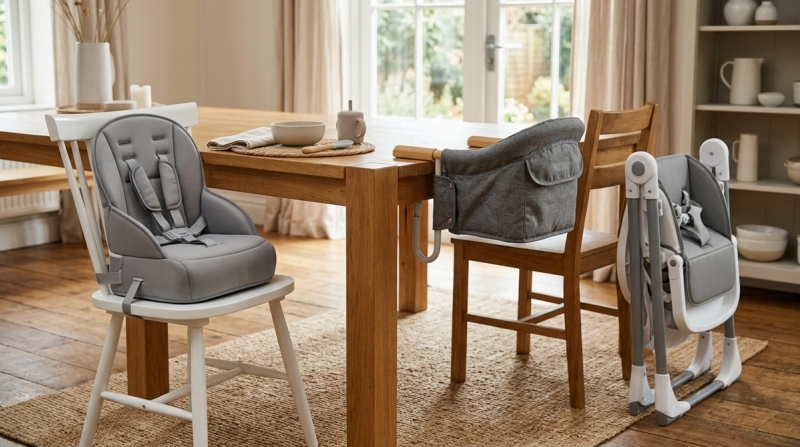
The whole portable high chair vs booster seat decision sounds simple until you actually start shopping.
Then suddenly you are looking at boosters that strap to chairs, clip-on seats that hang from tables, foldable travel chairs with tiny trays, and full-size high chairs that look like they belong in a restaurant kitchen. And somewhere in the middle of all that, you are just trying to figure out where your baby is going to eat breakfast without smearing banana into the rug.
Here is the short version.
For most small homes and apartments, a baby booster seat is the easiest everyday choice because it uses a dining chair you already own. If your family eats out a lot, a clip-on high chair can be brilliant, but only when the table is compatible. If you visit family often, travel, eat outdoors, or cannot count on having the right furniture, a freestanding travel high chair is usually the most flexible option.
You probably do not need all three.
You need one safe, stable baby feeding seat that fits your real life: your kitchen, your table, your storage space, your car, and your tolerance for cleaning dried oatmeal out of tiny corners.
Let’s break down what each one is actually good for.
Quick Comparison: Portable High Chair vs Booster Seat vs Clip-On Seat
#Option 1: Baby Booster Seat
#A baby booster seat sits on top of a regular dining chair and attaches with straps. Most have one strap around the back of the chair and another underneath the seat. Some come with their own tray. Others are designed to pull right up to the family table.
For many families, especially renters and apartment parents, this is the most practical small apartment high chair. It does not add another bulky piece of furniture to the room, and it lets you turn a chair you already own into a feeding spot.
That may not sound exciting, but when you are living with limited space, “does not take over the kitchen” is a pretty big win.
Why parents like it
#A booster seat is great when most meals happen at home.
It gives your baby a dedicated place to sit without making your dining area feel crowded. Hard plastic models are usually easier to wipe clean than fabric ones, which matters more than you think once your child discovers yogurt, pasta sauce, avocado, and the joy of dropping food directly into straps.
A booster also makes meals feel more connected. Your baby can sit at the table with everyone else instead of being off to the side in a separate high chair.
Pros
#- Saves floor space.
- Works well for everyday meals at home.
- Uses an existing dining chair.
- Many models are easy to wipe clean.
- Smaller than most full-size high chairs.
- Helps your baby sit with the family at the table.
- Often easier to store than a full-size high chair.
Cons
#- Takes over one adult dining chair during meals.
- Straps can collect crumbs and sticky food.
- Not every dining chair works with a booster.
- Some models are still bulky to carry around.
- Straps need to be checked often because they can loosen.
Who should skip a baby booster seat?
#Skip a booster if your dining chairs are lightweight, wobbly, narrow, delicate, curved, unusually shaped, or hard to strap around securely.
Also skip it if the booster does not sit flat and tight on your chair. A booster is only as stable as the chair underneath it. If the chair tips easily, slides around, or does not let the straps tighten properly, it is not the right setup.
Option 2: Clip-On High Chair
#A clip-on high chair, also called a hook-on chair, attaches directly to the edge of a table. It usually has metal arms, clamp-style attachments, and a fabric seat.
This can be a really handy choice if you eat out often, visit cafes, or want something that folds flatter than many boosters. If you have ever been handed a sticky restaurant high chair with a missing strap, you can probably understand the appeal of bringing your own.
But there is one important catch: a clip-on high chair is not for every table.
Actually, that is the whole deal with this type of seat. It is convenient when the table works. It is useless, and potentially unsafe, when the table does not.
Why parents like it
#A clip-on seat keeps your baby right at table height without needing a separate chair. In a crowded restaurant, that can be a big help. You are not trying to squeeze a bulky high chair into a walkway, and your baby can sit close to you during the meal.
Many clip-on high chairs also fold fairly flat, so they can fit in a car trunk, stroller basket, or travel bag. Not always effortlessly, but usually more easily than a freestanding travel chair.
Pros
#- Compact and travel-friendly.
- Useful at restaurants with compatible tables.
- Does not need an adult dining chair.
- Keeps your baby close to the table.
- Often folds flatter than other portable seats.
- Some fabric covers are removable for washing.
- Helpful in small spaces where an extra chair would be in the way.
Cons
#- Cannot be used on every table.
- Setup takes attention and proper tightening.
- Fabric seams can trap crumbs.
- Not helpful if your regular tables are incompatible.
- You need to check table fit every time you use it.
- Less predictable when traveling somewhere new.
Who should skip a clip-on high chair?
#Skip a clip-on high chair if your main table is glass, lightweight, unstable, pedestal-style, loose-leaf, or has a thick edge, deep apron, or shape that prevents the clamps from attaching exactly as the manual requires.
Also skip it if you often eat in places where you have no idea what the tables will be like. A clip-on seat is convenient, but it is not a “make it work” product. If the table is questionable, do not use it there.
Option 3: Freestanding Travel High Chair
#A freestanding travel high chair is a small folding chair made for feeding. Think of it as a compact high chair with its own legs. It usually has a fabric or structured seat, a harness, folding legs, and sometimes a removable tray.
This is often the best family visit baby gear if you regularly go to grandparents’ houses, relatives’ homes, friends’ places, vacation rentals, parks, or outdoor meals where nobody has baby equipment ready for you.
Why parents like it
#The biggest advantage of a freestanding travel high chair is that it does not depend on someone else’s furniture.
You do not need a dining chair that works with booster straps. You do not need a table that accepts clip-on clamps. You just need a flat, stable surface and enough space to open the chair safely.
That makes it useful for backyard dinners, picnics, camping trips, holiday rentals, and family homes that are not set up for babies.
It can also give your child a familiar little eating spot when everything else around them is new. That may sound minor, but when you are trying to feed a tired baby in someone else’s kitchen, familiar helps.
Pros
#- Does not rely on a dining chair or table.
- Great for family visits and outdoor meals.
- Folds for storage and travel.
- Often comes with a carry bag, depending on the model.
- Creates a familiar feeding spot away from home.
- More predictable when you do not know what furniture will be available.
Cons
#- Takes up floor space while open.
- Fabric can be harder to clean than smooth plastic.
- Wider legs may become a tripping hazard in tight spaces.
- Usually bulkier than a clip-on high chair.
- Still another item to pack, carry, clean, fold, and store.
Who should skip a freestanding travel high chair?
#Skip this option if your home is very tight and you do not have safe floor space to open it fully.
Also skip it if you travel extremely light and want the smallest possible feeding setup. A freestanding travel chair is flexible, but it is not the most compact option.
How to Choose Without Buying Too Much
#The easiest way to choose is to stop thinking about every possible situation and focus on your normal week.
If most meals happen at home in a small dining area, start with a baby booster seat. It solves the daily problem without adding much clutter.
If you eat out often and your usual restaurants have sturdy, compatible tables, a clip-on high chair may make sense. Just remember that you need to check the table every time.
If you visit family, stay in rentals, go to parks, or eat outdoors often, a freestanding travel high chair is probably the safest bet. It does not depend as much on the furniture around you.
A good question to ask is:
Where will I use this seat three times a week, not three times a year?
Buy for the routine first. Occasional situations can usually be handled with a bit of planning. Daily meals need to be simple, safe, and easy enough that you will actually use the seat instead of leaving it in a closet.
Buying Checklist for New Parents and Caregivers
#Before buying any portable feeding seat, check these things.
1. Read the manual before using it
#Every seat has its own rules. Check the manual for age guidance, sitting ability, size limits, weight limits, chair compatibility, table compatibility, cleaning instructions, and harness use.
Do not rely only on product photos. Product photos always make setup look calm and easy. Real life usually involves a hungry baby, one clean spoon, and someone asking where the bibs went.
2. Check your furniture first
#For a booster, make sure your dining chair is sturdy, wide enough, and shaped so the straps can tighten securely.
For a clip-on high chair, check the table material, edge thickness, underside, apron, and stability. If the clamps cannot attach exactly the way the manufacturer says they should, that table is not suitable.
For a freestanding chair, make sure you have enough clear floor space to open it fully without creating a tripping hazard. In small kitchens, those little legs can stick out more than expected.
3. Be honest about cleaning
#Babies do not just eat food. They relocate it.
Smooth plastic is usually easier to wipe. Fabric can be comfortable and packable, but crumbs hide in seams, straps, folds, and corners. Removable covers are helpful if the product allows washing.
Also look at the tray. A removable tray can make cleanup easier, but only if it locks securely during use and is simple to clean afterward.
4. Think about carrying and storage
#A portable seat is only useful if you will actually bring it with you.
Check the folded size, weight, carry bag, and whether it fits in your car, stroller basket, closet, or luggage. For apartment families, storage matters almost as much as setup. Sometimes more.
5. Pick stability over style
#A cute seat is nice. A stable seat is better.
Choose the option that fits your furniture, sets up firmly, and lets you use the harness correctly every time. The best baby feeding seat is not necessarily the prettiest one. It is the one you can use safely without a fight.
High Chair Safety Notes for Any Seat
#Basic high chair safety applies whether you choose a booster seat, clip-on high chair, freestanding travel high chair, or full-size high chair. Safety organizations such as the CPSC, AAP, and Health Canada regularly emphasize proper setup, restraint use, supervision, and following manufacturer instructions.
Keep these safety habits front and center.
Use the straps every time
#Always buckle your child using the restraint system provided with the seat.
Use the straps for full meals, quick snacks, restaurant stops, and “just two minutes” moments too. Babies are fast, and trays are not restraints.
The tray is for food. The harness is for safety.
Make sure the setup is stable
#For boosters, use all required attachment straps and tighten them according to the manual.
For clip-on seats, attach only to tables approved by the manufacturer. Avoid glass, unstable, lightweight, pedestal, loose-leaf, or incompatible tables unless the manual specifically says that setup is allowed.
For freestanding travel high chairs, place the chair on a flat, stable surface. Keep it away from stairs, cords, edges, doorways, and busy walkways.
Your child should sit upright
#Use a feeding seat only when your child meets the product’s sitting and developmental requirements.
Your child should be able to sit upright as required by the manual. If your baby slumps, leans heavily, or cannot stay upright in the seat, stop using it for now and follow the product guidance or ask your pediatrician.
Follow the manual’s limits
#Every seat has limits. Check the manual for size, weight, sitting ability, and use restrictions.
Do not use the seat in a way the manufacturer does not allow, even if it seems fine for one quick meal.
Stay close during meals
#A feeding seat is not a place to leave a child unattended.
Stay nearby while your child is eating, and take them out when mealtime is over. Even if they look settled. Especially if they look a little too interested in leaning, twisting, or testing gravity.
Best Choice by Situation
#Best for small apartments
#A baby booster seat is usually the most practical choice. It turns an existing dining chair into a feeding spot and avoids adding a large high chair to a tight room.
Best for restaurants
#A clip-on high chair can be a great restaurant high chair alternative if the table is compatible and you are comfortable setting it up correctly.
If table compatibility is uncertain, a freestanding travel high chair may be more predictable, although it takes more floor space.
Best for family visits
#A freestanding travel high chair is often the easiest family visit baby gear because it does not depend on your host’s chairs or table edges.
Best for outdoor meals
#A freestanding travel high chair is usually the best fit for parks, backyards, camping, and casual outdoor meals, as long as it is placed on a flat, stable surface.
Best for everyday home use
#For many renters and apartment families, the baby booster seat wins. It is simple, compact, and easy to build into a normal mealtime routine.
Final Takeaway
#You do not need a house full of feeding gear. You need the seat that fits your actual meals.
For tight homes, start with a baby booster seat. For families who eat out often, a clip-on high chair can be useful, but only on compatible tables. For travel, outdoor meals, and visits to relatives, a freestanding travel high chair is often the most practical choice.
Whatever baby feeding seat you choose, the safety routine stays the same: use the straps, set it up correctly, make sure your child sits upright, follow the manual and limits, and stay close during meals.