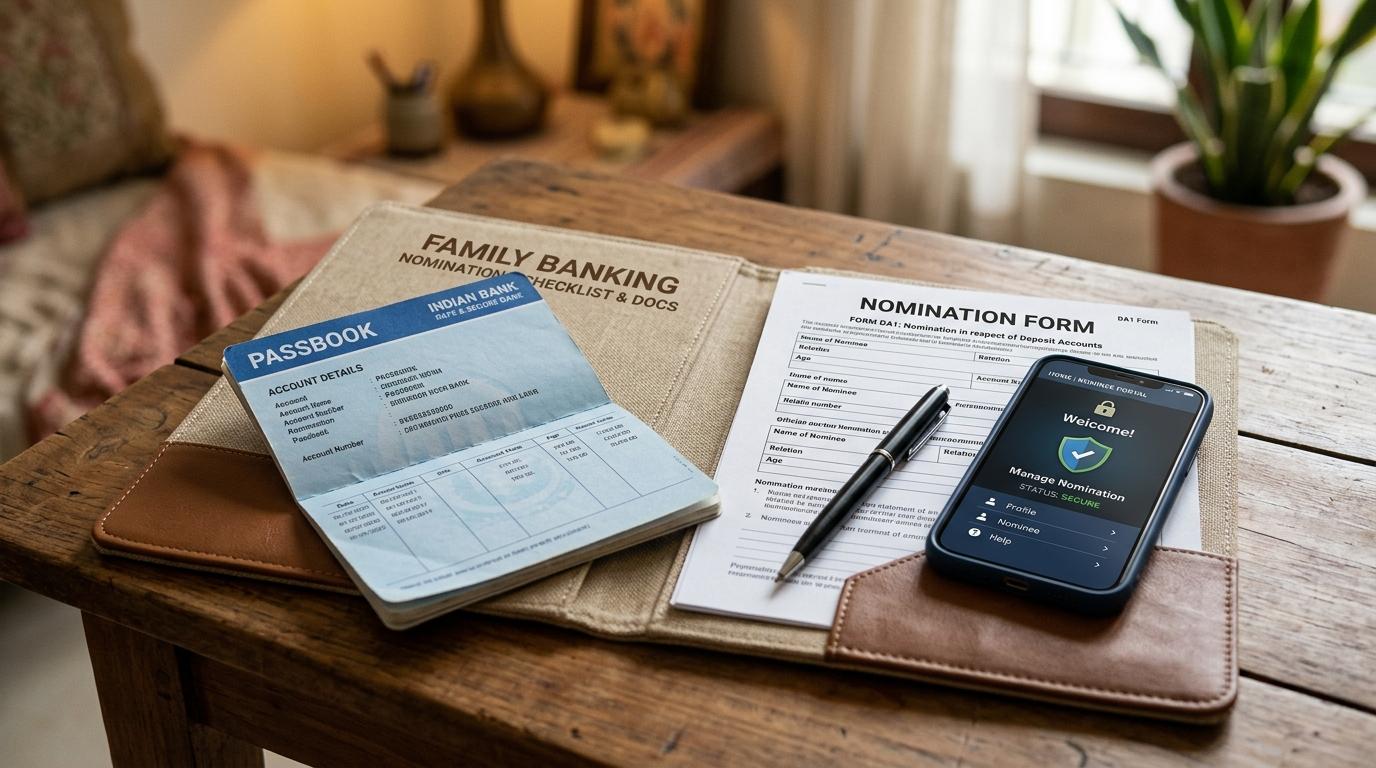
A bank nominee in India is the person you register with your bank so that, after your death, the bank knows who can receive the money, access the locker, or collect articles kept in safe custody.
It sounds like a small banking detail. In reality, it can save your family a lot of stress at a very difficult time.
But there is one important point many people miss: a nominee is not always the final legal owner of the money or assets. A nominee mainly helps the bank complete the claim settlement process. Final ownership may still depend on a will, succession law, legal heirs, or a court dispute.
From November 1, 2025, the RBI-linked nomination framework has made bank nomination clearer, including support for up to four nominees where applicable. So if you have a savings account, fixed deposit, recurring deposit, locker, or safe custody facility, it is worth checking your nomination now.
Not someday. Not “later”. Now.
General education disclaimer: This article is for general awareness only. It is not legal, financial, tax, or estate-planning advice. A bank nominee helps with claim settlement, but nomination by itself does not always decide final ownership. For inheritance issues, wills, disputes, succession questions, or unclear claims, speak to your bank and a qualified legal professional.
What is a bank nominee?
#A bank nominee is the person whose name is recorded with the bank to handle the claim after the account holder’s death.
Nomination can apply to:
- Savings accounts
- Current accounts, where allowed
- Fixed deposits
- Recurring deposits
- Safe deposit lockers
- Articles kept in safe custody with the bank
Think of the nominee as the person the bank can deal with when the account holder is no longer around.
That can make things much easier for the family. Instead of everyone trying to figure out who should approach the bank, the bank already has a name on record.
But nomination should not be confused with inheritance.
The nominee may receive the money or get access to the locker for settlement purposes. That does not automatically mean the nominee becomes the final owner of everything. Final rights may depend on the deceased person’s will, legal heirs, succession law, and any family or legal dispute.
So yes, nomination is very useful. But it is not a complete replacement for a will, estate planning, or clear family communication.
Why nomination matters for ordinary families
#Many people assume nomination is only important for wealthy families or people with large estates.
That is not true.
Even one savings account or one fixed deposit can become a problem if there is no nominee. After a person passes away, nobody can simply walk into the bank and say, “This money belongs to the family.” The bank has to follow its process.
Without a nominee, the family may need extra documents to prove who can claim the money. This can take time, especially if:
- There are multiple legal heirs
- Family members live in different cities
- Documents are missing
- There is disagreement among heirs
- The account holder never told anyone about the account
With a nominee, the bank usually has a clearer route for settlement. The nominee may still need to submit documents, but the bank already knows who has been nominated by the account holder.
That one simple step can prevent a lot of confusion later.
What changed in 2025?
#The key official reference is the Reserve Bank of India (Nomination Facility in Deposit Accounts, Safe Deposit Lockers and Articles kept in Safe Custody with the Banks) Directions, 2025.
These Directions were issued through an RBI notification dated October 28, 2025 and came into effect from November 1, 2025.
The 2025 framework is linked to changes under the Banking Laws (Amendment) Act, 2025. It gives banks a clearer structure for handling nomination in:
- Deposit accounts
- Safe deposit lockers
- Articles kept in safe custody
Earlier in the year, the RBI had also issued a circular dated January 17, 2025, asking banks to improve nomination coverage. In simple terms, banks were told to pay more attention to accounts and facilities where nomination was missing.
For customers, the message is very clear:
Do not wait for your family to discover the problem after you are gone. Check your nomination while you can.
Key points under the 2025 RBI nomination framework
#Here are the main things bank customers should understand.
1. Up to four nominees may be allowed, where applicable
#The 2025 framework supports nomination of up to four persons, depending on the account or facility and the bank’s process.
This is a useful change because earlier, many customers were used to naming only one nominee for a deposit account.
For families where responsibilities are shared among more than one person, this can make nomination more practical.
2. Nomination can be recorded in a clearer way
#The new framework allows banks to record nomination details in a more structured manner, especially where multiple nominees are involved.
This can help reduce confusion later, because the bank has more specific information on record.
3. Lockers and safe custody articles are also covered
#Many people remember nomination for their savings account but forget about their locker.
That can be a big mistake.
A locker may contain:
- Jewellery
- Property papers
- Insurance documents
- Family records
- Investment documents
- Other valuables
The RBI Directions cover safe deposit lockers and articles kept in safe custody with banks. So if you have a locker, check its nomination separately.
Do not assume your savings account nominee automatically covers your locker.
4. Banks are expected to improve nomination coverage
#The RBI’s January 2025 circular focused on improving nomination coverage across banks.
This means banks are expected to make it easier for customers to register, review, and update nomination details.
But do not leave everything to the bank. You should still check your own accounts, deposits, and lockers.
Nominee vs joint holder vs legal heir
#These three terms are often mixed up, but they do not mean the same thing.
A simple way to remember it:
- A nominee helps the bank settle the claim.
- A joint holder operates or shares the account as per the account mandate.
- A legal heir is connected to inheritance rights.
If the nominee, joint holder, and legal heir are the same person, things may be simpler.
If they are different people, the family may need legal advice.
When should you add or update a bank nominee?
#You should check your bank nominee whenever there is a major life change.
Common situations include:
- Marriage
- Birth or adoption of a child
- Death of an existing nominee
- Divorce or separation
- Change in family responsibilities
- Opening a new fixed deposit
- Opening or renewing a locker
- Moving accounts between banks or branches
- If you are unsure whether nomination was ever registered
Even if nothing has changed, it is still wise to check once in a while.
Many people believe they added a nominee years ago. Later, the family discovers that the nomination was missing, incomplete, or linked only to one account and not to other deposits or facilities.
A quick check can avoid that.
Step-by-step checklist to add, update, or verify your bank nominee
#This is not complicated. You just need to do it carefully.
Step 1: Make a list of your bank relationships
#Write down where you have:
- Savings accounts
- Current accounts, if any
- Fixed deposits
- Recurring deposits
- Lockers
- Articles kept in safe custody
- Joint accounts
Do this bank by bank.
If your family does not even know where your accounts are, nomination alone may not help quickly. A basic list can make things easier for them.
Step 2: Check whether a nominee is already registered
#Use only official bank channels.
You can usually check through:
- The bank’s official mobile app
- The bank’s official net banking website
- Account details section, if available
- Account statement, where nomination details are shown
- Branch visit
- Bank staff or relationship manager at the branch
Look for terms such as:
- Nominee registered
- Nomination details
- Nominee name
- Nomination status
- DA1, DA2, or DA3 forms
Do not rely only on memory. Check what the bank actually has in its system.
Step 3: Choose the nominee carefully
#Choose someone who is:
- Trustworthy
- Easy for the family to contact
- Responsible with documents
- Aware that they may need to deal with the bank
- Unlikely to create unnecessary confusion
Many people choose a spouse, adult child, parent, sibling, or another close family member.
But there is no one-size-fits-all answer. The right nominee depends on your family situation.
Also remember: the nominee helps with bank settlement. Nomination does not automatically settle inheritance questions.
Step 4: Keep nominee details correct
#Banks may ask for details such as:
- Full name
- Relationship with the account holder
- Age or date of birth
- Address
- Identification details, where required
- Guardian details, if the nominee is a minor
If the nominee is a minor, a guardian usually needs to be named. This helps the bank know who can act on behalf of the minor until the minor becomes an adult.
Step 5: Add nominee through a safe banking channel
#To add a nominee to a bank account, use only your bank’s official process.
Common options include:
- Net banking
- Mobile banking
- Branch form
- Bank-approved digital process
- Official customer service route shown on the bank’s website or app
For deposit accounts, these forms are commonly used:
- Form DA1 for registering nomination
- Form DA2 for cancelling nomination
- Form DA3 for changing or updating nomination
For lockers and safe custody articles, banks may use separate forms or procedures. Ask your branch for the correct process.
Step 6: Update nominee details when life changes
#To update a bank nominee, do not rely on verbal instructions or family understanding. The bank’s records must be changed.
You may need to update nomination if:
- The nominee’s name has changed
- The nominee’s address or relationship details are incorrect
- The nominee has died
- You want to nominate someone else
- You want to add or revise multiple nominees, where applicable
- Your old nomination was made before the 2025 framework and you want to review it
Always ask for an acknowledgement after the bank records the change.
Step 7: Keep proof of nomination
#After registering or updating nomination, keep proof safely.
This may include:
- Bank acknowledgement
- SMS or email confirmation
- Scanned copy or photo of the submitted form
- Screenshot of nomination status, if available
- Deposit receipt showing nomination, if issued
Also tell your nominee which bank and branch to contact.
But do not share passwords, PINs, OTPs, UPI PINs, card details, CVV numbers, or net banking access. A nominee does not need these.
Step 8: Check lockers and safe custody separately
#This is important enough to repeat.
Your savings account nomination may not automatically cover your locker.
Check nomination separately for:
- Each savings account
- Each fixed deposit, if separately held
- Each recurring deposit
- Each locker
- Articles kept in safe custody
This matters even more if your locker contains jewellery, property papers, family documents, or other valuables.
Safety checklist: avoid fraud while updating nomination
#Nomination update is a normal banking process. But fraudsters often use “urgent bank update” messages to scare people.
Be careful.
Follow this checklist:
- Do not search for random bank helpline numbers on social media or unknown websites.
- Use only the bank’s official website, app, branch, passbook, or verified communication.
- Never share OTP, PIN, CVV, card number, UPI PIN, or net banking password.
- Do not click links from unknown SMS, WhatsApp, or email messages claiming your nomination will expire.
- Do not install screen-sharing apps if someone says they will “help update nominee”.
- If visiting a branch, carry original ID and copies only as required.
- Ask for acknowledgement after submitting any nomination form.
- If something feels rushed, threatening, or strange, stop and contact the bank through official channels.
A genuine nomination update should not require secret banking credentials.
What happens when the account holder dies?
#Usually, the nominee needs to contact the bank and submit the documents required by the bank.
These may include:
- Death certificate of the account holder
- Nominee’s identity proof
- Nominee’s address proof
- Claim form
- Account or deposit details
- Any other documents required by the bank
The bank then verifies the claim and settles it according to its process and the applicable RBI framework.
If there is no nominee, or if there is a dispute, the bank may ask for additional legal documents. This is where delays often begin.
And again, even if the nominee receives the money from the bank, that does not automatically end every inheritance question. If legal heirs disagree, they should take professional legal advice.
Common mistakes to avoid
#Mistake 1: Assuming nomination is automatic
#Opening a bank account does not always mean nomination was properly registered.
Check the status.
Mistake 2: Naming a nominee but not telling anyone
#Your nominee does not need your passwords or PINs.
But they should at least know which bank to contact.
Mistake 3: Forgetting fixed deposits
#Many people nominate someone for a savings account but forget separate fixed deposits.
Check each deposit.
Mistake 4: Ignoring lockers
#Lockers and safe custody articles can create serious stress for families if nomination is missing.
Check them separately.
Mistake 5: Treating the nominee as the final owner
#This is one of the biggest misunderstandings.
A nominee helps the bank settle the claim. Final ownership may depend on legal rights, succession law, or a will.
Mistake 6: Not updating after family changes
#An outdated nominee can create confusion.
Review nomination after major life events, even if the update feels small.
A simple family record you can keep
#You can keep a private family record with basic information like this:
| Bank or branch | Account or facility type | Nominee registered? | Nominee name | Last checked |
|---|---|---|---|
| Example: ABC Bank, Pune | Savings account | Yes | Name | Month, year |
| Example: ABC Bank, Pune | Fixed deposit | To check | Not sure | Month, year |
| Example: XYZ Bank, Delhi | Locker | Yes | Name | Month, year |
Do not write passwords, OTPs, PINs, CVVs, or card details in this record.
Keep it simple. Keep it safe. Make sure your family knows where to find it if needed.
Quick final checklist
#Before you move on, do these five things:
- Check whether each bank account has a nominee.
- Check fixed deposits separately.
- Check locker and safe custody nomination separately.
- Update nominee details if your family situation has changed.
- Save the bank acknowledgement and tell your nominee which bank to contact.