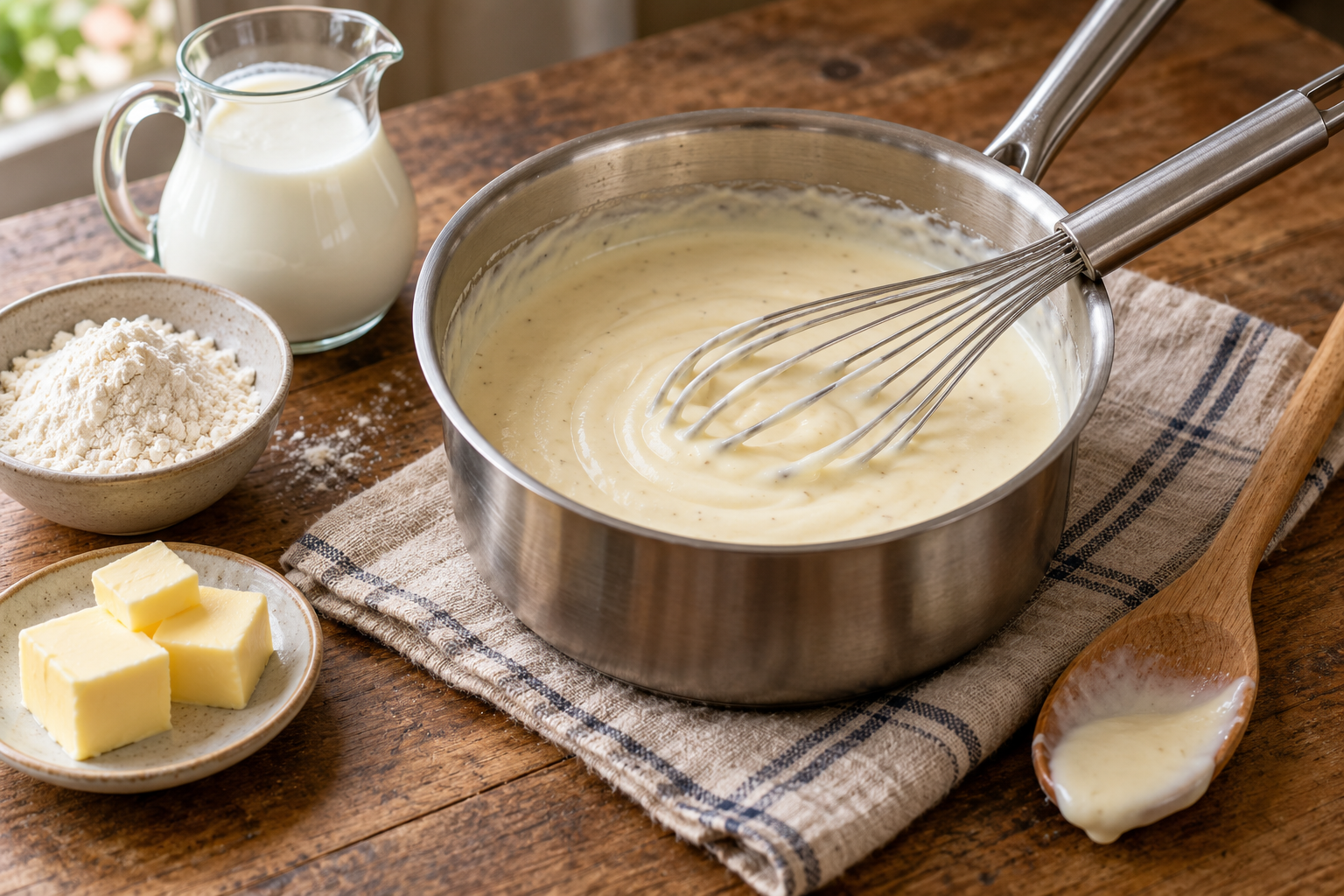
Béchamel is a white sauce made by cooking flour with butter, then gradually adding milk and heating until the sauce thickens. The butter-and-flour paste is called a roux. Keep that paste pale, mix the first additions of milk thoroughly, and give the finished sauce enough gentle cooking time before judging its thickness.
The useful skill is knowing what you are looking at. A stiff paste early in the process is expected. Dry pockets surrounded by milk need more mixing. A smooth sauce that becomes thicker as it stands may simply need loosening. Those situations call for different decisions.
The recipe card gives a measured, neutral batch. The guide explains the texture changes and how to use the sauce without turning every dinner into the same thick, creamy dish.
What béchamel is, and what it is not
#Béchamel gets its body from flour dispersed in a milk-based sauce. It does not need cream or cheese to become creamy. Adding cheese makes a variation; it is not a required ingredient in the base.
That distinction matters when reading a recipe. If a lasagne asks for béchamel, a jar of cheese sauce may bring more salt and a different flavor. If a pasta dish asks for cream, replacing it with béchamel changes the way the sauce coats the food. Similar color does not make sauces interchangeable.
Think of the base as a component rather than a finished meal. It can provide a creamy layer, carry a modest amount of seasoning, or become a cheese sauce. The rest of the dish still decides how much you need and how loose it should be.
Start with a clear texture goal
#A white sauce for spooning over vegetables should flow. One being spread between layers needs enough body to stay where it is put. A sauce that will receive cheese needs room for that addition to change its texture and seasoning.
Before cooking, ask what happens next. Will the sauce be served immediately, combined with other ingredients, or baked again? Are those ingredients wet or fairly dry? Follow the larger recipe's quantities and method when assembling a specific dish; a standalone sauce recipe cannot determine every lasagne's liquid needs.
| Planned use | What to look for while warm | What to avoid |
|---|---|---|
| Coating vegetables | A smooth coating that still pours | A paste sitting in a mound |
| Layering in a bake | A sauce that spreads without running straight away | Using thickness to compensate for a watery filling |
| A cheese-sauce base | Smooth, slightly loose sauce before cheese | Seasoning heavily before tasting the cheese addition |
| Reheating a chilled portion | Even heat and restored flow | Judging the cold, firm sauce as a failed batch |
These are practical checkpoints, not separate recipes. Use the measured batch as your starting point, then make small adjustments after it has cooked. Changing several ingredients before seeing the original result makes it harder to understand what worked.
Choose ingredients that make the first batch predictable
#Use plain wheat flour, also called all-purpose flour, for the base recipe. Measure the butter and flour by weight. Equal weights are easy to scale; equal spoonfuls do not necessarily weigh the same. Leveling a heaped spoon after the fact is less reliable than weighing before the pan goes on.
Whole milk is a straightforward starting choice. This is a milk sauce, so its flavor matters. Use milk you would be happy to drink and butter with no stale or scorched smell. Season at the end, especially if the sauce will later meet salty cheese or a seasoned filling.
Have the milk measured in a jug before melting the butter. Put a whisk and a spoon or heat-safe spatula within reach. Choose a saucepan with enough room for whisking without splashing, and use utensils compatible with its surface. The recipe does not require an expensive pan, but it does require access to its bottom and corners.
Keep the first batch simple. An infused milk, a handful of cheese, and several spices may all be useful in another version. Together they make it harder to tell whether a problem comes from the base or an addition.
Understand the three changes in the pan
#The exact preparation sequence is in the recipe card. While following it, watch these changes rather than expecting the sauce to look finished at every stage.
A pale roux
#Flour mixed into melted butter becomes a paste. Stir so there are no loose flour patches. For this sauce the target is pale, not a deeply browned roux. A dark roux belongs to a different flavor and cooking goal.
Gentle bubbling is useful; smoking butter or rapidly browning patches mean the heat is too high. A saucepan can retain heat after you turn the knob down. Move it off the burner briefly if necessary, then resume once you can control it.
A thick mixture after the first milk
#The first small addition may turn the paste into something surprisingly stiff. That alone is not a lump problem. Work the mixture until it is uniform before adding more milk. The distinction is between a thick, even paste and little dry pieces floating in liquid.
Pouring the whole jug in immediately creates more liquid to work through while trying to find those pieces. If you are learning the method, slower additions give you a clearer view. You can pause the pouring; there is no need to race the jug.
A smooth sauce that thickens with heat
#Once all the milk is incorporated, the sauce needs cooking, not just mixing. Flour starch thickens as it heats in the liquid. Stir across the base and around the edges, where a thick layer can build up while the center still looks loose.
A coating on the back of a spoon is a useful sign, but consider the next use too. The sauce should have a smooth appearance and no obvious floury taste after cooking. Cool a small spoonful before tasting; never taste dry flour or a scalding spoonful straight from the pan.
Why recipes disagree about warm or cold milk
#Some methods use warmed milk and a roux. Others combine the ingredients cold and heat them together. Both approaches appear in established recipes. Their instructions belong to their own method, rather than forming one set of rules you can freely mix.
For a first attempt, choose one complete approach. The card here uses gradual additions to a cooked roux. Warming the milk gently is optional; steady whisking and checking for a uniform mixture remain necessary. Milk temperature cannot compensate for leaving dry flour trapped in the pan.
Do not interpret every difference between recipes as a contradiction. A sauce with more flour relative to milk will behave differently from a lighter one. An optional infusion also changes the timetable. Compare ingredients and the intended finish before deciding one instruction must be wrong.
Fix lumps before changing the whole batch
#If the mixture is uneven during the early additions, stop adding milk and whisk it smooth. Briefly taking the pan off the heat gives you time to work without the bottom thickening as quickly. Scrape around the corners as well as the middle.
If small lumps remain after the milk is incorporated, try firm whisking first. A fine-mesh sieve is a practical fallback: strain into a clean heatproof vessel, then return the sauce to a clean pan if it needs further cooking. Handle the hot pan and liquid carefully.
Do not assume that adding more milk will dissolve every lump. It can leave you with the same lumps in a thinner sauce. Likewise, dry flour sprinkled into the finished pan introduces a new dispersal problem. First identify whether the issue is uneven mixing, insufficient cooking, or simply the wrong final consistency.
Straining also has limits. It removes solids; it does not remove a burnt flavor or correct excessive salt. If you discard a substantial amount of flour in large lumps, the remaining sauce may have less thickening power than the original batch.
Too thick, too thin, floury or scorched?
#Too thick
#Check it while warm. Béchamel becomes firmer as it cools, so a chilled portion is not a fair comparison with a freshly cooked one. Whisk in a small splash of milk, heat evenly, and assess again before adding more.
Additions are easier to control when they are small. If you alternate large pours of milk with extra flour, you can end up making much more sauce than dinner requires. Keep track of what you changed so the next batch starts closer to the texture you want.
Too thin
#Ask whether it has reached a gentle bubbling stage and had time to cook. If not, continue cooking and stirring before adding a thickener. If it has cooked properly, check whether you measured too much milk or too little flour.
For a slightly loose sauce, a little more gentle simmering may be enough. Avoid boiling hard in an attempt to force a quick result. For a major measuring error, starting a correctly measured batch may be more useful than repeatedly improvising additions. You can save the experience by recording the error rather than turning it into a larger pan of uncertain sauce.
Floury taste
#A sauce can look thick before its flavor is ready. Give it the cooking time described in the recipe, with stirring and controlled heat. Do not use additional salt or cheese to hide an uncooked base. If it still tastes unpleasant after proper cooking, check your measurements and ingredients before serving it.
Scorched bottom
#Stop stirring a burnt layer into the rest. Carefully transfer the unaffected sauce to a clean pan without scraping the base. If the burnt taste has already spread through the sauce, the reliable solution is a new batch. A spoonful of cream does not erase scorching.
Use the sauce with the rest of the meal in mind
#For vegetables, consider their moisture before adding sauce. A puddle of cooking water on the plate will dilute a carefully made coating. Let cooked vegetables drain appropriately, then combine only as much sauce as the serving needs. You can always offer extra separately.
For a baked dish, read the assembly instructions before starting the sauce. The recipe may rely on a particular balance between sauce, filling and pasta. Making every component extra thick can leave the finished dish dry; making every component loose can create the opposite problem.
For a cheese variation, complete the white sauce first and add grated cheese off the heat, stirring until melted. Taste before adding further salt. If following a macaroni-cheese recipe, use its cheese quantity and other seasoning instructions rather than assuming an arbitrary handful will give the intended result.
For a practical first dinner, choose one use for the whole batch. For example, make the sauce for a vegetable bake using that bake's assembly directions. Once you know how the base behaves, it is easier to plan a second batch with a different finish. This is a learning example, not a claim of a personally tested meal.
Cool and reheat leftovers deliberately
#Milk-based sauce needs prompt refrigeration. Transfer leftovers to shallow containers so they cool quickly; do not leave a deep saucepan on the counter until completely cold. Health Canada advises discarding cooked food left at room temperature for more than two hours and eating refrigerated leftovers within two to three days. Follow applicable local guidance and any shorter ingredient limit.
Label the container with the preparation date. If you want to prevent a surface skin, use food-contact covering suitable for the temperature, following its instructions. A smooth surface says nothing about microbiological safety: appearance and smell cannot establish that badly stored sauce is safe.
Reheat only the portion needed. Start with controlled heat and frequent stirring so it warms evenly; loosen with a little milk if necessary. Health Canada advises reheating leftovers to 74°C/165°F and bringing sauces to a full rolling boil while stirring. This is the reheating endpoint, not an instruction to boil the sauce aggressively throughout the process. Discard uneaten reheated leftovers under that guidance.
Keep a useful note for the next batch
#Record the flour and butter weights, milk volume, and intended use. Then add one sentence about the outcome: too firm once cooled, right for coating, or looser than the bake needed. That note gives the next adjustment a clear starting point.
The aim is a sauce that suits the food. A smooth béchamel that pours over vegetables and one that spreads neatly through a bake can both be successful. Learn the base with careful measuring, recognize its normal texture changes, and make the final adjustment for the meal in front of you.