The Dhanteras Silver Surge: High Gold Prices and the Shift to White Metal
#The arrival of Dhanteras marks the official beginning of the five-day Diwali festive period across India and within global South Asian diaspora communities worldwide. Rooted in ancient scriptural tradition, Dhanteras commemorates the emergence of Lord Dhanvantari—the divine physician and avatar of Lord Vishnu—from the cosmic ocean churn carrying an Amrit Kalash, a sacred vessel brimming with the nectar of immortality. Concurrently, the evening rituals honor Goddess Lakshmi and Lord Kuber, the cosmic custodian of wealth. Purchasing precious metals on this auspicious date is believed to anchor enduring prosperity, good fortune, and physical well-being into the household.
For generations, gold has served as the undisputed centerpiece of Dhanteras shopping. However, unprecedented macroeconomic shifts, geopolitical tensions, and relentless central bank reserve acquisitions have propelled physical gold prices to historic record highs. For millions of salaried middle-class families, young professionals, and festive shoppers, buying sovereign gold coins or substantial gold jewelry has moved beyond practical household festive budgets.
This financial reality has triggered an explosive surge in consumer demand for physical silver coins and minted bars. Often revered as the poor man's gold, silver offers accessible tangible entry into precious metal acquisition. A family can observe time-honored rituals, honor their spiritual obligations, and gift certified bullion tokens to relatives for a fraction of the cost of gold.
Yet buying silver coins is accompanied by a deceptive illusion of simplicity. Consumers who routinely insist on 24-karat hallmark verification when buying gold frequently treat silver coins as simple commodity tokens, assuming any shiny metallic disc purchased from a neighborhood jeweler is pure. In reality, the retail silver market in India is significantly more fragmented, less stringently regulated, and far more prone to under-caratage than the gold sector. Understanding metallurgical purity grades, recognizing the voluntary nature of silver hallmarking, navigating making charge formulas, and preserving assay packaging is the only way to ensure your festive investment retains its true intrinsic worth.
999 Fine Silver vs 925 Sterling Silver: The Metallurgical Divide
#The most widespread point of confusion among festive shoppers centers on the difference between 999 fine silver and 925 sterling silver. Many retail customers use the terms pure silver and sterling silver interchangeably, assuming they denote minor cosmetic variations. From an assaying and metallurgical perspective, they represent two fundamentally different materials engineered for distinct functional applications.
999 Fine Silver: The Investment Bullion Standard
#The number 999 signifies a fineness of 999 parts per thousand, meaning the metal contains 99.9 percent pure elemental silver. The remaining 0.1 percent consists of harmless, negligible trace elements that cannot be economically separated during commercial electrolytic refining. In premium investment markets, refiners like MMTC-PAMP also mint 999.9 silver (known commercially as four-nines silver), representing 99.99 percent absolute purity.
Elemental silver is one of the softest, most ductile metals on earth. In its unalloyed 999 state, fine silver possesses a distinct, brilliant white metallic luster and exceptional thermal and electrical conductivity. However, this purity comes with mechanical vulnerability: pure silver is exceptionally soft. A pure 999 silver coin can be visibly dented by a heavy drop, scratched by a fingernail, or warped if bent with thumb pressure.
Because of this physical malleability, 999 fine silver is never used for functional dinnerware, clasped jewelry, or wearable ornaments. Instead, 999 silver is the non-negotiable benchmark for:
- Traditional Dhanteras Lakshmi-Ganesh puja coins and religious altar tokens.
- Investment bullion rounds and cast ingots kept in bank lockers or household safes.
- Wealth-preservation gifts intended to be held indefinitely without physical handling.
When comparing precious metal investment instruments, readers often weigh physical bullion against financial alternatives like sovereign bonds and digital accounts, as detailed in our investment asset comparison between physical gold, digital wallets, and sovereign bonds. When buying physical silver, 999 represents the maximum tangible metallic purity available.
925 Sterling Silver: The Structural Jewelry Alloy
#In stark contrast, 925 silver—historically recognized as sterling silver—contains 925 parts per thousand of pure silver (92.5 percent), with the remaining 75 parts (7.5 percent) composed of base alloying metals, almost universally copper.
The addition of copper fundamentally alters the crystal lattice of the metal through solid-solution strengthening. While the alloy retains silver's characteristic bright reflective shine, its mechanical hardness, tensile strength, and resistance to deformation multiply several times over. Sterling silver resists scratching, maintains crisp sharp edges, and withstands continuous abrasive handling without warping.
Sterling silver is the global gold standard for manufacturing wearable jewelry, coin pendants, watch bezels, and ornate tableware. However, buying a 925 silver coin under the impression that you are buying pure investment bullion represents an immediate financial loss:
- You pay for a coin containing 7.5 percent non-precious copper that carries negligible scrap market value.
- When you eventually resell or exchange the coin, secondary bullion buyers calculate buyback value strictly on net pure silver content, discounting the 7.5 percent base metal instantly.
- Religious and spiritual customs for Dhanteras puja overwhelmingly prioritize unadulterated fine silver over mixed alloys.
| Purity Standard | Silver Content Ratio | Alloy Base Composition | Mechanical Hardness | Best Purpose |
|---|---|---|---|---|
| 999.9 Fine Silver | 99.99 percent pure silver | Zero base metals added | Exceptionally soft and delicate | Sovereign investment and institutional bullion |
| 999 Fine Silver | 99.90 percent pure silver | Negligible trace refining elements | Soft and easily scratched | Dhanteras puja coins and household wealth storage |
| 925 Sterling Silver | 92.50 percent pure silver | 7.50 percent refined copper | High tensile strength and rigid | Wearable coin pendants and daily jewelry |
| 900 Coin Silver | 90.00 percent pure silver | 10.00 percent base copper | Extremely durable and dense | Historical circulating coinage and antique tokens |
| 800 German Silver | 80.00 percent pure silver | 20.00 percent copper or zinc | Highly rigid and resistant | Utensils, bowls, and decorative homeware |
The Voluntary Hallmarking Reality: Why Most Silver Coins Lack Official Stamps
#To protect retail consumers against rampant metal adulteration, the Government of India, operating through the Bureau of Indian Standards (BIS) under the Ministry of Consumer Affairs, has progressively mandated compulsory hallmarking across hundreds of districts nationwide. However, the single most critical legal fact that festive consumers overlook is that mandatory hallmarking applies strictly to gold.
Unlike the gold sector, where selling unhallmarked jewelry in notified districts constitutes a punishable offense, BIS hallmarking for silver articles, utensils, and coins remains entirely voluntary.
Because jewellers are not legally compelled to submit silver products to accredited Assaying and Hallmarking Centers (AHCs), a massive proportion of silver coins sold during the festive rush carries zero independent regulatory verification:
- Local unorganized jewellers frequently use manual steel punches to stamp arbitrary numbers like 999, Pure, or Fine Silver directly into the soft metal in their workshops.
- These jeweler-stamped marks represent self-declarations, carrying zero legal weight, zero third-party certification, and zero guarantee of purity.
- Independent market sampling across Indian retail markets has repeatedly revealed that unhallmarked silver coins sold as 999 often test between 80 and 90 percent purity when subjected to laboratory fire assay testing, with the deficit made up of inexpensive zinc, nickel, or lead.
When buying silver coins for Dhanteras, smart consumers never settle for unhallmarked tokens or handwritten jeweler assurances. You must explicitly demand a voluntarily hallmarked BIS silver coin that carries certified, traceable micro-stamps.
The 3 Anatomy Elements of a Genuine BIS Silver Hallmark
#Under official Bureau of Indian Standards regulations (specifically Indian Standard IS 2112:2014 governing the hallmarking of silver articles), a genuine silver hallmark does not consist of a single vague mark. Instead, every legally certified silver coin must display three distinct, laser-etched anatomical components.
1. The Official BIS Logo
#The first mark is the triangular standard logo of the Bureau of Indian Standards. It depicts a stylized triangle enclosing three horizontal lines, symbolizing standardized quality and consumer protection. On minted coins, this logo is applied via precision laser engraving or deeply struck into the master die. If a coin features an elephant, a lotus, a swastika, or the jeweler's private initials without the triangular BIS emblem, it has not undergone accredited third-party assaying.
2. The Purity and Fineness Mark
#Directly adjacent to the BIS triangular logo is the three-digit purity specification. Under BIS silver standards, this number reflects the exact millesimal fineness of the metal:
- 999: Denotes pure fine silver containing at least 999 parts pure silver per thousand.
- 999.9: Denotes ultra-refined four-nines bullion.
- 925: Denotes certified sterling silver.
Beware of coins stamped with confusing fractional terms such as 99 or Silver Pure without the precise three-digit numerical grade.
3. The 6-Digit Alphanumeric HUID Code
#The third and most powerful protective feature is the Hallmark Unique Identification (HUID) code. Introduced to eliminate fraudulent stamping, the HUID is a six-character alphanumeric serial code (such as A7K9M2) laser-etched onto every hallmarked piece.
Every single HUID code is completely unique. When an assaying center tests a batch of silver coins and approves its purity, the center generates a digital record in the central BIS database linking that specific six-digit alphanumeric code to:
- The registered jeweller who submitted the coin.
- The certified Assaying and Hallmarking Center that performed the testing.
- The exact laboratory test date and time.
- The certified metallurgical purity grade.
Because the HUID is logged in a centralized national database, it cannot be forged, duplicated, or recycled from another batch without triggering instant verification discrepancies.
How to Authenticate a Silver Coin on the BIS CARE App in 30 Seconds
#The introduction of the HUID system empowers consumers to transform their smartphones into immediate bullion verification terminals. Rather than relying on a sales clerk's verbal pitch, any buyer standing at a jewelry counter can independently verify the pedigree of a silver coin before paying.
This verification is performed using the official BIS CARE mobile application, developed directly by the Bureau of Indian Standards and available on all major smartphone app stores:
- Launch the official BIS CARE app on your mobile device.
- Select the feature labeled Verify HUID on the main dashboard.
- Locate the six-digit alphanumeric HUID code etched into the edge or reverse of the silver coin, or clearly printed on the sealed assay card.
- Enter the six-character code into the search field and submit the query.
Within two to three seconds, the application queries the central BIS national database and returns a comprehensive authenticity report:
- Jeweller Registration Details: Confirms the legal corporate entity that manufactured or commissioned the coin.
- Assaying Center Name: Identifies the exact licensed laboratory that assayed the metal.
- Date of Hallmarking: Displays the calendar date on which the coin was certified.
- Article Classification and Purity: Explicitly confirms that the code corresponds to a silver coin certified at 999 purity.
If the app returns a notification stating Invalid HUID, Record Not Found, or if the displayed item description does not match the coin in your hand, step away from the purchase immediately. A missing or mismatched HUID is definitive proof of an uncertified or counterfeit product.
The True Retail Price Formula: Spot Price, Minting Premiums, and 3% GST
#One of the most frustrating aspects of holiday silver shopping is the dramatic pricing variation observed between different retail outlets. Two stores on the same street will often quote wildly divergent prices for a standard ten-gram silver coin on the exact same afternoon.
To avoid overpaying, festive shoppers must understand how retail silver pricing is structured. Transparent bullion pricing is governed by an exact mathematical formula:
Total Retail Price = (Net Weight in Grams x Current Silver Spot Price per Gram) + Minting/Making Charge + 3% GST
1. The Pure Bullion Spot Rate
#The base component is the raw commodity value of pure silver. In India, wholesale bullion spot prices are established twice daily by the India Bullion and Jewellers Association (IBJA) based on international commodity rates, foreign currency exchange, and import tariffs. Reputable jewellers update their base silver board rate daily in real time. Never purchase silver without confirming the store's posted rate against the live national IBJA spot benchmark.
2. Minting and Making Premiums
#Unlike gold coins, which are often priced close to raw spot value due to high absolute transaction sizes, silver coins carry a proportionally higher making or minting charge. Minting involves significant industrial overhead: melting, refining to 999 purity, precision rolling into sheets, blanking, annealing, chemical cleaning, high-tonnage hydraulic striking with custom dies, and laser hallmarking.
For simple, plain round silver coins (such as plain bullion discs or simple geometric tokens), reasonable minting premiums range between 5 percent and 10 percent of the underlying metal value (typically forty to one hundred rupees on a ten-gram coin). However, elaborate festive tokens featuring detailed colored Lakshmi portraits, high-relief three-dimensional repousse work, or mirror-finish proof minting can command making charges of 15 to 25 percent. Consumers must negotiate making charges and recognize that high artistic premiums are rarely recovered during future resale.
3. The Flat 3% Goods and Services Tax (GST)
#Under Indian indirect tax regulations, physical precious metals—including raw silver bullion, minted coins, and finished articles—attract a statutory flat Goods and Services Tax (GST) rate of 3 percent. This 3 percent tax is applied to the aggregate total of the underlying silver metal value plus the minting charges.
| Coin Denomination | Typical Silver Base Value | Reasonable Minting Fee Range | Applicable Three Percent GST | Target Retail Price Bracket |
|---|---|---|---|---|
| 5 Grams 999 Coin | Spot rate x 5 grams | 30 to 60 rupees per unit | 3 percent on total sum | Base metal plus 45 to 80 rupees total |
| 10 Grams 999 Coin | Spot rate x 10 grams | 50 to 120 rupees per unit | 3 percent on total sum | Base metal plus 75 to 150 rupees total |
| 20 Grams 999 Coin | Spot rate x 20 grams | 90 to 180 rupees per unit | 3 percent on total sum | Base metal plus 130 to 240 rupees total |
| 50 Grams 999 Bar | Spot rate x 50 grams | 150 to 300 rupees per unit | 3 percent on total sum | Base metal plus 220 to 420 rupees total |
| 100 Grams 999 Bar | Spot rate x 100 grams | 250 to 500 rupees per unit | 3 percent on total sum | Base metal plus 380 to 700 rupees total |
The Blister Pack Trap: Why Breaking the Plastic Seal Destroys Resale Value
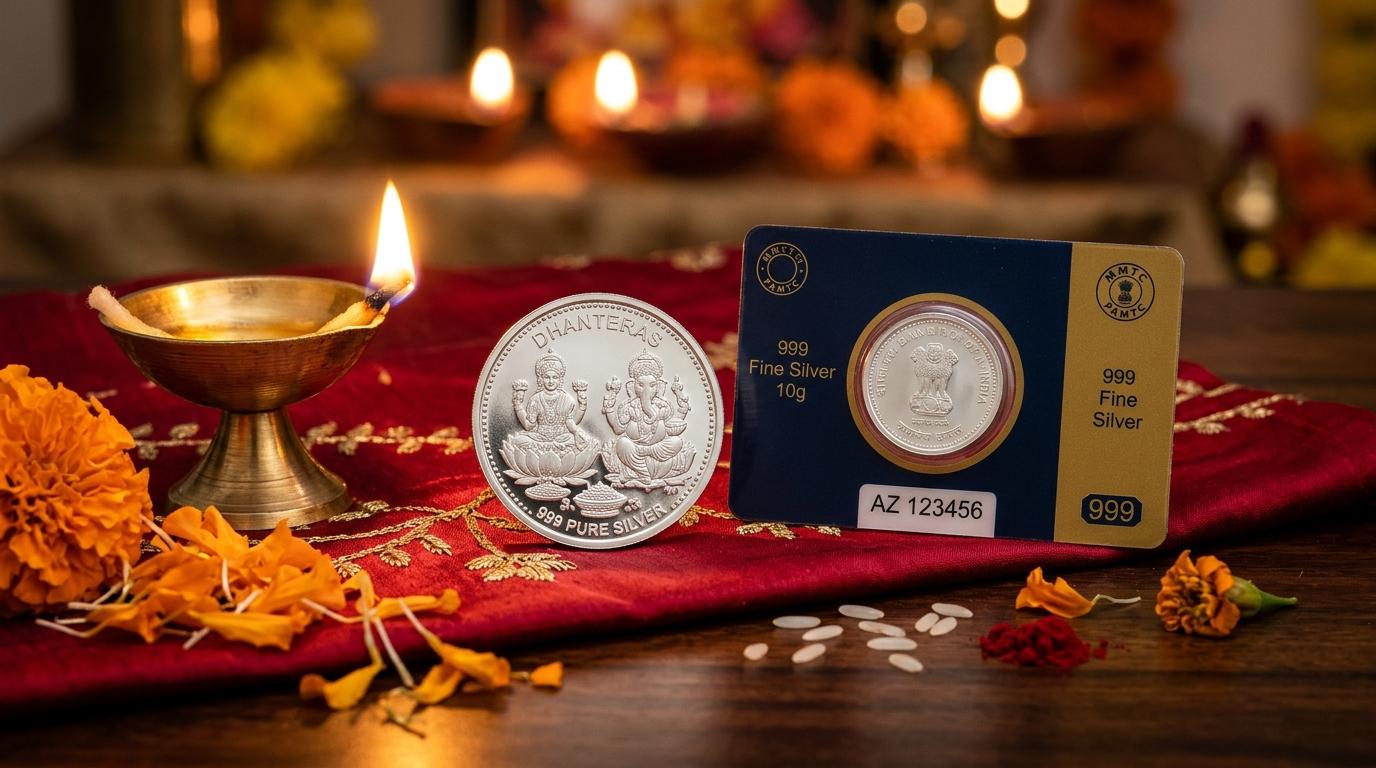
#In modern precious metals retailing, premium refiners and major jewelry brands package minted 999 silver coins inside rigid, transparent tamper-evident plastic assay cards, commonly referred to in the industry as blister packs or CertiCards.
A pervasive holiday temptation among home cooks and families is cutting open the plastic casing to physically touch the silver coin, place it directly onto the puja thali, or bathe it in milk, honey, and water during festive abhishekam rituals. While spiritually understandable, physically unsealing an assay card destroys a substantial portion of the coin's resale value.
The Chemical Vulnerability: Atmospheric Sulfur Corrosion
#Pure silver does not undergo oxidative rusting like iron. However, elemental silver is exceptionally sensitive to atmospheric sulfur compounds, particularly gaseous hydrogen sulfide ($H_2S$) present in everyday environmental air. When unsealed silver is exposed to ambient air, sulfur molecules chemically bond with surface silver atoms to form silver sulfide ($Ag_2S$), manifesting visually as unsightly yellow, brown, or black surface tarnish.
An assay blister pack is hermetically sealed in an inert environment, isolating the pure silver from ambient moisture and sulfur. Keeping the blister card intact guarantees that the coin maintains its pristine mirror luster for decades without requiring abrasive polishing that strips away microscopic layers of metal.
The Liquidity Penalty: Bullion vs Scrap Classification
#The primary financial function of the assay card is serving as an unbroken chain of custody. The sealed packaging incorporates the certified assayer's signature, weight confirmation, serial number, and purity guarantee.
When a customer brings a sealed, undamaged assay blister pack to a reputable bullion dealer or bank-affiliated jeweler for resale:
- The dealer accepts the coin immediately at full live spot value based purely on printed net weight.
- No invasive chemical testing, acid scratching, or electronic density verification is required.
- The coin is resold directly into the secondary market as premium certified bullion.
Conversely, the moment the plastic blister seal is sliced, punctured, or discarded, the coin loses its certified provenance. In the eyes of secondary buyers, an unsealed coin must be treated with skepticism. To verify that an unsealed coin is not a silver-plated copper slug, the jeweler must subject it to destructive touchstone testing, specific gravity testing, or thermal melting. Consequently, jewellers penalize unsealed coins with testing fees and melting loss deductions ranging from 5 percent to 15 percent below spot rate.
If your household traditions require placing a silver coin directly onto a puja thali or submerging it in liquids, purchase an inexpensive, unsealed loose silver token for ritual use, and keep your primary 999 investment coins hermetically sealed inside their factory blister cards.
Invoice Transparency: Why Cash Receipts Without HUID Ruin Your Buyback
#During the hectic shopping rush of Dhanteras, informal jewelry counters frequently offer customers an enticing proposition: skip the formal computerized tax invoice, pay in physical cash, and save the 3 percent GST charge, taking home a simple handwritten slip of paper or an unitemized receipt.
Accepting an informal cash memo on precious metals is one of the costliest financial blunders a festive consumer can make. Under Indian consumer protection and taxation laws, an unitemized cash receipt strips the buyer of virtually all legal recourse:
- If laboratory testing subsequently reveals that a coin sold as 999 is actually an 85 percent alloy, a handwritten slip without GST registration details is inadmissible as legal proof of purchase before Consumer Disputes Redressal Commissions.
- When you attempt to resell the coin years later, jewellers strictly decline to honor buyback commitments without an original computerized tax invoice.
- In the absence of an itemized invoice, secondary dealers classify the coin as unverified scrap, subjecting it to maximum melting discounts.
Essential Components of a Valid Tax Invoice
#Before authorizing payment at any jewellery counter, inspect the billing terminal screen and insist on a computer-generated tax invoice that explicitly details seven mandatory parameters:
- Complete Registered Business Identity: The legal corporate name, registered physical address, and 15-digit Goods and Services Tax Identification Number (GSTIN) of the jeweler.
- Individual Item Description: Explicitly identifying the article as a minted silver coin, not a generic silver article.
- Gross Weight and Net Weight: Both figures displayed in grams, measured to at least three decimal places (e.g., 10.000 g), confirming zero deduction for packaging materials.
- Purity Certification: Explicitly stating the millesimal fineness grade (such as 999 or 999.9).
- Base Bullion Spot Price: Displaying the live silver spot rate per gram applied to the transaction.
- Itemized Minting/Making Charges: Displaying the fabrication fee separately from the metal cost.
- The 6-Digit HUID Code: The exact alphanumeric identification code matching the coin and assay blister card printed on the receipt.
The Essential Pre-Counter Buying Checklist for Dhanteras Shoppers
#To ensure your festive silver shopping experience is smooth, transparent, and financially sound, follow this systematic six-step verification sequence before completing your purchase:
- Step 1: Match Purity to Purpose: Decide on your requirement prior to visiting the store. Choose 999 fine silver for puja tokens, gifting, and bullion storage. Choose 925 sterling silver only if you are purchasing a wearable coin pendant or functional silverware.
- Step 2: Demand a Voluntarily Hallmarked BIS Coin: Do not accept vague jeweler stamps. Request an assay-certified coin bearing the triangular BIS logo, the 999 purity mark, and a clear six-digit HUID code.
- Step 3: Run the BIS CARE App Verification: Open the official BIS CARE app on your phone, enter the six-digit HUID code, and confirm that the digital certificate matches the store name, hallmarking center, and 999 purity grade.
- Step 4: Inspect the Assay Blister Seal: Examine the transparent plastic packaging under good lighting. Ensure there are no hairline tears, adhesive peeling, razor cuts, or pinprick punctures along the edges.
- Step 5: Audit the Price Calculation: Verify that the jeweler’s base metal rate aligns with the day’s published IBJA spot rate, and ensure the making charge does not exceed standard 5 to 10 percent margins for plain minted coins.
- Step 6: Clarify Buyback Terms in Writing: Ask the store manager upfront about their exact buyback policy. Confirm whether the store guarantees a 100 percent metal value buyback on live spot rate for sealed coins, and ensure this commitment is stamped on your computerized tax invoice.
By adhering to these disciplined buying standards, consumers can celebrate Dhanteras with complete peace of mind, transforming festive shopping into a secure, enduring investment for household prosperity.