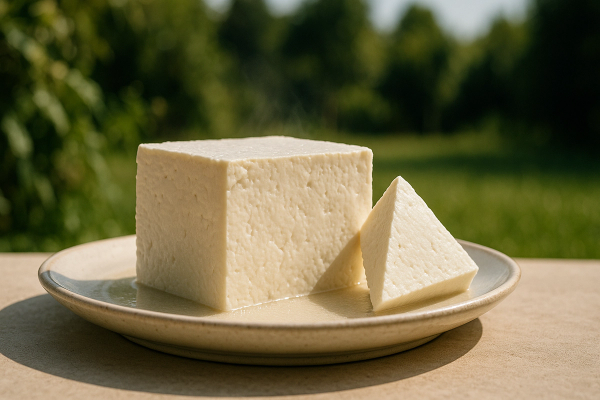
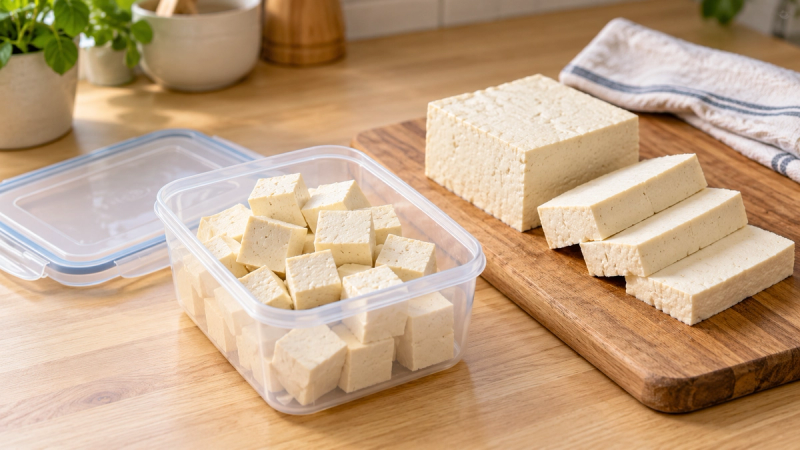
Yes, you can freeze many types of tofu. Firm and extra-firm blocks are a useful starting point when you want a chewier, more porous ingredient for soups, curries or sauced dishes. Check the pack first: a product's freezing and storage instructions take priority over a general kitchen tip.
The main tradeoff is texture. Frozen and thawed tofu does not return to its original smoothness. That can be useful when you want it to take up sauce, but disappointing when the dish depends on a delicate, creamy texture.
Choose the dish before freezing the block. Saving tofu for a curry and saving silken tofu for a chocolate mousse are different decisions.
What freezing changes, and what it does not
#Tofu holds water within a protein structure. When that water freezes and later melts, the structure changes. A thawed block can have visible pores, release more water when pressed, and feel coarser or chewier when cooked.
This is why freezing is sometimes a cooking technique rather than just a storage method. Nasoya's preparation guidance recommends it for a meatier texture and better sauce absorption. Hodo also describes a coarser texture in its frozen extra-firm tofu, suggesting soups and crumbled preparations as useful applications.
“Meatier” describes the bite. It does not mean the tofu will taste like chicken, and freezing adds no seasoning. You still need a sauce, broth or other flavour you actually like.
It also does not guarantee crispness. A wet surface still needs drying before pan-frying or baking. Think of two separate jobs: freezing changes the inside; drying and cooking determine the outside.
Which tofu should you freeze?
#Read both the tofu type and its handling instructions. The word “firm” alone is not enough: firm silken tofu and a firm water-packed block belong to different texture families.
| Tofu on the pack | What to expect | When freezing makes sense |
|---|---|---|
| Firm or extra-firm water-packed tofu | A more porous, chewy texture after thawing and draining | Sauced cubes, soups, curries and braises, if the pack permits freezing |
| Dense, pre-pressed or super-firm tofu | Already has a firm bite; the result depends on the product | Saving portions or trying a different texture, following its instructions |
| Soft or silken tofu | Its smooth texture changes; handle gently | Only when a changed texture suits the dish and the manufacturer permits it |
| Marinated or ready-to-eat tofu products | The tofu, sauce and coating may respond differently | Follow the product's specific instructions rather than a plain-block method |
For a first attempt, a plain firm or extra-firm block makes the result easier to judge. You can see whether you like the texture before committing a seasoned product or a whole meal to the freezer.
Silken tofu is a texture decision, not a blanket ban
#It is too simple to say that silken tofu can never be frozen. Mori-Nu publishes a freezing method for its firm and extra-firm silken products specifically to create a different texture. Its method calls for sliced or cubed tofu and at least 48 hours of freezing.
That does not mean freezing preserves the fresh product's creaminess. Keep tofu unfrozen when your plan relies on that texture, such as a silky sauce, mousse or smooth dessert. For a deliberate texture experiment, use the directions for your exact product.
You can check Mori-Nu's tofu tips for that product-specific method. For thawing, use the refrigerator or another food-safe method described below; do not adopt the page's room-temperature thawing option.
How to freeze a plain tofu block
#This method is for plain tofu whose packaging or manufacturer allows home freezing. If the label says not to freeze it, keep it refrigerated and use it as directed instead.
Check the condition and decide the portions
#Start with tofu that has been stored correctly and is still within its manufacturer's instructions. Freezing is a poor last-minute plan for a forgotten open pack with an uncertain history.
Decide whether you will want the whole block at once. A whole block needs little preparation, but you will later have to thaw it before dividing it easily. Slabs or cubes are more convenient when you want smaller portions.
For example, if your next meal needs cubes for a curry, cut those cubes now. If you want to choose between cubes and crumbles later, leave a larger piece. This is meal planning, not a requirement for a particular shape.
Drain and pack for the freezer
#For a drained-block method, open the pack, discard its packing liquid and place the tofu in a freezer-safe bag or container. Use clean hands, utensils and a board. A long pressing session before freezing is not essential to this method; removing excess water after thawing is the useful next step.
If freezing individual pieces, arrange them separately on a lined tray until solid, then transfer them to a sealed freezer bag or container. Separating them first makes it easier to take out the portion you planned rather than a cluster frozen together.
Remove excess air from a freezer bag without crushing the tofu. Label it with the tofu type and freezing date, and retain the manufacturer's instructions. Keep the freezer at -18°C / 0°F or below.
Freeze until solid
#Check that the tofu is frozen through rather than relying on a fixed number of hours. Block thickness, portion size, packaging and your freezer affect the timing. Start ahead of the meal rather than expecting this to be an immediate dinner shortcut.
Freezing an unopened pack can also be appropriate when the manufacturer permits it. Hodo explicitly allows freezing its unopened products. That permission should not be generalized to every tofu tub, carton or pouch.
How long can frozen tofu stay in the freezer?
#There is no single duration that overrides every product's directions. The Tofoo Co., for example, instructs customers to freeze its extra-firm tofu as soon as possible after purchase, use it within one month, thaw it fully and use it on the same day. It also says not to refreeze it.
Those are instructions for Tofoo, not a universal one-month rule for all tofu. Check the manufacturer's current storage guidance when using that product, and keep the instructions for any other brand you freeze.
Storage quality and food safety are also different questions. FDA guidance explains that properly handled food kept continuously at -18°C / 0°F remains safe while its quality can decline. That assumes safe food went into a functioning freezer and stayed frozen. It does not make a previously mishandled block safe or cancel product-specific directions.
For an ordinary home routine, plan a named meal and a use date within the product's guidance. “Tofu for next week's curry” is a more useful label than “tofu, someday.” If no freezing instructions are supplied, ask the manufacturer rather than treating an internet storage range as a guarantee.
Thaw safely, then remove the released water
#The refrigerator is the easiest option when you can plan ahead. Put the tofu in a covered container or on a tray to catch liquid, and keep it at 4°C / 40°F or below. Check the centre before pressing or cutting a block: a thawed outside does not mean the middle is ready.
Allow enough time before the meal, but do not promise that every block will thaw overnight. A thick block and small cubes will behave differently. Once thawed, follow the product's directions for how soon to use it.
If you need a faster method, keep the tofu in a leak-proof bag submerged in cold water and change the water every 30 minutes. Cook promptly after thawing. Microwave defrosting is another option: use a microwave-safe container and cook immediately afterward, because the edges may warm before the centre thaws.
Health Canada's food-safety guidance lists refrigerator, cold-water and microwave thawing, and advises against thawing at room temperature. Do not leave a block on the counter all afternoon, or use warm water to speed up a cold-water thaw.
After thawing, drain the released liquid. Gently press a firm block between clean towels or use a tofu press, stopping before you crush it. Pat the surface dry before a cooking method that needs browning. Treat delicate pieces more gently; they do not need to survive a heavy weight to be useful.
Choose a dish that suits the changed texture
#The practical question is whether you want tofu to feel smooth or to hold broth and sauce. For previously frozen tofu, these are useful directions to consider:
- Soup or a saucy curry: use pieces whose shape survives thawing. Their porous texture can make broth or sauce part of the bite.
- A rice bowl or stir-fry: drain and dry the tofu before cooking it. Freezing alone will not stop a wet surface from steaming.
- Crumbled filling: if the block breaks while pressing, consider a scramble or seasoned crumble instead of forcing it back into neat cubes.
- A creamy dessert or smooth dressing: use fresh tofu of the type the recipe calls for. Do not expect thawing to undo the texture change.
These are cooking options, not claims that one frozen block works equally well in every recipe. If you prefer tofu's original tender bite, there is no need to freeze it for texture at all.
A simple two-meal plan
#Here is a hypothetical way to use one permitted-to-freeze extra-firm block. Divide it into two meal-sized portions before freezing. Keep both portions sealed and labelled.
Move the first portion to the refrigerator ahead of a curry night. Once fully thawed, drain it, gently press it and cook it using your curry recipe. Leave the second portion frozen for a later meal within the pack's guidance.
For the second meal, thaw only that portion, dry the pieces and use them in a rice bowl or crumble them into a filling. The benefit is being able to choose a meal without thawing more tofu than you need. It is not a reason to repeatedly thaw and refreeze the whole block.
If the result is not what you expected
#It is too spongy. That may be the texture change you were trying, rather than a cooking failure. Use a saucy dish if you like the bite; next time, leave tofu unfrozen when you want a smoother centre.
It falls apart when pressed. Handle the next batch more gently and check that you bought the intended tofu type. If this batch has been handled safely, crumbles can still suit a filling or scramble.
It is wet and will not brown. Drain and pat it dry after thawing. Adding it to the pan straight from a puddle leaves the surface-drying job unfinished.
It has dry, leathery patches. Poorly sealed packaging can cause freezer burn, which affects quality. Review how you packed it, but do not use that explanation to dismiss mould, an unusual smell or an uncertain storage history.
You cannot establish how it was stored. Stop there. Smell and appearance cannot prove food is safe, and freezing does not kill most bacteria. A well-labelled, safely handled block is the starting point for this technique.