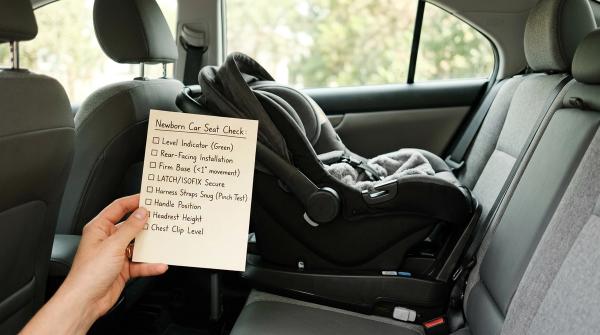
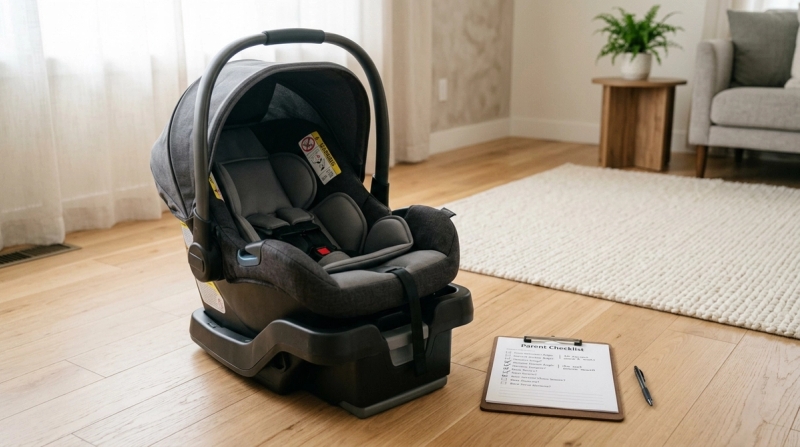
Direct answer: A car seat expiration date is usually counted from the date of manufacture, not the day you buy it. Before using a new infant, convertible, all-in-one, or booster seat, find the DOM label, confirm the manual’s usable-life rule, register the seat, check recalls, and learn when the manufacturer says to replace it after a crash.
Buying a car seat feels simple until you start comparing infant seats, convertible seats, ISOFIX or LATCH, recline angles, harness limits, newborn inserts, and safety labels. This checklist keeps the job practical: check the labels first, then fit, recalls, registration, and crash rules.
Why Car Seats Expire
#A car seat is a safety device made from plastic, foam, harness webbing, buckles, clips, labels, moving parts, and instructions. Those parts are tested for a defined period of use.
Car seats sit in hot cars, cold cars, direct sun, humidity, dust, food crumbs, and everyday mess. Over time, materials can wear down even when the seat looks fine from the outside. Safety standards and vehicle designs also change, and older seats may have faded labels, missing manuals, or unavailable replacement parts.
That is why parents should follow the exact label and manual for their seat instead of guessing from another parent’s model.
Car Seat Expiration Date Checklist
#Do this as soon as the car seat arrives, especially if you bought it online.
- Find the date of manufacture label.
- Look for wording such as DOM, Manufactured on, Do not use after, Expires on, or Useful life.
- Check whether the expiration date is printed on the label or calculated from the manufacture date.
- Inspect the plastic shell for molded or engraved date wording.
- Check both the infant carrier and detachable base.
- Save a photo of the model number, serial number, manufacture date, and expiration wording.
- Confirm the manual is included or download the official manual.
- Register the seat with the manufacturer.
- Check for recalls before the first ride.
Where to Find the Manufacture Date
#Look for the label on the back, bottom, or side of the plastic shell. It may also be under the cover, near the belt path, or on the infant seat base.
The label may say:
- Date of Manufacture
- DOM
- Manufactured on
- Manufactured in
- MFG date
If your seat was manufactured in 2024 but bought in 2026, the usable life usually began in 2024. That can still be fine, but it means you should calculate the remaining life before removing tags or discarding the box.
Quick Reference Table
#When Do Car Seats Expire?
#Many car seats last around 7 to 10 years, but there is no single rule for every seat. Infant seats, convertible seats, all-in-one seats, and boosters can have different usable lives depending on brand and model.
Use this simple formula:
Date of Manufacture + Manufacturer’s Stated Usable Life = Expiration Date
Always check your exact seat. Do not rely only on a general online rule, a marketplace listing, or a social media comment.
Recall and Registration Steps
#Car seat registration helps the manufacturer contact you if there is a recall, repair kit, replacement part, or safety notice.
- Find the details: model name, model number, serial number, batch number, and manufacture date.
- Register the seat: use the registration card, manufacturer website, or QR code if provided.
- Check recalls: use the manufacturer’s support page or an official recall database for your country.
- Save proof: keep registration confirmation, manual link, and label photos in a baby-documents folder.
In the United States, NHTSA provides car seat recall and registration resources. In other countries, use the manufacturer, importer, retailer, or local product-safety authority.
Should You Replace a Car Seat After an Accident?
#A car seat can become unsafe before its expiration date if it has been in a crash.
NHTSA guidance says car seats should be replaced after a moderate or severe crash. Some manufacturers are stricter and require replacement after any crash, even if it seems minor. Your exact manual is the final authority for that seat.
Replace or stop using the seat if:
- The manual says to replace it after any crash.
- The crash was moderate or severe.
- There are cracks, stress marks, broken parts, or buckle issues.
- The harness, shell, base, or recline mechanism no longer works correctly.
- You cannot confirm the manufacturer’s post-crash rule.
Do not judge by looks alone. Hidden stress can matter, so contact the manufacturer when uncertain.
New Parent Car Seat Buying Checklist
#Before buying or using a new car seat, confirm:
- It matches your child’s age, height, weight, and developmental stage.
- It supports safe newborn fit if you are buying for a newborn.
- It fits your vehicle seat and allows the correct recline angle.
- Your car supports the install method you plan to use: seat belt, ISOFIX, or LATCH depending on your market.
- The manufacture date leaves enough usable life for your family.
- The safety labels are readable.
- The manual is available.
- All included parts are present.
- The seat has no recall affecting your model.
- You are not using unapproved cushions, strap covers, inserts, or accessories.
India-Aware Buying Notes
#If you are buying a car seat in India, check the manufacture date as soon as the box arrives. Imported baby gear may spend time in shipping or warehouse stock, so the manufacture date may be earlier than expected.
Keep the invoice and packaging until you confirm:
- The DOM label is readable.
- The expiration guidance is clear.
- The model and serial numbers match the product.
- No parts are missing.
- The seat fits your actual car.
- The manual explains seat belt, ISOFIX, or other approved installation options.
Many Indian parents also look for recognized labels such as ECE R44/04 or R129/i-Size where applicable. Check the physical product label, not only the online listing image.
Common Unsafe Assumptions to Avoid
#- “It is new, so it has the full lifespan.” Not always. Count from the manufacture date.
- “It looks fine, so expiration does not matter.” Aging is not always visible.
- “All seats expire after 10 years.” Lifespan varies by model.
- “A small crash never matters.” Check NHTSA guidance and your exact manual.
- “Registration is optional paperwork.” It helps you receive recall notices.
- “Extra padding makes the seat safer.” Only use accessories approved by the manufacturer.
What If You Cannot Find the Expiration Date?
#Do not guess. Check the back, bottom, sides, belt path, and base. Look for molded text in the plastic shell. Read the manual’s usable-life section. Search the manufacturer’s website using the model number, or contact support with photos of the labels.
If the manufacturer cannot confirm the usable life, do not treat the seat as safe to use indefinitely.
Simple Record-Keeping Tip
#Create one phone note with:
- Brand
- Model name
- Model number
- Serial number
- Date of manufacture
- Expiration date
- Registration confirmation
- Recall check date
- Manual link
- Customer support contact
Also save photos of the label, manual cover, installation page, and crash replacement page.
Final Takeaway
#A car seat can feel intimidating at first, but the core checks are simple: find the labels, read the manual, register the seat, check recalls, and respect the expiration date. If there is a crash, follow the manufacturer’s rule and official safety guidance before using the seat again.