The Thermal Envelope Bottleneck: Why Windows Dominate Home Energy Loss
#In a modern home constructed to current energy standards, the structural walls are packed with fiberglass, mineral wool, or dense-pack cellulose insulation, routinely achieving thermal resistance values between R-13 and R-21. Overhead, attics and roof assemblies are insulated to R-38 or R-60, creating a thick, protective thermal blanket that holds conditioned air inside the living space.
Windows, by contrast, represent massive structural gaps in the building envelope. Even in homes with modern dual-pane glazing, a standard window offers an effective insulation rating of roughly R-3 to R-4. An older, uninsulated single-pane window provides an effective rating of approximately R-1—insulating no better than a single sheet of heavy cardboard.
The mathematical consequences for residential energy consumption are staggering:
- Massive energy waste: Research by the United States Department of Energy establishes that heat loss and heat gain through residential windows drive roughly 25 percent to 30 percent of total household heating and cooling energy use.
- Thermal discomfort and room abandonment: In winter, cold glass draws radiant warmth directly out of human bodies through radiative exchange, making a room set to 70 degrees Fahrenheit feel uncomfortably chilly. In summer, unfiltered solar radiation streams through glass surfaces, turning living rooms into unintended greenhouses and causing localized air temperatures to spike by 10 to 15 degrees.
- Chronic HVAC strain: Heating and air conditioning equipment must be oversized specifically to overcome window heat transfer, cycling on and off continuously and driving up monthly utility bills.
Overcoming this thermal bottleneck does not necessarily require spending tens of thousands of dollars on whole-house window replacements. By understanding the biophysics of heat transfer, how microscopic low-emissivity coatings manipulate the electromagnetic spectrum, and how to decode standardized energy performance ratings, homeowners can make informed, cost-effective decisions that maximize comfort and slash utility bills.
The Physics of Window Heat Transfer: Conduction, Convection, and Thermal Radiation
#To evaluate window performance, one must first look at the three fundamental mechanisms by which thermal energy moves through a fenestration assembly: conduction, convection, and radiation.
Conduction: Heat Moving Through Solid Matter
#Conduction is the direct transfer of thermal kinetic energy from molecule to molecule through a solid material. When winter temperatures drop, the warm indoor air excites the molecules on the interior pane of glass. That kinetic vibration transfers through the solid pane, across the structural window frame, and out to the exterior glass surface, dissipating into the cold outdoor atmosphere.
The rate of conductive heat transfer depends strictly on the thermal conductivity of the materials chosen for the frame and glazing assembly:
- Aluminum frames: Extremely conductive, transferring heat thousands of times faster than insulated walls. Without advanced thermal breaks (polyamide plastic thermal barriers isolating the interior and exterior aluminum profiles), metal frames act as direct energy bridges that freeze in winter and sweat condensation.
- Wood and vinyl frames: Exhibit low thermal conductivity, providing vastly superior insulating qualities that minimize conductive heat loss along the perimeter sash.
- Composite and fiberglass frames: Offer structural strength combined with hollow cavities that can be filled with insulating foam, matching the thermal expansion rates of glass while minimizing conduction.
Convection: Circulating Fluid Currents
#Convection occurs when thermal energy moves through liquid or gas currents. In an insulated glazing unit (IGU), convection takes place within the sealed cavity separating the glass panes.
During cold winter weather, the air directly contacting the warm interior pane heats up, expands, becomes less dense, and rises toward the top of the window frame. Simultaneously, the air contacting the cold outer pane cools down, becomes denser, and sinks toward the bottom sill. This continuous temperature differential sets up an active circular convective loop within the gap. 
As the air circulates, it acts as a thermal conveyor belt, constantly ferrying heat away from the warm inside pane and dumping it directly onto the cold outside pane. Controlling convection requires engineering the precise width of the space between panes and filling the cavity with dense, viscous inert gases that resist fluid circulation.
Thermal Radiation: The Dominant Heat Flow Culprit
#While conduction and convection are significant, thermal radiation accounts for the majority of window heat gain and loss. Radiation is the transfer of electromagnetic energy through space, requiring no physical contact or fluid medium.
In building physics, windows must contend with two entirely distinct wavelengths of radiant energy:
- Short-wave solar radiation: Direct sunlight consists of ultraviolet rays (below 380 nanometers), visible light (380 to 740 nanometers), and near-infrared solar radiation (740 to 2,500 nanometers). This short-wave energy passes easily through clear glass. When sunlight strikes interior floors, furniture, and walls, those surfaces absorb the solar energy and heat up.
- Long-wave infrared radiation: Once interior surfaces are warmed by sunlight or household heating systems, they re-radiate that thermal energy back into the room as invisible long-wave infrared radiation (above 2,500 nanometers).
Here lies the fundamental trap of standard clear glass: clear glass is largely transparent to incoming short-wave solar radiation, allowing heat to enter the home freely. However, warm glass absorbs long-wave infrared heat and re-radiates it in both directions. In winter, precious indoor heat radiates from warm furniture to the cold glass, which radiates it out into the night sky. In summer, hot exterior pavement and ambient outdoor air radiate heat through the glass into the living space.
Cracking the NFRC Energy Label: Decoding U-Factor, SHGC, and Visible Transmittance
#When shopping for energy-efficient windows or evaluating existing installations, homeowners are confronted with the certified performance label issued by the National Fenestration Rating Council (NFRC). The NFRC is an independent, non-profit organization that provides standardized, laboratory-tested ratings for whole-window systems (including glass, frame, and spacers).
Understanding these metrics allows consumers to separate genuine engineering efficiency from marketing hype.
U-Factor: The Measure of Non-Solar Heat Transfer
#The U-factor (sometimes written as U-value) measures the overall rate of non-solar heat transfer through the entire window assembly. It quantifies how much heat escapes through conduction, convection, and long-wave radiation under standard laboratory temperature differentials.
- Engineering unit: Measured in British thermal units per hour, per square foot, per degree Fahrenheit of temperature differential (Btu/h·ft²·°F). In metric systems, it is expressed in Watts per square meter Kelvin (W/m²·K).
- Numerical scale: Typically ranges from 0.15 for super-insulated triple-pane windows to 1.20 for single-pane clear glass in an uninsulated aluminum frame.
- Crucial rule: Lower U-factors mean better insulation. A lower U-factor indicates that less heat escapes your home during winter and less ambient heat conducts into your home during summer.
- Relationship to R-value: U-factor is the exact mathematical inverse of thermal resistance R-value ($R = 1 / U$). A window with a U-factor of 0.25 has an equivalent insulating rating of R-4 ($1 / 0.25 = 4$).
Solar Heat Gain Coefficient (SHGC): Controlling Solar Radiation
#The Solar Heat Gain Coefficient (SHGC) measures the fraction of incident solar radiation admitted through a window, both through direct transmission and through absorption followed by inward release.
- Numerical scale: Expressed as a unitless decimal number between 0.00 and 1.00.
- Practical meaning: An SHGC of 0.25 means the window allows only 25 percent of available solar heat to enter the home, reflecting or absorbing the remaining 75 percent. An SHGC of 0.65 allows 65 percent of solar heat to penetrate.
- Crucial rule: Lower SHGC numbers block more solar heat. Unlike U-factor, where lower is always better regardless of geography, the ideal SHGC depends entirely on your local climate zone. In hot southern climates, an ultra-low SHGC (below 0.25) is mandatory to minimize air conditioning costs. In cold northern climates, a higher SHGC (0.40 to 0.55) is often desirable on south-facing windows to harvest free passive solar heat during freezing winter months.
Visible Transmittance (VT): Preserving Daylight
#Visible Transmittance (VT) measures the amount of light within the visible optical spectrum (380 to 740 nanometers) that passes through the glazing assembly.
- Numerical scale: Expressed as a unitless decimal between 0.00 and 1.00.
- Practical range: Most clear residential windows have a VT between 0.50 and 0.70. A window with a VT of 0.60 transmits 60 percent of daylight.
- Crucial rule: Higher VT numbers mean brighter rooms and reduced need for artificial daytime lighting. The engineering goal of modern window design is to achieve an ultra-low SHGC to block heat while maintaining a high VT to keep rooms naturally bright.
| NFRC Performance Metric | Numerical Scale Range | Primary Physical Mechanism | Ideal Cold Climate Target | Ideal Hot Climate Target | Homeowner Practical Takeaway |
|---|---|---|---|---|---|
| U-Factor | 0.15 to 1.20 (Btu/h·ft²·°F) | Conduction, convection, and long-wave radiation | Under 0.27 (Triple-pane target: 0.18 to 0.22) | Under 0.35 (Double-pane with thermal frame) | Lower is always better; directly prevents winter heat escape |
| Solar Heat Gain Coefficient (SHGC) | 0.00 to 1.00 (Ratio) | Short-wave solar radiation admission | 0.35 to 0.55 (Harvests passive winter solar heat) | Under 0.25 (Blocks intense radiant cooling loads) | Climate-dependent; low blocks summer heat, high captures winter sun |
| Visible Transmittance (VT) | 0.00 to 1.00 (Ratio) | Visible daylight spectrum transmission (380-740 nm) | Over 0.50 | Over 0.45 | Higher values preserve natural daylight without dark tint |
| Air Leakage (AL) | 0.1 to 0.3 (cfm/sq ft) | Infiltration through frame joints, weatherstripping, sills | Under 0.15 | Under 0.20 | Lower values eliminate physical drafts and air infiltration |
| Condensation Resistance (CR) | 1 to 100 (Relative scale) | Surface temperature maintenance against interior dew point | Over 60 | Over 45 | Higher values prevent winter moisture condensation on glass |
The Magic of Low-E Coatings: Sputtered Silver and Infrared Reflection
#The single greatest technological breakthrough in modern building envelope science is the development of low-emissivity, or Low-E, glass coatings.
Every physical object has an emissivity rating—a measure of how efficiently its surface emits thermal radiation compared to a theoretical black body. Standard clear float glass has an emissivity of approximately 0.84, meaning it absorbs and re-radiates 84 percent of the thermal energy that hits it, making it an exceptionally poor thermal barrier.
A Low-E coating is a microscopically thin, virtually invisible stack of metallic oxide and pure silver layers applied to the glass surface. This coating reduces the surface emissivity from 0.84 down to 0.02 to 0.05.
The Physics of the Optical Filter
#Low-E coatings function as passive optical filters, exploiting the fact that visible daylight and thermal heat occupy different wavelengths on the electromagnetic spectrum:
- Visible daylight transmission: The microscopic thickness of the silver layers (measured in nanometers, hundreds of times thinner than a human hair) allows short wavelengths of visible light (380 to 740 nanometers) to pass through unhindered.
- Long-wave infrared reflection: When long-wave infrared heat (above 2,500 nanometers) strikes the Low-E layer, the metallic silver acts like a thermal mirror. Instead of absorbing the heat, the coating reflects up to 95 percent of the infrared energy directly back toward its source.
In winter, the Low-E coating reflects radiant indoor heat back into the room, preventing it from radiating outward to the cold exterior. In summer, the coating reflects ambient exterior heat away from the house, keeping the interior cool.
Manufacturing Technologies: Hard-Coat vs Soft-Coat
#Low-E coatings are manufactured using two primary industrial methods, each possessing distinct physical properties:
- Pyrolytic (Hard-Coat) Low-E: Applied during float glass manufacturing while the glass ribbon is still semi-molten at 1,100 degrees Fahrenheit. A chemical vapor of tin oxide is sprayed onto the surface, chemically fusing directly into the glass matrix. Hard-coat Low-E is extremely durable and scratch-resistant, allowing it to be exposed to air on storm windows. However, its thermal performance is moderate, typically achieving an emissivity around 0.15 with higher U-factors.
- Magnetron Sputter Vacuum Deposition (MSVD or Soft-Coat) Low-E: Applied off-line inside massive vacuum chambers. The glass passes through magnetic sputtering cathode arrays that blast atom-thin layers of zinc oxide, titanium dioxide, and pure silver onto the cold glass surface. Soft-coat Low-E provides vastly superior thermal performance, achieving emissivities as low as 0.02 with double or triple silver layers. However, because pure silver oxidizes rapidly when exposed to air, soft-coat Low-E must always be sealed inside the protected, gas-filled cavity of an insulated glazing unit.
Surface Numbers Matter: Where Low-E Belongs in Cold vs Hot Climates
#In building science, the physical position of the Low-E coating within the insulated glass unit is just as important as the coating itself. Placing a Low-E layer on the wrong glass surface can undermine energy performance and create seasonal overheating.
Fenestration engineers follow a universal glass surface numbering convention:
- Surface 1: The outdoor-facing exterior side of the outer glass pane. Exposed directly to weather, rain, and exterior air.
- Surface 2: The cavity-facing interior side of the outer glass pane. Protected inside the sealed gas gap.
- Surface 3: The cavity-facing exterior side of the inner glass pane. Protected inside the sealed gas gap.
- Surface 4: The room-facing interior side of the inner glass pane. Located inside the conditioned living space.
Glass Surface Numbering Convention for Double-Pane Windows:
[OUTDOORS]                                            [INDOORS]
    |                                                     |
    |   Surface 1                     Surface 3           |
    |   (Exterior Weather)            (Cavity Facing)     |
    |       |                             |               |
    |   [ OUTER PANE ]   [ SEALED GAP ]  [ INNER PANE ]   |
    |                    (Argon Gas)                      |
    |                             |               |       |
    |                         Surface 2       Surface 4   |
    |                         (Cavity)        (Room Side) |
Climate-Specific Surface Optimization
#The decision of where to position the Low-E coating depends on whether your climate is dominated by heating costs or cooling costs:
- Cooling-dominated climates (Southern zones, desert, tropical regions): The primary goal is stopping solar heat before it enters the building envelope. The Low-E coating is placed on Surface 2. When intense sunlight hits the outer pane, the Surface 2 coating reflects the radiant energy back out through the exterior pane before the heat can cross the gas cavity and enter the home.
- Heating-dominated climates (Northern zones, alpine regions, cold winters): The primary goal is retaining indoor heat while allowing free solar warmth to enter. The Low-E coating is placed on Surface 3. Incoming solar radiation passes through the outer pane, crosses the gas cavity, and enters the home. Meanwhile, radiant indoor heat from your furnace and living room is reflected back into the room by the Surface 3 coating.
- Dual Low-E in extreme northern zones: To achieve maximum insulating performance without upgrading to triple-pane glass, manufacturers apply a primary soft-coat on Surface 3 and a specialized durable hard-coat on Surface 4. This reflects room heat immediately at the interior surface, pushing the window unit to an effective R-5 insulation rating.
| Glass Surface Number | Physical Location in Assembly | Primary Energy Function | Optimal Climate Zone | Thermal Mechanism Description |
|---|---|---|---|---|
| Surface 1 | Outside face of exterior pane | Specialized pyrolytic anti-condensation or self-cleaning | Specialized northern/commercial | Rare in residential; absorbs weather abuse, reduces exterior dew |
| Surface 2 | Inside face of exterior pane (cavity side) | High solar reflectance, blocks radiant heat entry | Cooling-dominated (Southern, Desert) | Stops solar infrared before it crosses the insulated gas cavity |
| Surface 3 | Outside face of interior pane (cavity side) | High thermal heat retention, allows solar gain | Heating-dominated (Northern, Mountain) | Traps indoor warmth while allowing winter solar heat to penetrate |
| Surface 4 | Room-facing side of interior pane | Auxiliary radiant reflection into conditioned space | Extreme Northern (Dual Low-E assemblies) | Reflects indoor heat directly at room boundary, boosts unit to R-5 |
Inside the Insulated Glazing Unit: Spacers, Gas Fills, and Panes
#High-performance windows are sophisticated composite engineering systems. The glass panes are only one component of the Insulated Glazing Unit (IGU).
Inert Gas Fills: Argon vs Krypton
#The space between panes is not a vacuum; nor is it filled with standard room air. Ambient air contains moisture that would condense into fog when the glass gets cold, and air molecules readily set up convective loops.
Manufacturers evacuate the cavity and replace the air with dense, non-toxic inert gases:
- Argon Gas: The universal standard for high-performance residential windows. Argon makes up nearly one percent of Earth's atmosphere, making it inexpensive to extract. It is 38 percent denser than air, exhibits roughly 34 percent lower thermal conductivity, and has a higher dynamic viscosity that suppresses convective fluid movement within a half-inch cavity.
- Krypton Gas: An ultra-dense, rare gas used primarily in premium triple-pane windows. Krypton is twice as dense as argon and provides superior thermal performance in very narrow gaps (roughly a quarter-inch to three-eighths of an inch wide). However, krypton is dramatically more expensive than argon, making it cost-prohibitive for standard residential dual-pane windows.
Modern IGUs are sealed with dual-barrier polyisobutylene (PIB) and structural silicone seals that limit gas leakage to less than one percent per year, guaranteeing 20 to 30 years of thermal performance.
Warm-Edge Spacers: Eliminating Perimeter Thermal Bridging
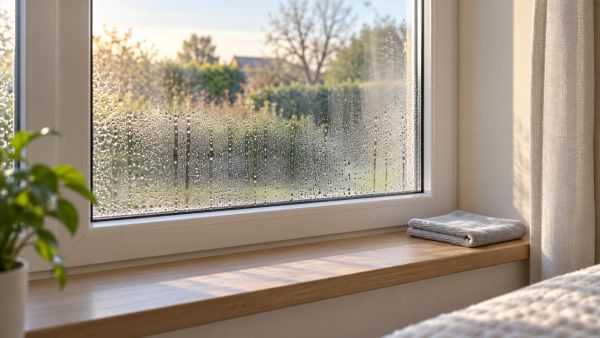
#In older double-pane windows, the glass panes were separated by hollow aluminum spacer tubes filled with silica desiccant beads. Aluminum is a ferocious thermal conductor. As a result, the outer perimeter of the glass acted as a continuous thermal bridge, chilling the edges of the window and causing water droplets to condense along the bottom sill every winter.
Modern windows utilize warm-edge spacer technology:
- Structural silicone foam spacers: Flexible, non-metallic foam tubes that contain zero metal, virtually eliminating conductive heat transfer along the glass edge.
- Stainless steel composite spacers: Thin stainless steel alloy wrapped in insulating polymers. Stainless steel conducts heat at less than ten percent the rate of standard aluminum, keeping edge-of-glass temperatures up to 10 degrees Fahrenheit warmer in winter and eliminating condensation lines.
| Glazing Configuration | Cavity Fill Medium | Typical Center-of-Glass U-Factor | Equivalent Thermal R-Value | Primary Engineering Application |
|---|---|---|---|---|
| Single Pane Clear Glass | None (Ambient outdoor air) | 1.05 to 1.10 | R-0.9 to R-1.0 | Uninsulated historic frames, garages, garden sheds |
| Double Pane Clear Glass | Dry Air (0.50 inch gap) | 0.48 to 0.50 | R-2.0 to R-2.1 | Baseline 1980s-1990s construction, uninsulated spacer |
| Double Pane with Low-E | Argon Gas (0.50 inch gap) | 0.24 to 0.28 | R-3.6 to R-4.2 | Universal standard for modern Energy Star residential homes |
| Double Pane Dual Low-E | Argon Gas (Surface 3 and 4) | 0.20 to 0.22 | R-4.5 to R-5.0 | High-performance cold-climate retrofits without frame alteration |
| Triple Pane with Two Low-E | Argon Gas (Dual 0.50 inch gaps) | 0.15 to 0.18 | R-5.5 to R-6.7 | Extreme northern climates, net-zero homes, high sound isolation |
| Triple Pane with Two Low-E | Krypton Gas (Dual 0.35 inch gaps) | 0.12 to 0.14 | R-7.1 to R-8.3 | Passive House certified envelopes, ultra-low energy architecture |
Climate-Zone Optimization: Matching Window Ratings to Your Local Weather
#A critical mistake made by well-intentioned homeowners is purchasing the highest-rated window on the market without verifying that its specifications match their geographic climate zone. A window engineered for optimal energy efficiency in Miami will increase heating bills if installed in Minneapolis.
The Energy Star program categorizes North America into distinct climate zones based on heating and cooling degree days:
- Northern Zone (Heating-Dominated): Over 70 percent of home energy use goes toward winter heating. Homeowners must prioritize an ultra-low U-factor (under 0.27, and ideally under 0.22 with triple glazing) to stop heat escape. On south-facing windows with good winter sun exposure, an intermediate to high SHGC (0.35 to 0.50) is advantageous, providing passive solar heating that offsets furnace runtime.
- Southern Zone (Cooling-Dominated): Over 70 percent of energy use goes toward summer air conditioning. Winter heating demands are negligible. Homeowners must prioritize an ultra-low SHGC (under 0.23, and ideally under 0.20) with Low-E on Surface 2 to reject solar radiation. U-factor is secondary; a moderate U-factor under 0.35 is entirely sufficient.
- North-Central and South-Central (Mixed Climates): Regions with freezing winters and hot, humid summers require balanced fenestration. Windows must maintain a low U-factor (under 0.28) combined with a moderate SHGC (0.25 to 0.30) to provide thermal comfort across all four seasons.
| Climate Classification | Heating vs Cooling Priority | Target U-Factor Window | Target SHGC Window | Recommended Low-E Sputter Spec |
|---|---|---|---|---|
| Northern (Cold / Very Cold) | 80% Heating / 20% Cooling | 0.20 to 0.27 | 0.35 to 0.50 (Passive Solar) | High-solar-gain soft-coat on Surface 3, Argon fill |
| North-Central (Mixed Cold) | 60% Heating / 40% Cooling | 0.25 to 0.28 | 0.25 to 0.35 | Moderate-solar soft-coat on Surface 3, Argon fill |
| South-Central (Mixed Hot) | 40% Heating / 60% Cooling | 0.28 to 0.30 | 0.23 to 0.25 | Low-solar soft-coat on Surface 2, Argon fill |
| Southern (Hot / Humid) | 15% Heating / 85% Cooling | 0.30 to 0.35 | Under 0.23 (Target: 0.18-0.21) | Triple-silver spectrally selective soft-coat on Surface 2 |
| Marine (Temperate / Cloudy) | 65% Heating / 35% Cooling | Under 0.28 | Under 0.30 | High visible transmittance (VT > 0.60) to maximize grey-sky light |
Retrofit vs Replacement: Low-E Films, Cellular Shades, and Interior Storms
#When homeowners experience uncomfortable window drafts or skyrocketing summer cooling bills, the default advice from contractors is full-frame window replacement. However, from a building science and financial perspective, whole-window replacement is frequently the least cost-effective intervention.
Full replacement costs between $800 and $1,500 per window opening once demolition, structural framing adjustments, exterior cladding repairs, and skilled installation labor are calculated. For an average home with 20 windows, the project cost easily surpasses $16,000 to $25,000. 
Because replacing functional double-pane windows with high-performance units typically saves between $200 and $400 per year on utility bills, the simple payback period often stretches between 20 and 40 years—exceeding the warranty lifespan of the new windows.
Unless existing window frames are structurally rotting, sashes are warped beyond mechanical repair, or glass seals have experienced catastrophic failure, homeowners should evaluate targeted, cost-effective thermal retrofits first.
Retrofit 1: Professional Aftermarket Low-E Window Films
#For structurally sound double-pane or single-pane windows suffering from excessive solar heat gain in summer, aftermarket Low-E window films deliver extraordinary returns.
Modern architectural window films use multi-layer ceramic and sputtered metal nanotechnology that adheres directly to the room-side glass (Surface 4):
- Thermal performance: Rejects up to 70 percent of total solar heat energy (slashing effective SHGC) while blocking 99 percent of fabric-fading ultraviolet radiation. Specialized all-season films also carry a low-emissivity coating that reflects up to 40 percent of winter room heat back inside.
- Financial return: Costs roughly $8 to $15 per square foot installed. Homeowners achieve 60 to 70 percent of the solar heat reduction of a brand-new window at less than one-fifth the capital cost, delivering a rapid payback period of two to five years.
Retrofit 2: Insulating Cellular (Honeycomb) Shades
#Double-cell honeycomb shades represent the most effective interior thermal window treatment available.
- Dead air entrapment: Cellular shades are engineered with cross-sectional hexagonal pockets that trap stationary air, creating an insulating buffer directly between the window pane and the living room.
- Thermal resistance: High-performance double-cell shades with side track seals increase the window assembly's insulation value by R-2 to R-4.5. When closed over a standard R-2 window, the effective insulation jumps to R-5.
- Operable seasonal management: Cellular shades offer an advantage that fixed glass cannot match: dynamic seasonal operability. On cold winter days, raise the shades on south-facing windows to harvest free solar heat; at sunset, lower the shades to trap warmth inside. In summer, lower the shades on east- and west-facing windows during peak morning and afternoon sun to prevent radiant heat entry.
Retrofit 3: Low-E Interior Storm Window Inserts
#For historic homes with single-pane wood windows or drafty vintage frames, magnetic interior storm inserts represent a building science triumph:
- Non-invasive installation: Lightweight aluminum or composite frames holding acrylic or Low-E glass snap securely into the existing interior window casing using magnetic strips, requiring zero exterior demolition.
- Air sealing and third pane performance: The interior insert creates a sealed, dead-air cavity between the storm pane and the existing window, slashing air infiltration by 80 percent and acoustic street noise by 50 percent. When fitted with Low-E glass, interior storm inserts transform a drafty R-1 single-pane window into an efficient R-3.5 assembly for $150 to $350 per window.
| Thermal Upgrade Strategy | Average Capital Cost per Window | Typical R-Value Improvement | Estimated Financial Payback | Best Practical Home Application |
|---|---|---|---|---|
| Aftermarket Low-E Ceramic Film | $80 to $150 ($8-$15 / sq ft) | +R-0.5 (Focus is solar SHGC rejection) | 2 to 4 Years | Structurally sound windows with severe summer afternoon sun |
| Double-Cell Insulating Shades | $100 to $250 per window | +R-2.0 to +R-4.5 (With edge seals) | 3 to 6 Years | Universal retrofit; dynamic seasonal privacy and light control |
| Magnetic Interior Storm Inserts | $150 to $350 per window | +R-2.5 to +R-3.5 (Cuts air leaks 80%) | 4 to 8 Years | Historic single-pane windows, noisy urban streets, rental units |
| Sash-Only Replacement Kit | $400 to $700 per window | +R-2.0 to +R-3.0 | 12 to 18 Years | Structurally sound existing window frames with broken sashes |
| Full-Frame Window Replacement | $800 to $1,600+ per window | +R-2.5 to +R-4.0 | 20 to 35 Years | Rotted wood frames, structural leaks, complete home renovation |
Step-by-Step Home Window Energy Audit
#Before spending capital on retrofits or replacement units, homeowners can execute a comprehensive four-step diagnostic audit using simple household tools:
- Visual and physical air infiltration inspection: On a windy day, slowly trace a lit incense stick or smoke pen around the perimeter of the window sash, meeting rail, and frame trim. If the smoke stream blows horizontally or curls erratically, drafts are penetrating the weatherstripping. Inspect the exterior perimeter for cracked, dried silicone caulk, and examine the sash meeting rails for missing cam-lock latches.
- The lighter flame reflection test for Low-E coatings: At night, hold a pocket lighter, match, or smartphone flashlight roughly two inches away from the glass. On a double-pane window, you will observe four distinct flame reflections. If all four reflections appear identical in warm yellow or orange color, the window is clear, uncoated glass. If one reflection displays a distinctly different hue—typically a pale violet, green, or blue tint—that specific surface has a Low-E coating.
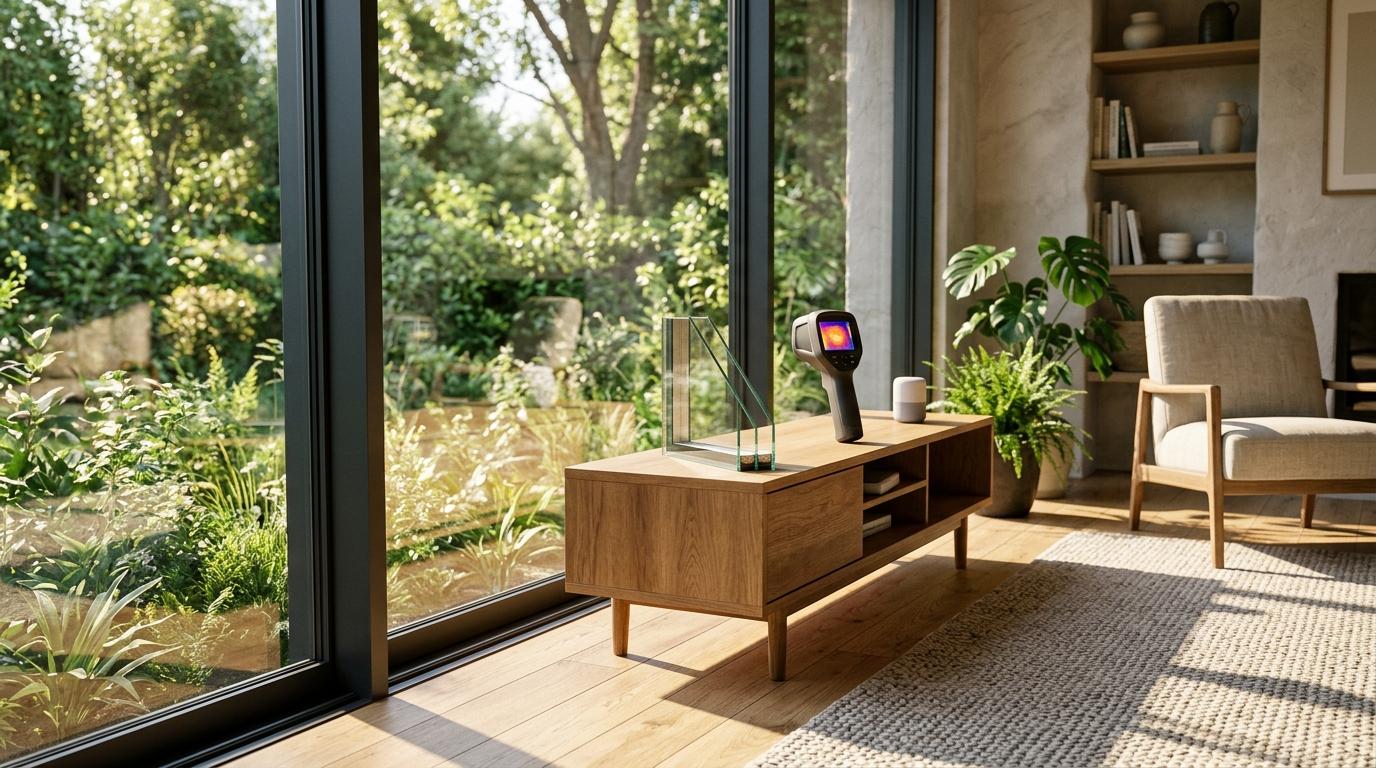
- Perimeter infrared thermometer scan: Using an inexpensive handheld infrared thermometer, scan the temperature across the center of the glass, the edge of the glass near the spacer, and the surrounding frame during a freezing winter day. A temperature difference of more than 15 degrees between the center of the glass and the room air indicates severe thermal conduction. If the edge of the glass is dramatically colder than the center, the unit has a conductive aluminum spacer.
- IGU seal failure examination: Inspect the cavity between the glass panes for permanent cloudiness, hazy white mineral streaks, or standing water droplets. If moisture exists inside the sealed cavity, the perimeter desiccant has saturated, the gas fill has escaped, and the IGU has failed. Failed IGUs do not require whole-frame replacement; a local glazier can fabricate and install a brand-new sealed double-pane glass pack directly into the existing sash for a fraction of the cost of a full window replacement.