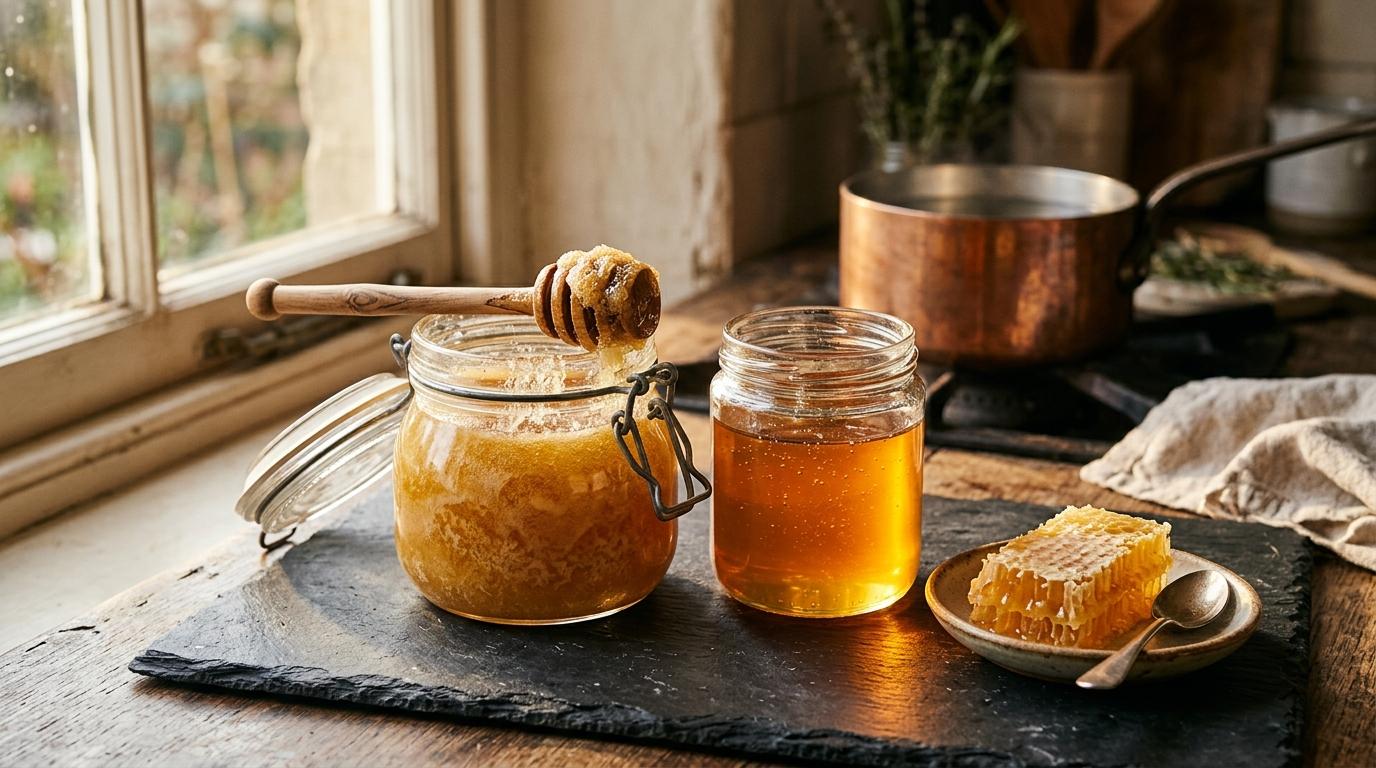
The Pantry Discovery: The Jar of Cloudy, Solid Honey
#Almost every household pantry harbors a glass jar of honey tucked behind tea tins or baking spices that has quietly transformed over time. What was once a translucent, free-flowing amber syrup has turned pale, opaque, thick, and gritty. For many home cooks, the first impulse is suspicion. In modern food culture, cloudiness, graininess, or solid white sediment usually signals mold, bacterial fermentation, or chemical degradation.
Consumers routinely throw away perfectly good jars of honey under the false impression that it has spoiled. Others assume that the crystallization is proof that they were cheated at the grocery store, believing that the manufacturer added cane sugar or corn syrup that crystallized out of the mixture.
Both assumptions are scientifically incorrect. Real, raw honey is one of the only biological food substances produced on Earth that essentially never spoils. Furthermore, crystallization is not an indicator of artificial adulteration; rather, it is one of the most reliable physical signatures of authentic, raw, unheated, high-quality bee honey.
To understand why honey lasts for centuries and why crystallization occurs as a natural physical phase change, one must examine the extraordinary biochemical machinery of the honeybee, the physical chemistry of supersaturated solutions, and the thermal parameters required to restore liquid clarity without destroying delicate enzymes.
The Ancient Food That Never Spoils: 3,000-Year-Old Egyptian Tomb Honey
#The legendary permanence of honey is not culinary folklore; it is a proven archaeological fact. When archaeologists excavated ancient Egyptian tombs, including the burial chambers of King Tutankhamun and elite New Kingdom officials, they discovered sealed clay pots and alabaster jars containing honey deposited more than 3,000 years ago as offerings to the afterlife.
When food scientists and entomologists sampled this millennia-old honey, they found it remarkably preserved. While the ancient honey had darkened considerably over thousands of years due to slow non-enzymatic Maillard reactions and had crystallized into a dense solid, it was microbiologically sound. It contained zero pathogenic bacteria, zero mold mycelia, and remained theoretically edible.
In nature, nearly all organic matter decomposes. When a fruit drops from a tree, bacteria and yeasts instantly attack its cellular structure, fermenting its carbohydrates into alcohol, vinegar, and carbon dioxide. Meat rots as putrefactive bacteria metabolize proteins into volatile amines. Dairy curdles as lactobacilli generate lactic acid.
Honey defies this universal biological law of decay. It does so because honey is not merely concentrated flower nectar; it is an engineered survival food created by honeybees (Apis mellifera) to sustain the hive through winters and droughts. To prevent their precious caloric hoard from fermenting in the warm, humid environment of a colony containing 50,000 living bees, the insects chemically and physically modify nectar into an environment hostile to all microbial life.
The 3 Antimicrobial Pillars of Honey: Low Moisture, Acidic pH, and Hydrogen Peroxide
#The indefinite shelf life of honey rests upon a tripartite biochemical defense network that makes bacterial and fungal survival physically impossible. If an airborne bacterial spore or wild yeast cell lands on the surface of raw honey, it cannot germinate, replicate, or survive.
1. Extreme Osmotic Pressure and Low Water Activity (The Dehydration Trap)
#Raw floral nectar begins as a watery solution containing roughly 70 to 80 percent moisture and 20 to 30 percent sugars. Forager bees carry this nectar back to the hive, where house bees regurgitate and swallow it repeatedly, mixing it with glandular secretions. The bees then deposit droplets into open honeycomb cells and vigorously fan their wings to circulate dry air across the comb.
Through this mechanical evaporation, the bees reduce the moisture content of the finished honey to between 14 and 18 percent. In food science, total moisture content is less critical than water activity ($a_w$), which measures the amount of unbound, free water molecules available for microbial metabolic reactions.
Pure water has a water activity of 1.00. Most pathogenic food bacteria (such as Staphylococcus aureus, Salmonella, and Escherichia coli) require a minimum water activity of 0.91 to multiply. Halophilic bacteria and xerophilic molds can survive down to 0.75 and 0.65 respectively.
Natural, ripe honey has a water activity between 0.50 and 0.60. At this microscopic level, honey functions like a biological sponge. It exerts immense osmotic pressure on any living cell that touches it. Because the concentration of dissolved solutes (sugars) outside the bacterial cell is vastly higher than the water inside the bacterium, water rushes out of the microbe through its cellular membrane via osmosis. The bacterial cell shrivels, dehydrates, and dies within hours.
2. Acidic pH and Gluconic Acid
#During the honey-making process, bees add an enzyme called glucose oxidase, secreted from their hypopharyngeal glands. In the presence of oxygen and water, glucose oxidase breaks down a fraction of the nectar's glucose into gluconic acid and hydrogen peroxide.
The accumulation of gluconic acid, along with minor amounts of citric, malic, and formic acids, drops the pH of honey into an intensely acidic range: typically between 3.4 and 4.5. For perspective, this is nearly as acidic as tomato juice or grapefruit juice. The vast majority of common food-spoilage bacteria thrive only in neutral pH environments between 6.5 and 7.5; the acidic bath of honey denatures bacterial transport proteins and halts cellular growth.
3. Endogenous Hydrogen Peroxide Production
#The second byproduct of the glucose oxidase reaction is hydrogen peroxide ($H_2O_2$), the exact same chemical compound found in medical antiseptic bottles. While hydrogen peroxide levels in undiluted honey are relatively low, they remain constantly present as an invisible chemical shield against oxidative degradation.
When honey is slightly diluted (for instance, on a cut or when consumed), the glucose oxidase enzyme awakens into higher activity, generating a continuous, low-concentration stream of antiseptic hydrogen peroxide that sterilizes the environment without damaging human cellular tissue.
| Antimicrobial Factor | Biochemical Mechanism | Measurement Threshold | Biological Effect on Microorganisms |
|---|---|---|---|
| Ultra-Low Water Activity | Osmotic pressure gradient draws water out of living cells. | aw value between 0.50 and 0.60 | Complete cellular dehydration and plasmolysis; prevents bacterial division. |
| High Gluconic Acid Concentration | Enzymatic conversion of glucose by bee hypopharyngeal secretions. | Acidic pH range between 3.4 and 4.5 | Inhibits neutral-pH bacterial reproduction; denatures outer cell wall proteins. |
| Endogenous Hydrogen Peroxide | Byproduct of glucose oxidase activity in the presence of oxygen. | Trace release (roughly 1 to 5 mg/kg) | Disrupts bacterial DNA and oxidizes cellular membranes upon dilution. |
The Physical Chemistry of Crystallization: Supersaturated Solutions and Glucose Monohydrate
#While honey possesses an indefinite biological shelf life, its physical appearance is dynamic. Crystallization is not a sign of expiration, nor is it a chemical spoilage reaction. It is a strictly physical phase change governed by the laws of thermodynamics and crystallization kinetics.
Chemically, honey is a supersaturated sugar solution. 
In nature, a given volume of water at room temperature can only dissolve a finite amount of solid sugar. If you stir cane sugar into a glass of room-temperature water, it dissolves until the liquid reaches saturation; any additional sugar settles at the bottom.
Honey defies this equilibrium. Through the thermal warmth of the bee hive (maintained at approximately 95°F / 35°C) and active enzymatic inversion, honeybees force roughly 70 to 80 percent total carbohydrates into less than 20 percent water. When honey cools to ordinary room temperature, the liquid contains far more dissolved sugar than water can physically hold in stable liquid suspension.
The primary sugars in honey are two simple monosaccharides:
- Fructose (Fruit Sugar): Accounts for roughly 35 to 45 percent of honey. Fructose is extraordinarily soluble in water and prefers to remain in a liquid, viscous syrup state.
- Glucose (Grape Sugar): Accounts for roughly 28 to 35 percent of honey. Glucose is substantially less soluble in water than fructose.
Because glucose cannot stay dissolved in this crowded water matrix, it precipitates out of solution. As glucose molecules fall out of the liquid phase, they capture one molecule of water for every molecule of glucose, forming solid crystalline structures known as glucose monohydrate ($C_6H_{12}O_6 \cdot H_2O$).
These glucose monohydrate crystals settle throughout the jar, forming a network of solid lattices. The fructose remains in liquid suspension in the microscopic spaces between the glucose crystals. As a result, the honey shifts from a clear liquid to a thick, semi-solid, spreadable consistency with a lighter, creamy color.
Fructose vs Glucose: Why Clover Honey Solidifies While Acacia Stays Liquid
#Not all honeys crystallize at the same rate. You may purchase a jar of pale clover honey that turns solid within four weeks, while an amber jar of acacia, chestnut, or tupelo honey sitting in the exact same pantry remains crystal-clear for over two years.
The speed of crystallization is dictated almost entirely by the fructose-to-glucose ratio (F/G ratio) and the glucose-to-water ratio (G/W ratio) of the specific flower nectar collected by the bees:
[CRYSTALLIZATION VELOCITY COMPARISON]

Rapid Crystallizing (High Glucose / F:G < 1.1)
  [ Canola / Rapeseed ] --------> Solidifies in 3 to 7 days
  [ Dandelion ] -----------------> Solidifies in 2 to 3 weeks
  [ Clover ] --------------------> Solidifies in 4 to 8 weeks

Slow Crystallizing (High Fructose / F:G > 1.3)
  [ Orange Blossom ] -----------> Remains liquid 6 to 12 months
  [ Chestnut ] ------------------> Remains liquid 1 to 2 years
  [ Acacia / Tupelo ] ----------> Remains liquid 2+ years without crystals
1. High-Glucose Honeys (Rapid Crystallization)
#When bees forage on plants such as oilseed rape (canola), dandelion, sunflower, or cotton, the resulting nectar is naturally high in glucose. When the F/G ratio drops below 1.11, or the G/W ratio exceeds 2.10, crystallization is inevitable and swift. Canola honey can crystallize inside the honeycomb frames before the beekeeper can even extract it, often solidifying within days of harvest into a fine, white, lard-like spread.
2. High-Fructose Honeys (Delayed Crystallization)
#When bees forage on black locust (acacia), sweet chestnut, tupelo, or sage, the nectar contains a massive excess of fructose compared to glucose. When the F/G ratio exceeds 1.30, and the G/W ratio remains below 1.70, the glucose molecules remain held in solution by the dominant, highly soluble fructose matrix. These honeys can sit undisturbed on a kitchen shelf for years without forming a single crystal.
Floral Sugar Composition Matrix:
#| Floral Nectar Source | Fructose Percentage | Glucose Percentage | Fructose-to-Glucose Ratio | Crystallization Tendency |
|---|---|---|---|---|
| Canola (Rapeseed) | 36 percent | 41 percent | 0.88 (Low) | Extreme: solidifies within 3 to 7 days into fine white paste. |
| Dandelion | 37 percent | 39 percent | 0.95 (Low) | Fast: forms dense crystals within 2 to 3 weeks of extraction. |
| Wildflower / Clover | 38 percent | 33 percent | 1.15 (Moderate) | Typical: develops granular crystals within 1 to 3 months. |
| Orange Blossom | 41 percent | 31 percent | 1.32 (High) | Slow: remains clear liquid for 6 to 12 months in pantry. |
| Acacia (Black Locust) | 44 percent | 27 percent | 1.63 (Very High) | Ultra-slow: remains liquid for 2 to 3 years without crystallization. |
| Tupelo | 45 percent | 26 percent | 1.73 (Highest) | Never: virtually immune to spontaneous room-temperature crystallization. |
Why Crystallization Proves Purity: Raw Unfiltered Honey vs Ultra-Filtered Syrup
#For a crystallization reaction to begin, it requires a nucleation point—a physical microscopic particle that acts as an anchor for the first glucose molecules to bond with. In chemistry, this is known as seed nucleation.
In authentic, raw, unfiltered honey, the jar is filled with millions of microscopic, natural nucleation sites:
- Microscopic pollen grains collected by the foraging bees.
- Tiny flecks of propolis (bee glue) and natural beeswax.
- Microscopic mineral salts and minute air bubbles whipped into the honey during extraction.
Each of these microscopic particles acts as a seed crystal. Once the first glucose molecule attaches to a pollen grain, neighboring glucose molecules lock into place, propagating a chain reaction of crystal growth throughout the entire volume of the jar.
Why Commercial Supermarket Honey Stays Liquid
#Mass-market honey sold in plastic bear squeeze bottles often stays liquid indefinitely. This is not because the bees made superior honey; it is because industrial packers process the honey to deliberately eliminate crystallization:
- High-Heat Pasteurization: Industrial honey is heated rapidly to 150°F to 170°F (65°C to 77°C). This high thermal energy melts all pre-existing microscopic seed crystals, resetting the crystallization clock.
- Ultra-Fine Pressure Filtration: The hot honey is forced through diatomaceous earth or microscopic mechanical filters under intense hydraulic pressure. This filtration removes all trace pollen grains, propolis flecks, and natural particulates.
Without seed nuclei to anchor onto, glucose molecules have tremendous difficulty initiating the crystallization lattice. However, this industrial treatment comes at a severe culinary and nutritional cost: high heat destroys raw honey's aromatic volatile floral esters, eliminates delicate antibacterial enzymes, and leaves behind a generic, flat, one-dimensional sweet syrup.
If your honey crystallizes, celebrate it: it is undeniable confirmation that your honey is genuinely raw, minimally processed, rich in natural pollen, and chemically pure.
The Thermal Decrystallization Bath: Why You Must Never Microwave Honey
#When you wish to return a jar of crystallized honey back to its smooth, pourable liquid state, the temptation is to grab the jar and microwave it for thirty seconds. 
In culinary science, microwaving honey is a catastrophic mistake.
Microwave ovens heat via dielectric heating, exciting polar water molecules unevenly throughout the food. Because honey contains very little water, microwaves create intense, uncontrolled localized "hot spots" where temperatures instantly soar past 160°F to 200°F (71°C to 93°C). 
This extreme, localized heat scorches the sugars, degrades the delicate floral aroma into a cooked, caramel-like flavor, and permanently denatures honey's beneficial bioactive enzymes. Furthermore, once microwaved honey cools, the remaining scorched sugar fragments serve as aggressive new nucleation sites, causing the honey to recrystallize faster and into coarser, harder crystals than before.
The Scientific Water Bath Method (Step-by-Step):
#To decrystallize honey while preserving 100 percent of its biological integrity and floral aromatics, you must use a gentle, indirect warm-water bath (a bain-marie):
- Loosen the Lid: Remove or slightly unscrew the lid of the glass honey jar to allow expanding air to vent safely.
- Prepare the Water Bath: Place a folded cloth or metal trivet at the bottom of a deep saucepan or heatproof bowl. (This prevents the bottom of the glass jar from making direct contact with the hot metal base of the pot, which creates hot spots).
- Set the Jar: Rest the glass honey jar on top of the trivet inside the pot.
- Add Warm Water: Pour hot tap water into the pot until the water level reaches roughly three-quarters of the height of the honey in the jar. Do not let water splash inside the honey.
- Control the Temperature: Monitor the water temperature with an instant-read kitchen thermometer. Keep the water strictly between 104°F and 110°F (40°C to 43°C). Never let the water exceed 115°F (46°C).
- Stir Periodically: As the outer layers of honey warm and liquefy, use a clean, dry stainless steel spoon or glass rod to stir the honey gently every ten minutes. Stirring distributes thermal energy evenly and breaks apart the remaining crystalline glucose lattices.
- Cool Slowly: Once all crystals have dissolved into transparent liquid, lift the jar out of the water, dry the outside with a towel, tighten the lid, and let it cool naturally on a wooden cutting board at room temperature.
Enzymes and Heat Damage: Invertase, Diastase, and Hydroxymethylfurfural (HMF)
#The reason professional beekeepers and food scientists insist upon keeping the decrystallization bath below 104°F to 110°F (40°C to 43°C) is tied to the preservation of honey's bioactive protein architecture.
Inside a working bee hive, the temperature of the brood comb is rigorously thermoregulated by the bees between 93°F and 95°F (34°C to 35°C). The enzymes added by the bees evolved to operate in this precise thermal window. Exposing honey to temperatures above 115°F (46°C) initiates rapid thermal denaturing:
1. Invertase
#Invertase is the primary enzyme responsible for splitting complex sucrose nectar into simple glucose and fructose. It is exceptionally heat-sensitive. Exposing honey to 120°F (49°C) for just two hours destroys more than 50 percent of its invertase activity, leaving the honey enzymatically inert.
2. Diastase (Amylase)
#Diastase breaks down complex starches into maltose. International food regulatory bodies, including the European Union and the international Codex Alimentarius, measure the Diastase Number (DN) as the primary legal indicator of honey freshness and authenticity. Honey that has been overheated or adulterated shows a severely depressed diastase number (below 8 DN), rendering it commercially substandard.
3. Hydroxymethylfurfural (HMF)
#When honey is subjected to heat, the acidic environment catalyzes the chemical dehydration of fructose into a cyclic organic compound called 5-hydroxymethylfurfural (HMF). 
In freshly harvested, unheated raw honey, HMF is virtually absent, typically measuring under 5 to 10 milligrams per kilogram. However, if honey is boiled, microwaved, or subjected to excessive heat, HMF concentrations skyrocket past 40 to 80 mg/kg. International export laws strictly prohibit the sale of table honey with HMF levels exceeding 40 mg/kg (or 80 mg/kg for tropical honey), as high HMF indicates thermal damage, loss of nutritional enzymes, and stale, aged inventory.
Optimal Pantry Storage: The 50°F to 59°F Crystallization Trap
#Preventing crystallization—or slowing its progress to a crawl—comes down to understanding how temperature governs crystal nucleation and crystal growth.
Many well-meaning consumers put their honey in the refrigerator to "keep it fresh."
The refrigerator is the absolute worst place to store honey.
In physical chemistry, crystallization requires two competing thermodynamic conditions:
- High supersaturation: Low temperatures increase the degree of supersaturation and drive molecules together.
- Molecular mobility: Sufficient kinetic movement (low viscosity) so glucose molecules can move through the liquid to attach to a crystal lattice.
When honey is stored in the refrigerator at 38°F (4°C), the extreme cold dramatically increases the honey's viscosity, turning it thick and sluggish. While the supersaturation is high, the glucose molecules cannot move easily through the dense syrup to form crystals.
However, the thermal zone between 50°F and 59°F (10°C to 15°C) is the dangerous sweet spot: the maximum crystallization velocity zone. 
In this temperature band—frequently found in unheated winter pantries, cool basements, or drafty garages—viscosity is low enough to permit rapid molecular migration, while temperature is cold enough to drive intense glucose precipitation. A jar of honey kept at 55°F will crystallize ten times faster than a jar kept at room temperature.
The Golden Storage Rules:
#- Maintain Stable Room Temperature: Store honey between 65°F and 75°F (18°C to 24°C). At warm room temperature, crystallization is suppressed because glucose solubility is naturally higher.
- Keep Airtight in Glass: Honey is hygroscopic—it aggressively absorbs ambient moisture from the air. If stored in an unsealed container in a humid kitchen, honey can absorb enough water vapor to push its moisture content above 19 percent, allowing wild osmophilic yeasts (Zygosaccharomyces) to trigger fermentation. Always screw the jar lid tightly shut.
- Freeze for Total Suspension: If you buy honey in bulk and want to keep it in a permanent, crystal-clear liquid state for years, pour it into freezer-safe containers and store it in a deep freezer below 0°F (-18°C). At sub-zero temperatures, molecular movement is completely frozen in place, halting all crystallization without damaging enzymes or altering flavor.
The Practical Kitchen Takeaway: Embracing Natural Crystallization
#Recognizing that honey crystallization is a natural physical phase change rather than biological decay transforms how you manage your pantry. Far from being spoiled or adulterated, a jar of crystallized honey is tangible confirmation of raw, unheated purity that retains its full spectrum of pollen grains, floral aromatics, and protective enzymes.
When crystallization occurs, you have two culinary choices:
- Enjoy the Spreadable Texture: Creamy crystallized honey spreads effortlessly across warm sourdough toast, scones, and roasted vegetables without running off the edges or making bread soggy. Many European cultures deliberately churn honey into finely crystallized creamed honey for this exact culinary benefit.
- Perform a Gentle Warm Water Bath: When liquid honey is needed for tea, glazes, or dressings, submerge the jar in warm water maintained strictly between 104°F and 110°F (40°C to 43°C). With gentle patience, the glucose crystals dissolve back into clear solution while every delicate floral ester and bioactive enzyme remains fully preserved.
By storing honey in airtight glass jars at room temperature and avoiding extreme temperature extremes, you can enjoy one of nature's only immortal foods indefinitely.