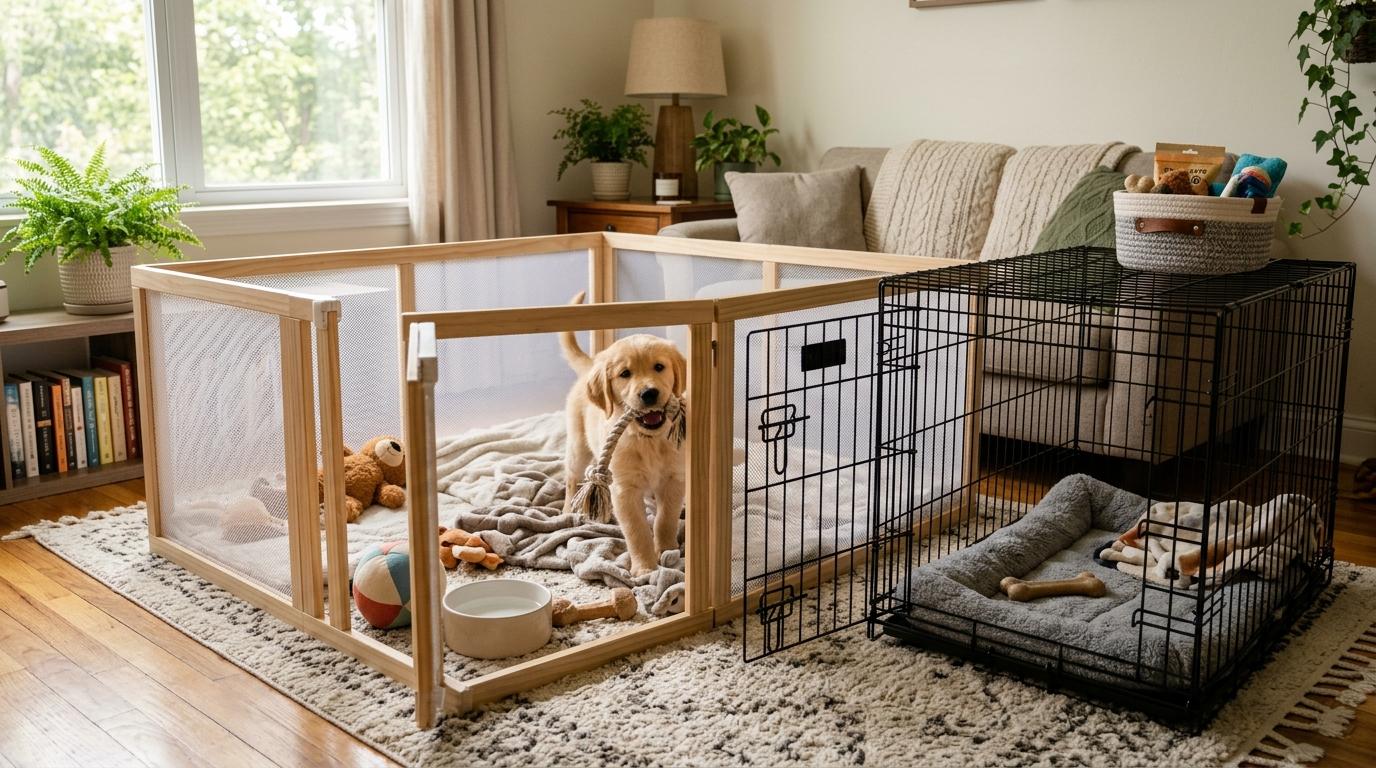
If you’re trying to choose between a dog crate and a puppy playpen, here’s the most honest answer: if you can manage it, get both.
Not because you need to buy every puppy product on the internet. You really don’t. But a crate and a playpen solve different problems, and together they can make those first few puppy weeks feel much less chaotic.
A crate is best for sleep, naps, quiet time, and potty training support. A playpen is better for daytime moments when your puppy is awake, curious, and absolutely ready to make terrible decisions the second you look away.
If you live in a small apartment and can only buy one right now, start with a crate.
Bringing a puppy home is lovely. It is also a bit like inviting a tiny, furry tornado into your house.
One moment they’re sleeping like an angel. The next, they’re chewing your slipper, licking the floor, climbing under furniture, biting a charger cable, or trying to drag a towel twice their size across the room.
So the real question is not just, “Should I buy a crate or a playpen?”
It’s more like:
“How do I keep this puppy safe, help them settle, and slowly teach them how to live in my home?”
That’s where crates and playpens can both help, as long as they’re introduced gently and never used as punishment.
Let’s break it down simply.
The Main Difference: Bedroom vs Living Room
#Think of a crate as your puppy’s bedroom.
It is small, calm, and meant mostly for sleep and rest. A properly sized crate gives your puppy a safe little place to switch off. It can also help with potty training because most puppies prefer not to pee or poop where they sleep.
A puppy playpen is more like a small living room.
It gives your puppy a bit more space to move around, chew a toy, stretch, look at you, and be part of the home without having access to every wire, shoe, curtain, dustbin, and chair leg in sight.
Neither one works like magic on day one. Your puppy still needs time, patience, toilet breaks, training, and plenty of reassurance. But used well, both can make life easier for you and safer for your puppy.
Crate vs Playpen Comparison Table
#When to Use a Crate
#Use a crate when your puppy needs rest, safety, or a clear sleep space.
A crate is especially useful for:
- Overnight sleep
- Short daytime naps
- Potty training routines
- Short periods when you cannot supervise
- Preventing chewing of wires, shoes, furniture, and unsafe household items
- Teaching your puppy how to settle calmly
Crate size matters a lot.
The crate should be big enough for your puppy to stand up, turn around, and lie down comfortably. But it should not be so big that your puppy can use one side as a toilet and the other side as a bed.
If your puppy will grow into a much larger dog, buy a crate with a divider panel. That lets you adjust the space as your puppy grows.
For warm homes, humid weather, or hot Indian summers, a wire crate is often more practical for daily home use than a closed plastic carrier. It gives better airflow and lets your puppy see what’s happening around them.
Place the crate somewhere your puppy still feels included. Near your bed, sofa, or work desk is usually better than a lonely corner far away from everyone.
Your puppy does not want to feel abandoned. They just need a safe little spot to rest.
When to Use a Playpen
#Use a puppy playpen when your puppy is awake and active, but you cannot give them your full attention every second.
A playpen is helpful when:
- You are working from home
- You are cooking
- You are cleaning
- You need to take a call
- Your puppy is in a bitey, restless mood
- You want your puppy nearby without giving them access to the whole house
This is where playpens are brilliant, especially in apartments.
Your puppy can see you, move around a little, play with safe toys, and stay away from things like cables, plants, bins, cleaning products, kitchen items, balcony doors, and furniture legs.
Choose the playpen carefully. Some puppies chew fabric. Some push lightweight panels around. Some climb like they are training for a prison break.
For many puppies, a sturdy metal playpen is safer and longer-lasting than a soft mesh one.
When to Use Both
#For most homes, the best answer is not crate or playpen.
It’s crate and playpen.
A simple puppy apartment setup can look like this:
- Crate as the sleep zone
- Playpen attached outside as the activity zone
- Water in a stable or clip-on bowl
- Safe chew toys inside
- Waterproof mat or washable flooring underneath
- Puppy-proofed space around the whole setup
During the day, you can leave the crate door open while your puppy is in the pen. This gives them a choice. They can nap inside the crate, then come out to stretch, chew, or watch you.
This setup works especially well if you live in a flat, have limited rooms, or cannot puppy-proof the whole house.
And honestly, most people cannot puppy-proof the whole house perfectly. Puppies find things you didn’t even know were there.
A pen-and-crate setup gives them some freedom without giving them the chance to eat your Wi-Fi cable.
When to Use Neither
#A crate or playpen should not become your puppy’s whole life.
Use neither when your puppy is:
- Playing with you
- Doing short training sessions
- Exploring a puppy-proofed room under supervision
- Meeting calm family members
- Getting safe, positive social experiences
- Relaxing near you while you can supervise
Your puppy still needs connection, play, training, cuddles if they enjoy them, toilet breaks, and time to learn about normal life.
They need to hear household sounds. They need to walk on different surfaces. They need to learn that people moving around, doors opening, utensils clanking, and the lift making noise are all part of everyday life.
The crate and playpen are tools.
Very useful tools, yes.
But they are not babysitters, even though every puppy parent has wished for one at some point.
Apartment Setup Checklist for a New Puppy
#Use this checklist to create a safe puppy zone in a small home.
- Wire crate with divider panelChoose one that can fit your dog’s adult size, then use the divider while your puppy is still small.
- Sturdy puppy playpenMetal is often better than fabric or mesh for puppies who chew, push, or climb.
- Waterproof floor protectionUse a washable mat under the playpen to protect tiles, wood, rugs, or rental flooring.
- Easy-clean beddingPick bedding you can wash often. In hot weather, some puppies may prefer a cool mat or even the plain crate tray.
- Safe chew toysKeep a few puppy-safe chew toys in rotation. Do not leave anything that can be shredded, swallowed, or broken apart.
- Spill-resistant water bowlA clip-on bowl can help reduce spills inside a crate or pen.
- No loose wires nearbyCheck phone chargers, Wi-Fi cables, lamp cords, extension boards, laptop chargers, and anything else that looks chewable.
- No access to balcony gaps or open doorsApartments need extra care around balconies, stairwells, windows, and lift areas.
- Keep cleaning products awayDo not store floor cleaners, phenyl, detergents, pest sprays, or bathroom products near the puppy zone.
- Place it where family life happensA puppy zone near your desk, sofa, or bedroom is usually better than isolating your puppy far away.
How to Make the Crate or Playpen Feel Safe
#One of the biggest mistakes new puppy parents make is using the crate only when things have already gone wrong.
The puppy is overtired. You are annoyed. A slipper has been destroyed. Someone has stepped in pee. Then the puppy gets put into the crate.
Now the crate starts to feel like punishment.
That’s not what we want.
Start before you desperately need it.
Try this instead:
- Let your puppy explore firstKeep the crate or playpen door open. Let your puppy sniff it, walk in, walk out, and investigate without pressure.
- Add good thingsPut meals, treats, or safe toys inside. Your puppy should start thinking, “Oh, nice things happen here.”
- Keep early sessions shortStart with just a few calm minutes. Build up slowly. There is no need to rush.
- Stay nearby at firstSit close while your puppy learns to settle. Once they are comfortable, slowly increase the distance.
- Use it when your puppy is calm tooDo not only use the crate or pen when your puppy is wild, naughty, or exhausted. Use it during calm moments as well.
- Pair it with toilet breaksFor potty training, take your puppy to the toilet area after naps, after meals, after play, and before longer rest times.
- Do not punish cryingA little complaining can happen at first. Panic is different. If your puppy is truly distressed, slow down and make the setup easier.
The goal is not to “make the puppy submit.”
The goal is to teach them:
This place is safe. You can relax here.
Safety Cautions Every Puppy Parent Should Know
#Never use the crate or playpen as punishment
#Do not shove your puppy into a crate because they chewed a slipper or had an accident.
That teaches fear, not manners.
The crate and playpen should mean rest, food, toys, calm, and safety. Not anger.
Avoid long confinement
#A young puppy cannot stay confined for long periods without toilet breaks, movement, play, and human contact.
Short, planned use is helpful.
Long, repeated confinement can create stress, frustration, and bad habits.
Remove collars and harnesses
#Before placing your puppy in a crate or playpen, remove collars, tags, and harnesses.
They can get caught on wires, panels, or gaps. It sounds unlikely until it happens, and then it can become dangerous very quickly.
Check the fit and structure
#Look for sharp edges, loose panels, broken wires, wide gaps, or unstable doors.
Puppies are unbelievably good at finding weak spots. It is almost impressive, if it weren’t so stressful.
Keep the space cool and ventilated
#In hot weather, humid homes, or Indian summers, be extra careful.
Do not place the crate or pen in direct sunlight, near a balcony door with harsh sun, beside heaters, or in a stuffy corner without airflow.
Do not leave unsafe chews inside
#If a toy can be torn apart or swallowed, do not leave it with an unsupervised puppy.
Choose durable, puppy-appropriate toys and check them often for damage.
Vet and Trainer Warning Signs
#A little whining during early crate or playpen training can be normal, especially when your puppy is new to your home.
But strong distress is different.
Speak with a vet or qualified trainer if your puppy shows:
- Repeated panic when placed in the crate or playpen
- Heavy panting when the room is not hot
- Excessive drooling
- Frantic biting or pawing at the bars
- Repeated escape attempts
- Toileting from fear or panic
- Refusing to enter even with food or gentle encouragement
- Sudden change in behavior around confinement
- Signs of injury from trying to get out
If your puppy panics, do not just leave them to “cry it out” for ages.
Make the setup easier. Shorten the time. Stay closer. Go slower. If it keeps happening, get professional help.
So, What Should You Buy First?
#Here is the practical answer.
Buy a crate first if:
#- You can only buy one item right now
- Potty training is your main concern
- You need a safe overnight sleep space
- Your apartment is very small
- You want something useful for travel or short stays
- Your puppy is chewing everything
Buy a playpen first if:
#- You are home most of the day
- You can supervise nearby
- Your puppy needs more daytime movement
- You have enough floor space
- You already have another safe sleep solution
- Your main issue is keeping your puppy away from wires, furniture, or kitchen activity
Buy both if:
#- You can afford both
- You have even a small corner for a puppy zone
- You want easier potty training and safer daytime management
- You work from home
- You live in an apartment and cannot puppy-proof the whole place
- You want your puppy to learn both rest and independent play
Use neither as your only plan if:
#- Your puppy is panicking in confinement
- You are using the crate as punishment
- Your puppy is being left too long
- The setup is unsafe
- Your puppy has a medical or behavioral issue that needs help
Final Takeaway
#For most new puppy parents, especially in apartments and small homes, the best setup is both: a crate for sleep and potty training support, plus a playpen for safe daytime movement.
If you can only buy one, choose the crate first. It helps with safe sleep, structure, and potty training.
Add a puppy playpen when you can.
Used kindly, crates and playpens do not replace your attention or your relationship with your puppy. They simply make puppyhood safer, calmer, and a lot more manageable for everyone at home.