If you’re trying to figure out how to stop cat scratching furniture, here’s the honest answer: you don’t stop the scratching itself. You give your cat a better place to do it, and make the sofa less exciting.
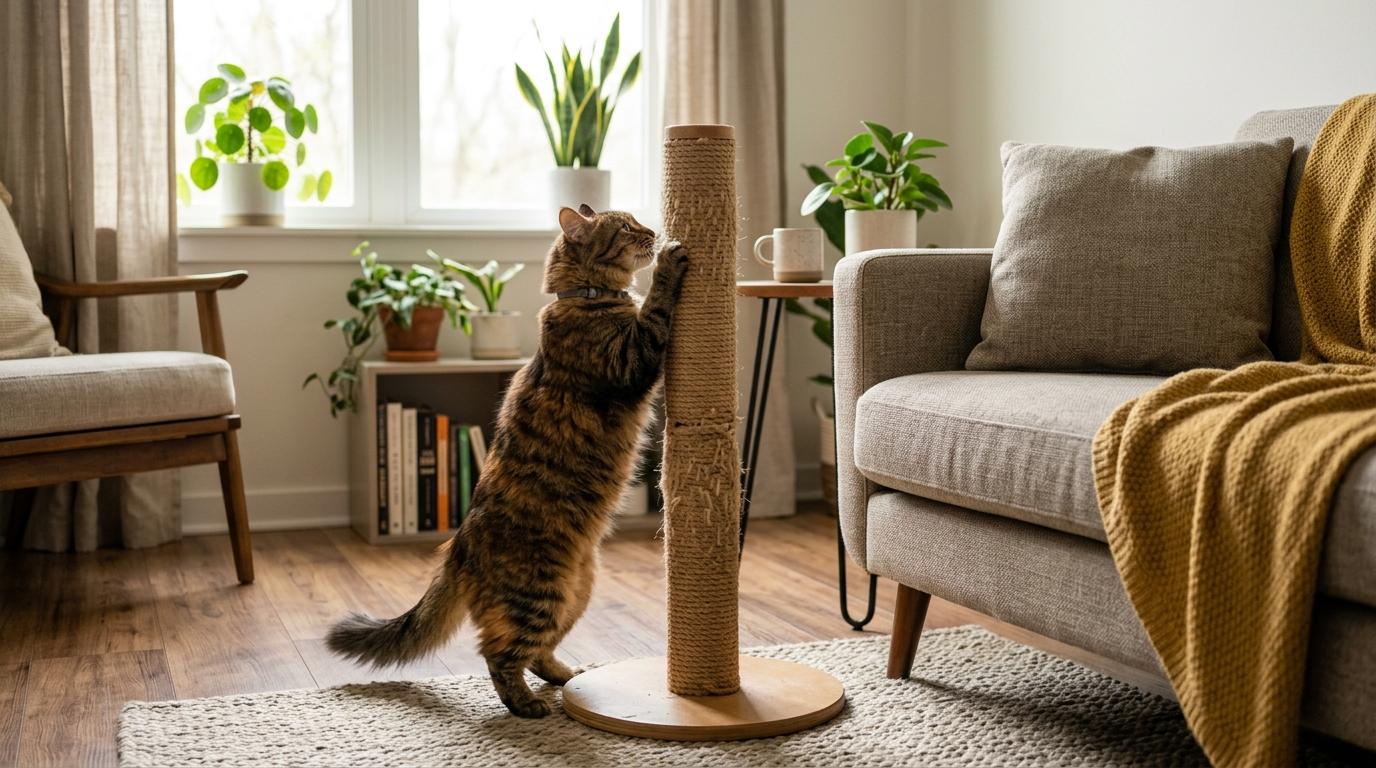
Start simple. Put a sturdy cat scratching post right next to the sofa arm, chair corner, or mattress edge your cat keeps attacking. Then protect that spot with a safe cat scratch deterrent, like pet-safe double-sided tape, a fitted sofa cover, or a tightly tucked throw. Every time your cat uses the scratcher, even for one tiny scratch, reward them.
Because your cat is not trying to ruin your furniture out of spite. Scratching is normal cat behaviour. The trick is to redirect it in a way that makes sense to your cat.
Why cats scratch furniture
#Cats scratch because they are cats. It’s not revenge. It’s not attitude. It’s not “bad manners”. Veterinary and animal behaviour sources such as the ASPCA, Cornell, AAFP-AAHA feline care guidance and PetMD describe scratching as a natural feline behaviour.
When your cat scratches the sofa, they may be stretching, keeping claws healthy, marking territory, releasing energy or choosing the best available texture. Sofas are stable, tall, textured and placed where people spend time, so they can look like perfect scratching stations.
The humane rule: redirect it
#You cannot train a cat to never scratch. Scratching is a need. What you can teach is where to scratch.
Give them a better “yes”: a sturdy scratching surface, the right height or angle, a texture they enjoy, placement near the problem area and rewards when they use it.
Make the old spot a gentle “no”: pet-safe double-sided tape, a sofa cover, a washable throw, a smooth temporary barrier or short-term blocking if practical.
Avoid punishment. Yelling, hitting, chasing or spraying water may scare your cat and damage your bond. Also, declawing should never be used as a furniture-saving shortcut.
Step 1: Watch how your cat scratches
#Before buying a random post, observe your cat for two or three days. Do they scratch vertically, like sofa arms or walls? Horizontally, like rugs or mattress edges? Do they prefer fabric, cardboard, rope, jute, sisal or carpet-like textures? Do they scratch after waking, when you come home, or near windows and doors?
This tells you what kind of scratcher your cat is most likely to use.
Step 2: Choose the right scratching post
#A good scratcher should be stable, tall or long enough for a proper stretch, textured enough for claws to grip, placed where your cat already scratches and easy to access.
If your cat scratches sofa arms or walls, try a tall vertical post. If your cat scratches rugs or mattress edges, a flat cardboard scratcher or mat-style scratcher may work better. Many cats benefit from one vertical and one horizontal option.
Scratcher comparison table for apartments
#Step 3: Put the scratcher beside the problem spot
#Place the new scratcher exactly where the scratching is happening. If your cat scratches the left arm of the sofa, place the scratcher right next to that sofa arm.
Not across the room. Not on the balcony. Not behind the bedroom door. Right there.
Once your cat uses it regularly, you can slowly move it a few centimetres at a time toward a better final location.
Step 4: Make the sofa less rewarding
#Use humane options such as pet-safe double-sided tape, a fitted sofa cover, a washable throw tucked firmly around the scratched area, a smooth temporary barrier, or short-term access blocking.
Avoid strong scent sprays, harsh homemade mixtures and essential oils. Cats have sensitive noses, and some substances can be unsafe. Physical barriers are usually simpler and safer.
Step 5: Reward the behaviour you want
#When your cat uses the scratcher, reward them immediately. Use a small treat, gentle praise, a short play session or strokes if your cat enjoys touch.
Do not force your cat’s paws onto the scratcher. Instead, make the scratcher interesting with a wand toy nearby, a little catnip or silvervine if your cat responds to it, and placement near nap spots.
14-day retraining checklist
#Days 1 to 3: Observe and set up
#- Watch where your cat scratches most often.
- Notice whether they scratch vertically or horizontally.
- Notice the texture they prefer.
- Get a scratcher that matches your cat’s style.
- Place the scratcher right beside the damaged furniture.
- Make sure the scratcher is stable and does not wobble.
- Stay calm. No shouting, chasing or scolding.
Days 4 to 6: Add a gentle deterrent
#- Cover the scratched sofa area with pet-safe double-sided tape, a fitted cover or a temporary barrier.
- Keep the scratcher beside the covered spot.
- Add catnip or silvervine if your cat likes it.
- Reward any interest in the scratcher.
- If your cat returns to the sofa, calmly redirect with a toy.
Days 7 to 9: Build the new habit
#- Play with a wand toy near the scratcher once or twice a day.
- Reward every use of the post, mat or cardboard scratcher.
- Keep the deterrent on the sofa.
- Add a second scratcher if your cat scratches in more than one place.
- Place a scratcher near a favourite sleeping spot.
Days 10 to 12: Reduce sofa interest
#- Continue rewarding scratcher use.
- Keep the sofa covered or taped.
- If your cat ignores one scratcher, try a different angle or texture.
- Check whether the post is too short, too light or too far from the problem area.
- Add daily play for indoor cat enrichment.
Days 13 to 14: Adjust placement slowly
#- If your cat uses the scratcher daily, move it only a little if needed.
- Shift it a few centimetres at a time toward the final location.
- Do not suddenly move it to another room.
- Keep one scratcher near the sofa if that is still your cat’s main social area.
- Continue rewards, then slowly reduce treats and use praise or play.
What if your cat still scratches the furniture?
#If your cat is still choosing the sofa, something about the setup may need adjusting. The scratcher may be too small, too wobbly, the wrong texture or in the wrong place. Your cat may also need more enrichment or more than one scratching option.
A bored indoor cat may scratch more. Add short play sessions, safe window watching, puzzle feeding, climbing space and regular interaction.
Apartment-friendly indoor cat enrichment ideas
#Try a daily wand toy session, a cardboard scratcher near a window, a cat tree if you have space, a stable perch near a safely screened window, toy rotation, food puzzles, a cosy sleeping spot away from household noise and two scratching options.
If you open windows or balconies, make sure they are securely screened or netted. Cats can fall even if they are usually careful.
What not to do
#Do not yell, hit, chase or spray water. Do not force your cat’s paws onto the scratcher. Do not hide the scratcher far from the problem area. Do not use harsh chemicals or strong essential oils. Do not expect one tiny post to replace a large sofa. Do not remove every scratching option.
Veterinary and safety note
#Scratching is normal. But a sudden change in behaviour can sometimes mean something else is going on.
Speak with a veterinarian if your cat suddenly scratches much more than usual, seems stressed, hides often, limps, overgrooms, shows signs of pain, stops using the litter box, or has any other sudden behaviour change.
This article is for general behaviour guidance only. It does not diagnose or treat medical problems.