Quick answer: For many Indian homes with regular municipal water, sediment and carbon filters usually need replacement every 9 to 12 months. An RO membrane often lasts around 18 to 24 months, sometimes longer if the input water is not too hard or dirty. But if your home uses borewell water, tanker water, or gets muddy water during monsoon, you may need to check things earlier.
The best approach is simple: don’t go only by the service date. Watch the TDS reading, taste, smell, water flow and tank filling time.
Safety disclaimer
#This guide is meant for general home maintenance and drinking water awareness. It is not a substitute for professional water testing, medical advice, or local public health instructions.
If you suspect sewage mixing, chemical contamination, flooding-related contamination, repeated stomach infections, or any serious water quality issue, contact your local authorities or a qualified water testing professional.
If any filter or purifier claims NSF certification or another third-party certification, don’t rely only on a sticker. Try to verify the claim using the product details or manufacturer information.
Quick RO filter replacement schedule for Indian homes
#Use this table as a starting point, not as a strict rule. Your actual water purifier filter change schedule depends on your input water quality, TDS, dust, pipe condition, family usage, monsoon water quality and how regularly the purifier is maintained.
If your home uses high-TDS borewell water, tanker water, dusty supply, or your purifier is used heavily every day, stay closer to the shorter replacement range.
If you have cleaner municipal water and your TDS, taste and flow stay stable, some parts may last longer.
First, understand what each RO filter actually does
#A water purifier is not one magical box that does everything at once. It is a chain of different stages. Each stage has a specific job, and each one shows different signs when it needs attention.
1. Sediment filter: the dirt catcher
#The sediment filter is usually the first stage. In many Indian homes, it sits outside the purifier in a transparent or white pre-filter bowl.
It catches physical impurities like sand, mud, rust particles, silt and pipe dirt. This filter protects the rest of the purifier. If it gets clogged, the RO pump and membrane have to work harder. That can reduce performance and may also increase service issues later.
When to check it: Look at it every few months. Check it more often during monsoon, after pipeline repair, or after a water supply interruption.
Signs it may need replacement:
- The filter has turned dark brown or black
- Water flow has reduced
- The cartridge looks slimy
- Tap water has recently looked muddy
- The purifier takes much longer to fill the tank
A little discolouration is normal. But if the filter looks muddy, choked or slimy, don’t ignore it.
2. Carbon filter: the taste and smell stage
#Carbon filters are usually used before and/or after the RO membrane.
A pre-carbon filter helps reduce chlorine and odour before water reaches the RO membrane. This matters because chlorine can damage many RO membranes over time.
A post-carbon filter improves the final taste of purified water.
Signs your carbon filter may be exhausted:
- Water smells like chlorine
- Water tastes flat or stale
- There is a musty aftertaste
- The taste suddenly changes, even though TDS looks normal
- Water has an odd smell after sitting in the tank
Don’t judge a carbon filter only by how it looks from outside. It may look fine, but the carbon inside may have already lost much of its ability to absorb smell and taste-causing compounds.
3. RO membrane: the expensive part you should not replace blindly
#The RO membrane is the main part responsible for reducing dissolved salts. This is the stage that has the biggest impact on TDS reduction.
It is also one of the costlier parts of the purifier. So don’t replace it only because someone says, “Membrane weak ho gaya hai.” Ask for evidence.
A better way is to track:
- Input TDS: tap water before purification
- Output TDS: purified water after RO
- Water flow rate
- Taste changes
- Tank filling time
Possible signs that the RO membrane needs replacement:
- Output TDS rises sharply compared to your usual reading
- Purified water starts tasting very different
- Tank filling becomes very slow, even after sediment and carbon filters are checked
- Technician inspection shows heavy scaling or clogging
- Rejection water and purified water performance has clearly changed
A membrane may fail faster with high-TDS borewell water, hard water or poor pre-filtration. It can last longer with cleaner municipal supply and timely pre-filter replacement.
4. UV lamp: the part that can glow and still need checking
#A UV lamp water purifier stage uses ultraviolet light as part of the disinfection process. In many RO+UV purifiers, this stage works after filtration.
Here is the tricky part: a UV lamp may still show visible light, but its effective UV intensity can reduce over time. So don’t depend only on “blue light aa raha hai, so it is fine.”
Check the UV stage if:
- The purifier shows a UV error or alarm
- The recommended service period is complete
- The lamp is not glowing
- The purifier has been unused for a long time
- There was a recent contamination event nearby
- Water smell or hygiene concerns have increased
UV systems also need proper flow and reasonably clear water to work well. If the water is muddy or highly turbid, upstream filtration becomes very important.
5. UF membrane: useful, but not the same as RO
#UF means ultrafiltration. A UF membrane physically blocks larger particles and some microorganisms, depending on its design and rating.
But UF does not reduce dissolved salts like an RO membrane.
So UF can be useful in low-TDS water situations, but it will not solve high TDS water problems.
Signs to check UF:
- Weak flow
- Repeated clogging
- Slime or biofilm concerns
- Stale smell from stored water
- Storage tank hygiene issues
Some UF systems allow cleaning or backwashing. But don’t assume every UF membrane can be safely cleaned at home. Follow the purifier manual or ask a trained technician.
TDS and taste checks: the simple habit that helps the most
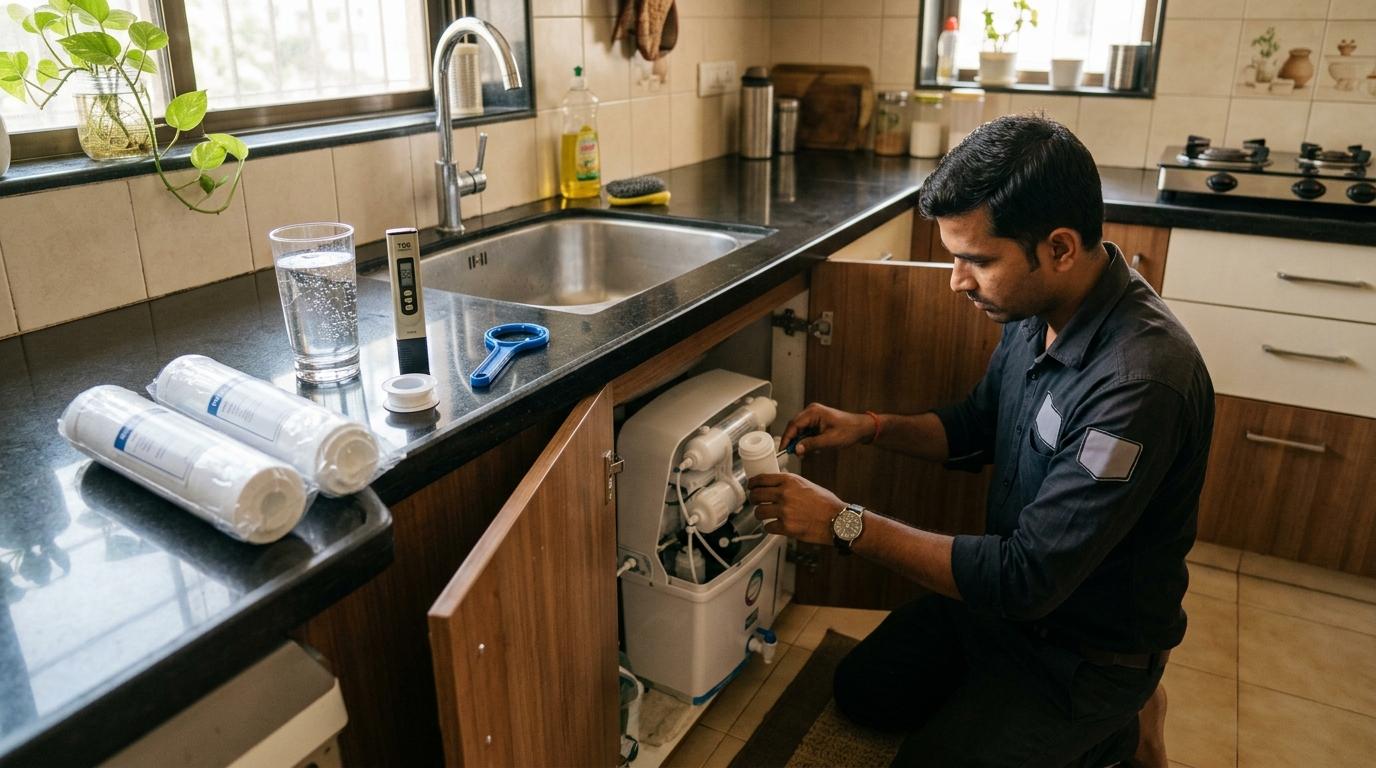
#A TDS meter is one of the most useful tools for RO owners. It does not test everything, and it is not a replacement for lab testing. But it gives you a basic idea of whether your RO membrane is doing its main job.
How to use a TDS meter at home
#Once a month, check:
- Tap water TDS, before purification
- RO water TDS, after purification
- Taste and smell, from the glass you actually drink
- Tank filling speed, compared with what is normal for your home
Save the readings on your phone. Nothing fancy is needed. Just note the date, input TDS, output TDS and any taste or flow issue.
Over time, your own home readings become more useful than a generic service reminder.
For example, if your output TDS is usually stable and suddenly rises a lot, that is a stronger warning sign than simply saying, “The membrane is two years old.”
What TDS cannot tell you
#A TDS meter does not confirm that water is free from bacteria, viruses, pesticides, sewage contamination, or every harmful chemical. It mainly measures dissolved solids.
So if water smells foul, looks dirty, or you suspect sewage mixing, don’t rely only on TDS. Get proper help.
Taste and smell still matter
#Taste is not a scientific test, but it is a useful early warning.
Watch for chlorine smell, earthy or musty taste, sour or stale taste, bitter taste, sudden metallic taste, or water that tastes different from your usual purified water.
If taste changes suddenly, check the carbon filter, storage tank hygiene, UV stage and RO output TDS.
Monsoon and Indian apartment realities
#Water quality in Indian homes can change a lot. Even in the same city, one building may get municipal water, another may depend on borewell water, and many apartments use a mix of municipal, borewell and tanker water.
During monsoon, extra caution helps because water supply can be affected by:
- Muddy inflow
- Pipeline disturbance
- Higher humidity
- Dirty overhead or underground storage tanks
- Local flooding
- Sewage mixing risks in affected areas
This does not mean you need panic servicing every month. It simply means you should watch your purifier more closely when the water quality changes.
Good monsoon habits:
- Look at the sediment filter more often
- Clean the external filter bowl if it is dirty
- Check for smell from stored water
- Do not ignore slow flow
- Empty and clean the storage tank during service
- Call qualified help if water contamination seems serious
Should you service your RO every 3 months?
#Not always.
A routine inspection can be useful, especially in high-use homes. But changing all filters every three months is not automatically required for every Indian apartment.
You may need earlier service if:
- Your water is high-TDS borewell water
- The sediment filter clogs quickly
- A large family uses the purifier daily
- Water smells or tastes different
- The tank fills slowly
- There has been flooding, pipeline repair or suspected contamination
- The purifier was unused for a long time
You may not need full replacement if:
- Output TDS is stable
- Taste is normal
- Flow is normal
- Sediment filter is not heavily clogged
- There are no UV errors
- The purifier was serviced properly recently
The sensible middle path is this: inspect regularly, replace parts when there are clear signs, and don’t approve random part changes without readings or explanation.
Water purifier service checklist for Indian homes
#Use this checklist when a technician visits. It keeps the discussion practical and helps you avoid unnecessary upsells.
Before the technician opens the purifier
#- Ask for input TDS and output TDS readings.
- Note both readings on your phone.
- Tell the technician about taste, smell or flow issues.
- Mention whether your building uses municipal water, borewell water, tanker water or mixed supply.
- Ask which exact part they recommend replacing and why.
During inspection
#- Check the sediment filter condition yourself.
- Ask whether carbon filter replacement is based on age, taste, smell or service schedule.
- Do not approve RO membrane replacement without a TDS or flow-related reason.
- Check if the UV lamp has an alarm, indicator or completed service period.
- Ask whether the UF membrane is clogged or serviceable, if your purifier has UF.
- Confirm that the storage tank will be cleaned or sanitized as part of service.
Before accepting new parts
#- Ask for sealed cartridges or properly packed parts.
- Check product labels and compatibility.
- Prefer documented parts from the purifier brand or a reliable equivalent.
- Look for NSF certification or equivalent certification where performance claims are made.
- Do not accept loose, dirty or unlabelled cartridges.
Before the technician leaves
#- Run the purifier and check for leaks.
- Check tank filling sound and flow.
- Recheck output TDS after service.
- Taste the water after flushing, as advised by the technician.
- Ask what was changed and what was only cleaned.
- Keep the bill or service note.
Safe DIY: what you can and should not do
#Some small checks are fine for homeowners. Others should be left to trained service people.
Usually safe for residents
#- Looking at the external sediment filter
- Checking TDS with a meter
- Noting taste and smell changes
- Checking for visible leaks
- Cleaning the outside of the purifier
- Keeping the purifier area dry and ventilated
- Asking questions during service
Avoid unsafe DIY
#Do not open electrical UV parts, pump wiring or sealed purifier internals unless you are trained.
Do not wash and reuse carbon blocks or RO membranes. Do not bypass filters to “increase flow.” Do not use unknown chemicals inside the storage tank.
If water quality is seriously doubtful, especially after flooding or sewage mixing, stop guessing and get professional help.
How to avoid unnecessary service upsells
#A good technician will explain the problem clearly. A poor one may try to replace every part because “it is time.”
Watch for these red flags:
- They refuse to show TDS readings
- They say all filters must be changed without inspection
- They push RO membrane replacement even when output TDS and flow are normal
- They install loose filters without packaging
- They ignore tank cleaning
- They create fear without explaining the issue
- They cannot tell you which stage does what
Ask calm, direct questions:
- “What is the input TDS?”
- “What is the output TDS?”
- “Which filter is clogged?”
- “Is the membrane failing or only the sediment filter?”
- “Is the UV lamp due, or is there an error?”
- “Can you show me the old part?”
- “Is this cartridge sealed and compatible?”
You are not being difficult. You are simply maintaining a drinking water appliance your family uses every day.
Simple home record format
#Keep a small note on your phone like this:
After a few months, patterns become clear.
You will know if your sediment filter clogs every 6 months. You will notice if your carbon filter affects taste around a certain time. You will also know whether your RO membrane is stable or slowly getting weaker.
That is much better than relying only on a fixed service calendar.
Final takeaway
#A sensible RO filter replacement schedule is not about changing every part on a fixed date.
It is about knowing what each filter does, watching your water, and asking for basic evidence before approving replacements.
For everyday Indian homes, start with this rhythm: check sediment and carbon regularly, track TDS monthly, watch taste and smell, inspect UV and UF stages during service, and keep a simple record.
This small habit can save money, reduce unnecessary service upsells, and help you take better care of the drinking water your family uses every day.