Your cat is not being moody, aloof, or simply getting old. In the feline world, showing physical pain is a luxury that wild ancestors could not afford, which is why your domestic cat will suffer in complete silence while acting like nothing is wrong.
Dogs usually let you know when they hurt: they whimper, limp noticeably, or seek constant comfort. Cats do the opposite. A cat in moderate to severe chronic pain will quietly withdraw to a quiet corner, sleep in a guarded hunch, and silently tolerate joint inflammation or dental agony for months before their human realizes anything is amiss.
Learning to spot feline discomfort before a condition becomes an emergency is one of the most important skills a pet parent can develop. By watching five subtle facial changes on the Feline Grimace Scale, decoding daily mobility shifts, and understanding why purring does not always mean happiness, you can catch pain early and get your cat the relief they deserve.
The Bottom Line on Feline Pain
#Domestic cats retain the instinctual wiring of small wild felids. In the wild, an animal that vocalizes distress or limps openly invites rival predators to attack and signals weakness to other cats competing for territory. 
Because of this predator-prey paradox, cats mask physical distress until their coping mechanisms completely break down. 
When a cat stops jumping onto the bed, stops grooming their lower back, or urinates just outside the litter box, they are almost never being stubborn. These are quiet distress signals. Decoding these subtle changes early allows you to manage conditions like osteoarthritis, dental disease, or urinary inflammation with veterinary care before irreversible damage occurs.
The Evolutionary Paradox: Both Predator and Prey
#To understand why your indoor house cat hides pain, you have to look at their evolutionary biology. 
Larger predators like wolves and big cats sit firmly at the top of the food chain. If a wolf sprains a paw, they can afford to limp while resting with their pack. But the ancestor of our domestic cats—the African wildcat (Felis lybica)—is a solitary middle-tier predator. 
Middle-tier predators hunt small rodents and birds, but they are also actively hunted by larger carnivores like leopards, hyenas, and birds of prey. In that harsh ecological niche, showing vulnerability is fatal. If a solitary wildcat limps or cries out:
- Competitors will aggressively drive them out of their hunting territory.
- Larger predators will target them as easy prey.
- Small prey animals will easily detect them, leading to starvation.
Millions of years of natural selection hard-coded a single rule into feline genetics: hide every sign of weakness at all costs. Your domestic cat lounging on your rug still runs on that exact survival firmware. They do not understand that your living room is safe from predators. Their brain simply tells them that showing pain is dangerous.
The Feline Grimace Scale: 5 Facial Action Units
#For decades, veterinarians struggled to objectively evaluate pain in cats because traditional canine pain scales failed completely on felines. 
That changed with the development of the Feline Grimace Scale (FGS), a clinically validated tool developed by veterinary researchers at the University of Montreal. The scale evaluates five distinct facial action units (FAUs) that involuntary muscle contractions trigger when a cat experiences pain.
Observing your cat for thirty seconds from a distance while they are undisturbed reveals these five subtle facial markers.
| Facial Feature | Normal / Pain-Free (Score 0) | Moderate Discomfort (Score 1) | Severe Pain (Score 2) |
|---|---|---|---|
| Ear Position | Ears facing forward, erect and alert | Ears slightly pulled apart and rotated back | Ears flattened downward and rotated outward |
| Orbital Tightening | Eyes wide open, round, and clear | Eyes partially closed or squinting slightly | Eyes tightly squinted or completely shut |
| Muzzle Tension | Muzzle relaxed, round, and soft | Muzzle slightly tense, oval-shaped | Muzzle drawn back, tense, and flattened |
| Whisker Position | Whiskers loose, curved down naturally | Whiskers slightly curved or moving forward | Whiskers straight, stiff, and splayed outward |
| Head Position | Head held high above the shoulder line | Head aligned level with the shoulders | Head carried low, tucked down toward chest |
1. Ear Position
#A relaxed, content cat carries their ears facing forward and upright, tracking room sounds with gentle twitches. When a cat feels pain, the muscles at the base of the skull tense up. The ears rotate outward toward the sides of the head (often called airplane ears) and flatten backward against the crown.
2. Orbital Tightening
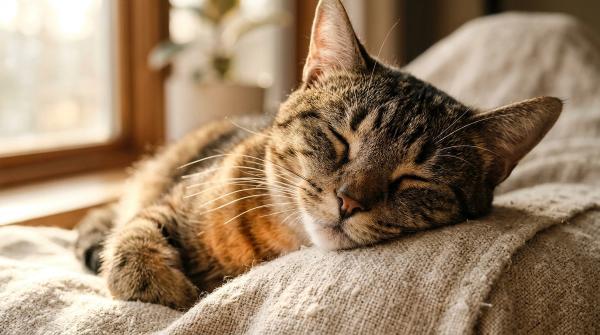
#In a pain-free cat, the eyes are open, round, and bright. When pain registers in the central nervous system, involuntary facial grimace muscles cause the eyelids to narrow. The cat develops a heavy-lidded, squinty gaze. Many owners mistake this squint for sleepiness, but a sleeping cat relaxes their face completely, whereas a cat squinting from pain maintains rigid muscle tension around the brow.
3. Muzzle Tension
#Check the fleshy pads where your cat's whiskers emerge. In a relaxed cat, these pads are round, full, and soft. In a cat experiencing pain, the muzzle contracts and flattens against the jawline, creating an elliptical, taut appearance across the upper lip.
4. Whisker Position
#Relaxed whiskers cascade down in a loose, gentle curve away from the cheeks. Under pain, the facial nerves pull the whisker follicles tight. The whiskers become straight and stiff, pointing forward like tiny antennae rather than resting softly against the face.
5. Head Position
#A comfortable cat rests with their head held naturally above the plane of their shoulders, observing their territory. A cat in distress carries their head low, tucked down between their front shoulder blades, often hovering an inch above the floor.
If you score your cat across these five features—giving 0 for normal, 1 for moderate, and 2 for severe—a total score of 4 or higher out of 10 indicates that your cat is experiencing significant pain and requires prompt veterinary evaluation.
Postural Clues: The "Meatloaf" vs the Guarded Hunch
#Every cat owner knows the classic "meatloaf" resting position: paws neatly tucked under the chest, tail wrapped snugly around the body, chin resting comfortably, looking like an unbaked loaf of bread.
A comfortable meatloaf is relaxed. The back curves smoothly, the muscles along the spine are loose, and the cat can easily roll onto their side for a stretch.
A guarded pain hunch, however, looks completely different once you train your eye to see it:
- The spine is arched unnaturally high and rigid.
- The paws are not tucked flat; instead, the cat balances rigidly on their front paw pads, keeping their weight lifted off their painful belly or chest.
- The elbows are held flared outward away from the ribcage to relieve pressure on tender abdominal organs or aching elbow joints.
- The head hangs heavily downward, with eyes half-shut.
- The tail is clamped tightly against the flank or tucked underneath the belly.
If your cat sits in this rigid, tense posture for hours at a time rather than sprawling out on their side, they are actively guarding an aching joint or inflamed internal organ.
Daily Routine Changes That Signal Discomfort
#Because facial expressions can be subtle, day-to-day behavioral routines provide the clearest evidence of chronic pain. Cats are creature-of-habit animals; any uncharacteristic break in their normal schedule warrants investigation.
1. The Broken Jump: Reluctance to Leap
#Cats are natural vertical climbers. When feline osteoarthritis develops—affecting over 90% of cats over the age of twelve—the first sign is not a limp. It is hesitation before jumping.
Watch your cat approach their favorite sofa, bed, or window ledge. A pain-free cat bounds upward in a single fluid motion. A cat with joint pain will:
- Stop, crouch, and look back and forth between the floor and the ledge multiple times, calculating the impact.
- Seek out intermediate stepping stones (like a low stool or wastebasket) to break a single leap into two smaller hops.
- Hesitate even more when jumping down. Landing puts immense compressive shock on arthritic front elbows and carpal joints.
- Choose to sleep on lower surfaces (like the rug or an open bottom shelf) rather than their customary high perch.
2. Grooming Extremes: Over-Licking vs Unkempt Matting
#Grooming is both a hygiene necessity and a self-soothing ritual for felines. Pain alters grooming in two opposite directions:
- Targeted Over-Grooming (Barbering): If a cat experiences localized joint pain or bladder inflammation, they will lick that specific area compulsively until the fur is stripped bare. A cat with feline lower urinary tract disease (FLUTD) will often lick the hair off their lower abdomen and inner thighs. A cat with hip arthritis will repeatedly chew at their lower spine or hip joints.
- Neglected Grooming (The Greasy, Matted Coat): Grooming the hindquarters, base of the tail, and lower spine requires serious spinal flexibility. When spinal spondylosis or arthritis sets in, twisting around to clean the back becomes excruciating. The coat along the lower back becomes dull, greasy, and develops dense clumps of matted hair, accompanied by heavy dandruff.
Litter Box Hesitation: Pain Mistaken for Bad Behavior
#One of the most tragic misunderstandings between humans and cats occurs around the litter box. When a previously well-trained cat starts urinating on the bathroom rug, bed, or laundry pile, frustrated owners often assume the cat is acting out in spite.
Cats do not act out of spite. Inappropriate elimination is almost always a physical pain response:
- High-Sided Litter Boxes: Stepping over a six-inch plastic rim requires an arthritic cat to put their entire body weight onto one painful rear leg while swinging the other over the wall. Getting into the box hurts.
- Unstable Litter Substrate: Deep, loose clay litter shifts underfoot like dry beach sand. For a cat with unstable joints or hip dysplasia, balancing on shifting gravel while squatting is unstable and painful.
- Negative Association: If a cat experiences sharp burning pain while urinating—such as from urinary crystals, bacterial cystitis, or bladder stones—they associate that sharp pain with the physical box itself. They seek out soft, cool, flat surfaces (like bath mats or tile floors) hoping the new location will not hurt.
If your cat begins eliminating outside the litter box, the very first step is never punishment or behavioral training. The first step is a veterinary urinalysis and joint check.
The Purring Paradox: Why Distressed Cats Still Purr
#One of the greatest myths in pet care is that a purring cat is always a happy cat.
Cats purr when they are happy, nursing, or receiving gentle chin scratches. But veterinary professionals know that cats also purr intensely when they are in severe pain, giving birth, or dying in an emergency room.
Purring is not just a social communication signal; it is a self-soothing vibrational therapy mechanism. 
Feline purring frequencies sit predominantly between 25 and 150 Hertz. In biomedical acoustics research, sound frequencies in this exact range have been shown to stimulate bone density regeneration, relieve muscle spasms, ease breathing distress, and release endorphins that act as natural painkillers. 
When a cat is injured or experiencing acute systemic distress, their brain activates the laryngeal oscillator to vibrate their diaphragm and vocal cords. It is the feline equivalent of a human taking slow, deep, meditative breaths or rocking back and forth to endure severe physical trauma. 
If your cat is purring loudly while hunched in a tight ball, refusing food, or showing flattened ears, do not assume they are content. They may be purring to survive the pain.
Common Hidden Pain Culprits in Cats
#When cats experience chronic, low-grade discomfort, it typically stems from three major medical conditions:
- Feline Osteoarthritis (Degenerative Joint Disease): Extremely prevalent in cats over eight years old. It primarily attacks the elbows, hips, and lumbosacral spine. Because cats distribute their weight evenly across four paws, they rarely limp in a single leg unless a bone is fractured. Instead, they become quiet, sleep more, and stop jumping.
- Feline Tooth Resorption (FORL): Unlike human cavities, which start on the enamel crown, feline resorption starts at the root, dissolving the tooth from the inside out and exposing hypersensitive nerve pulp. Cats will continue to swallow food whole because hunger overpowers pain, but they will chew on one side, drop kibble pieces, or drool excessively.
- Feline Lower Urinary Tract Disease (FLUTD): Sterile cystitis and bladder inflammation cause agonizing cramping and burning. In male cats, urinary blockages can turn fatal within 24 to 48 hours.
When to Call the Vet vs Emergency Red Flags
#Feline discomfort requires different response timelines depending on the severity of the symptoms.
Emergency Signs (Go to an Emergency Vet Immediately):
#- Straining in the litter box without producing urine (especially in male cats; this is a life-threatening blockage).
- Open-mouth breathing, panting, or labored abdominal heaving while resting.
- Sudden dragging or paralysis of one or both rear legs (often signals an aortic thromboembolism or saddle thrombus).
- Inability to stand, collapsing, or complete unresponsiveness.
- Howling or shrieking while touching the abdomen.
Non-Emergency Signs (Schedule an Appointment Within 48 Hours):
#- Scoring 4 or higher on the Feline Grimace Scale.
- Consistent hesitation or failure to jump onto everyday surfaces.
- Licking a specific patch of fur down to raw pink skin.
- Neglected grooming and matted fur along the lower back.
- Urinating outside the litter box while still producing normal urine volumes.
- Unexplained irritability, hissing, or swiping when pet in the lower back or hip area.
The Verdict
#Cats do not complain, whine, or demand sympathy when they hurt. Their evolutionary programming commands them to suffer silently behind a calm, guarded face.
As cat parents, our responsibility is to look past that stoic poker face. Check their ear angles, watch their eyes, notice how easily they hop onto the bed, and listen to the quiet behavioral clues they leave behind. By catching feline pain early, you can work with your veterinarian to restore their comfort, mobility, and happiness for years to come.