If you’re trying to choose between a dog nail grinder vs clipper, start with a grinder if you’re a beginner. Clippers are quick and useful, but a grinder removes nail slowly, gives more control, and is usually less intimidating when you’re still learning how far is safe to trim.
Nail trimming seems simple until your dog wiggles, the tool feels awkward, and you remember there’s a sensitive part inside the nail that you really do not want to hit. This guide keeps the choice practical: what to buy first, how to use it calmly, and when to stop and ask a groomer or veterinarian for help.
Why Your Dog’s Nail Length Matters
#Long nails are not just a flooring problem, although your floors, sheets, sofa and bare legs may strongly disagree.
When a dog’s nails get too long, they can touch the ground with every step. Over time, that can affect how your dog places their paws and may make walking uncomfortable. Some dogs start shifting their weight or changing their posture, and it is easy to miss at first.
This can be especially common for apartment dogs. If your dog mostly walks on smooth floors, tile, laminate, marble, or short outdoor potty walks, their nails may not wear down much on their own. Dogs who walk often on rough pavement may get some natural filing, but many still need regular nail checks.
Nail care is also a good chance to notice what is normal for your dog. You may spot a cracked nail, swelling, tenderness, or a nail that is starting to curl before it becomes a bigger problem.
You are not trying to become your dog’s veterinarian. You are just getting familiar with their paws.
Dog Nail Grinder vs Clipper: What’s the Difference?
#Both tools can work well. The best choice depends on your dog’s nails, your confidence level, and how your dog feels about noise, vibration and having their feet handled.
Dog Nail Clippers
#Dog nail clippers cut the nail in one snip. They usually come in scissor-style or plier-style designs and are made to handle the curved shape of a dog’s nail.
Clippers can be great for:
- Fast trims
- Thick nails
- Overgrown nails that need length removed
- Dogs who hate buzzing or vibration
- Pet parents who already feel confident trimming nails
Where clippers can be tricky:
- One snip can take off too much
- The cut edge may be sharp
- The sudden clip can startle some dogs
- They require steady positioning
- It is easier to hit the quick if you misjudge the cut
Clippers are not the enemy. They are just less forgiving when you are still learning.
Dog Nail Grinders
#A dog nail grinder files the nail down little by little using a small rotating head. Instead of cutting the nail in one motion, you slowly smooth and shorten it.
Grinders are helpful for:
- Beginners who want more control
- Smoothing sharp nail edges
- Slowly shortening nails over time
- Black dog nails, where the quick is harder to see
- Nervous pet parents who are scared of cutting too far
- Regular at-home dog grooming
Where grinders can be tricky:
- The sound may worry some dogs
- The vibration can feel strange at first
- Grinding takes longer than clipping
- The nail can get warm if you hold the grinder in one spot
- It creates a bit of nail dust
For many new dog parents, a grinder simply feels less scary. You can touch the nail for a second or two, stop, reward your dog, and try again later.
Quick Comparison: Grinder vs Clipper vs Using Both
#What Should New Dog Parents Buy First?
#For most beginners, buy a dog nail grinder first.
A grinder gives you time to learn. You can figure out your dog’s nail shape, how they react to paw handling, and what feels comfortable for you. You can also stop after one nail and still call it a win.
Buy clippers first only if:
- Your dog has very thick or very long nails
- Your dog is calm about paw handling
- You have already been shown how to trim safely
- Your dog is truly frightened by grinder noise
- A groomer, vet, or vet tech recommends clippers for your dog
Long term, many dog parents use both. Clippers remove a tiny bit of length, and the grinder smooths the edge afterward.
The Quick: The Part You Need to Avoid
#The biggest thing to understand before trimming dog nails is the quick.
The quick is the living part inside the nail. It contains nerves and blood vessels. If you cut into it, it hurts and can bleed quite a lot. It can also make your dog much more nervous about nail trims in the future.
If Your Dog Has White or Clear Nails
#On lighter nails, the quick is usually easier to see. It often looks like a pink area inside the nail.
Trim only the tip and stay well away from the pink part. If you are unsure, take less. You can always do another tiny trim later.
If Your Dog Has Black Nails
#Black dog nails are harder because you usually cannot see the quick from the outside.
For black nails:
- Take off very small amounts
- Check the nail surface often
- Stop if you see a darker, fleshy-looking center
- Do not guess at a big cut
- Be extra careful if the nails are overgrown
This is one reason grinders are popular with beginners. They let you work slowly instead of making one big cut and hoping for the best.
If you are nervous, book a quick demonstration with a groomer, veterinarian, or veterinary technician.
A Gentle First Nail-Trim Routine
#Your first goal is not perfect nails. Your first goal is to teach your dog: “This is safe, it’s short, and treats happen.”
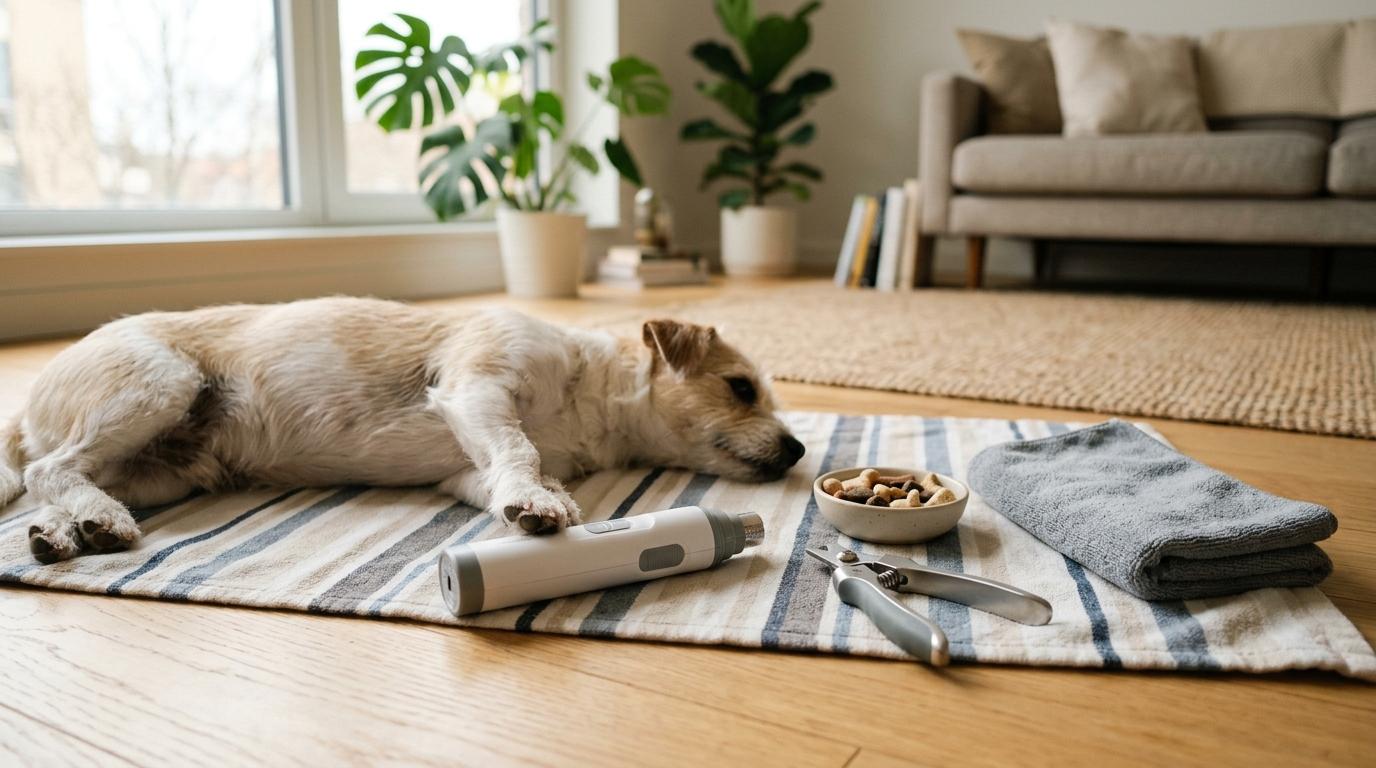
If you live in an apartment, choose a quiet time. Put your dog on a towel, rug, or yoga mat so they do not slip around on smooth floors. Have treats ready before you start.
Step 1: Touch the Paws Without Any Tools
#For a few days, practice simple paw handling when your dog is relaxed.
- Touch one paw gently.
- Praise calmly.
- Give a small treat.
- Let go.
Do not grab, squeeze, or chase your dog around with the tool in your hand. You want paw handling to feel boring and safe.
Step 2: Introduce the Tool Slowly
#Let your dog sniff the grinder or clippers while they are not being used.
If you are using a grinder:
- Show it while it is turned off.
- Reward calm curiosity.
- Turn it on at a distance for a second or two.
- Reward again.
- Turn it off.
Some dogs accept the sound right away. Others need several short sessions.
Step 3: Touch the Nail, Then Stop
#Before you actually trim, practice bringing the tool near the nail.
With a grinder, touch the nail for just a second or two, then lift it away. With clippers, place them near the nail without cutting.
Reward your dog and stop while things are still calm.
Step 4: Trim One Nail
#For the first real trim, do one nail.
If using clippers:
- Clip only the very tip
- Avoid big cuts
- Stay far away from the quick
- Stop if you feel unsure
If using a grinder:
- Grind for a second or two at a time
- Pause often
- Do not hold it in one spot
- Watch your dog’s body language
- Stop before your dog gets annoyed or scared
Then end the session.
Step 5: Build From There
#Over time, you can move from one nail to a few nails, then maybe one paw, and eventually all paws if your dog is comfortable.
Some dogs never love doing all their nails in one sitting. That is okay. Two nails today and two nails tomorrow is still a routine.
How to Know When to Stop
#Stop the session if your dog shows strong stress signals, such as:
- Pulling away again and again
- Freezing
- Trembling
- Growling
- Snapping
- Twisting or thrashing
- Trying hard to escape
- Heavy panting when they are not hot
- Refusing treats they normally love
Do not punish these signals. Your dog is communicating. They are telling you the session is too much.
Take a break. Go back to simple paw handling. Try again another day. Or ask a professional for help.
When to Call a Vet or Groomer
#At-home dog grooming is useful, but it is not always the right choice for every situation.
Call a groomer or veterinarian if:
- You are trimming for the first time and want a demonstration
- Your dog panics, growls, snaps, or thrashes
- The nails are very overgrown
- A nail is curling toward or into the paw pad
- You cannot tell where it is safe to trim
- You cut the quick and bleeding is heavy or will not stop
- A nail looks split, infected, injured, or unusual
- Your dog seems painful around the paw
- You are too nervous to continue safely
A groomer can help with routine trims. A veterinarian is the better choice for pain, swelling, embedded nails, injuries, heavy bleeding, or anything that looks medically concerning.
This guide is for general grooming education only. It does not replace advice from your veterinarian.
Beginner Buying Checklist
#When you are buying your first nail tool, do not get distracted by fancy features. You need something that fits your hand, suits your dog’s nail size, and feels easy to control.
If You’re Buying a Grinder
#Look for a grinder with:
- A pet-specific design
- A comfortable grip
- A noise level you can tolerate
- A grinding head that fits your dog’s nail size
- Simple speed settings, if available
- Easy cleaning instructions
- A guard or guide, if that helps you feel more confident
A quieter grinder can be helpful for nervous dogs and apartment living. Just remember that quiet does not mean no introduction needed.
If You’re Buying Clippers
#Look for clippers that are:
- Made for pets
- Sharp and sturdy
- Comfortable in your hand
- The right size for your dog
- Easy to position around the nail
- Not too bulky for small paws
Avoid using human nail clippers on dogs. Human nails are flatter, while dog nails are curved and thicker. A pet-specific tool is a safer choice.
Dull clippers can crush or split the nail instead of cutting cleanly. If your clippers feel like they are squeezing more than cutting, it is time to replace them.
Apartment Tips for Calmer Nail Care
#Apartment life can make nail care a little more interesting. You may have slippery floors, close neighbors, limited space, and a dog whose nails do not wear down much indoors.
A few small changes can help:
- Use a towel, rug, or yoga mat for traction
- Pick a quiet time of day
- Keep grinder sessions short if sound carries
- Trim when your dog is already calm
- Avoid nail trims during zoomies
- Have treats ready before you start
- Use good lighting, especially for black nails
- Do not start when you are rushed
- Sit in a position that feels natural for both of you
If your dog is small, you may be tempted to hold them tightly in your lap. Some dogs are fine with that. Others panic. If your dog struggles, try changing the setup instead of holding harder.
Final Verdict: Grinder, Clipper, or Both?
#If you are a new dog parent, especially if you are doing nail care in an apartment, start with a dog nail grinder. It is slower, but that is part of what makes it beginner-friendly. You can work little by little, smooth sharp edges, and stop before your dog feels overwhelmed.
Choose clippers if your dog has thick nails, if grinder noise is a major issue, or if a professional has shown you how to use them safely.
Use both once you are more comfortable: clip a tiny amount, then grind the edge smooth.
The best tool is not just the one that shortens the nail. It is the one you can use calmly, safely and regularly.