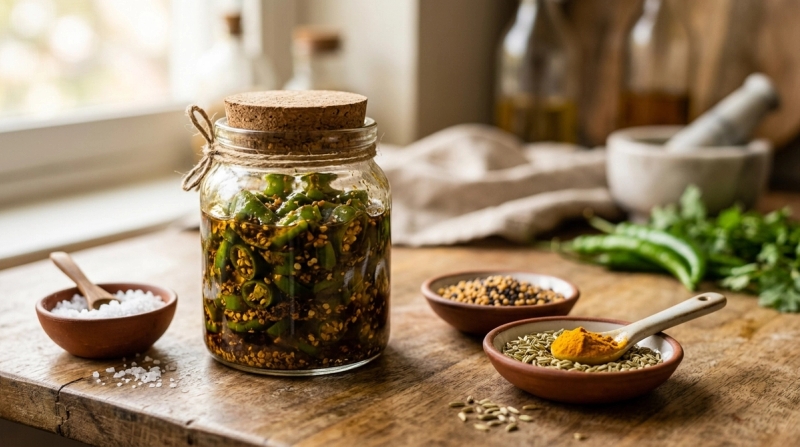
A good green chilli pickle does not sit quietly on the side of the plate. It wakes everything up.
One small piece with dal-chawal, curd rice, paratha, khichdi, or even plain roti-sabzi, and suddenly the whole meal feels sharper, warmer, and more alive. It is salty, spicy, a little sour, and full of that unmistakable mustard oil aroma.
But homemade green chilli achar needs some care. Green chillies are moist, and moisture is exactly what can make a pickle spoil if the salt, oil, acid, and cleanliness are not right. One damp spoon, one wet jar, or a few chilli pieces sitting above the oil can ruin the whole batch.
So this is not a “throw everything in a jar and forget it” pickle. It is still easy, but it asks for a little attention.
The goal is simple: help the good fermentation along, and make life difficult for mold and spoilage bacteria.
Why Green Chilli Pickle Needs Extra Care
#Green chillies are not like dry mango pieces or sun-dried ingredients. They hold a lot of moisture inside them.
That moisture is useful because salt pulls it out and helps form a salty brine around the chillies. But if the pickle is not handled properly, the same moisture can encourage spoilage.
A safer homemade chilli pickle depends on several things working together:
- Salt
- Acid
- Mustard oil
- Dry ingredients
- Clean handling
- Regular checking
- Time
Salt draws out moisture and helps control unwanted microbes. Vinegar or lemon juice adds acidity. Mustard oil creates a protective layer and gives the pickle its strong, classic flavour. Dry jars and dry spoons keep extra water out.
If you skip one of these steps, the pickle becomes much more likely to spoil.
For a wider look at Indian fermentation, you can also read allblogs’ guide on how to make fermented Indian pickles, chutneys and achar.
Equipment You Need
#Before you begin, make sure everything is clean and dry. Not just clean. Dry.
You will need:
- 1 clean glass jar or ceramic bharani with a tight-fitting lid
- Clean kitchen towels
- A large dry mixing bowl
- A dry wooden or stainless steel spoon
- A small pan for heating mustard oil
- A tray for drying the chillies
- Optional: clean muslin cloth and rubber band for the first few days
Do not use a damp jar. Do not use a spoon that was just rinsed. Do not assume a quick wipe is enough if the jar still feels humid or smells musty.
With pickle, dryness matters.
Salt, Brine, Oil and Acid Safety Rules
#Before making the pickle, it helps to understand the basic safety rules. These are what keep the batch stable.
1. Use Enough Salt
#For this fermented green chilli pickle, use salt equal to about 10% of the chilli weight.
That means:
- 250 grams green chillies
- 25 grams salt
Salt is not there only for taste. It pulls moisture out of the chillies and helps create the brine. It also makes it harder for unwanted microbes to grow.
Do not reduce the salt heavily and expect the same result. A low-salt pickle needs a different method and different safety controls.
2. Let the Brine Form
#When salt is mixed with chillies, it draws out their natural moisture. That salty liquid becomes part of the pickle environment.
This Indian-style chilli pickle will not look like a jar of cucumber pickles swimming in brine. You may only see some salty moisture mixing with the spices, vinegar, and oil. That is normal.
The important thing is that the chillies are salted properly and protected by acid and oil.
3. Use Mustard Oil as a Protective Layer
#Mustard oil is important in many Indian pickles. It adds flavour, but it also forms a protective layer over the ingredients.
Still, oil is not magic. It only helps when the chillies stay below the surface.
Any chilli piece sticking out into the air can grow mold.
Heat the mustard oil until it reaches smoking point, then let it cool completely before adding it to the pickle. This reduces the harsh raw smell and also helps drive off any possible moisture.
4. Add Acid Early
#Vinegar or lemon juice gives the pickle a sour start. This is useful in the early days, before the pickle has fully matured.
For this recipe, do not skip the acid.
5. Keep Water Out
#Extra water is one of the biggest reasons homemade chilli achar spoils.
The chillies must be washed and then dried properly. The jar must be dry. The spoon must be dry every time you use it.
This is especially important during monsoon or in a humid kitchen.
Monsoon and Humidity Cautions
#Making pickle during the rainy season is possible, but it needs extra care.
During monsoon, the air is damp, jars take longer to dry, chillies can hold hidden moisture, and sunlight may be unreliable. This increases the risk of mold.
If you are making fermented green chilli pickle during monsoon, be strict.
Follow These Monsoon Rules
#- Dry the washed chillies with a clean towel.
- Spread them on a tray and keep them under a fan until fully dry.
- Remove the stems only after drying.
- Slit the chillies only after they are dry.
- Use a fully dry jar.
- Avoid making a large batch if your kitchen is very humid.
- Check the oil level daily for the first few days.
- Never use a wet spoon.
- If the pickle looks or smells doubtful, discard it.
For more rainy-season pickle care, read allblogs’ guide on safe homemade pickle in monsoon and preventing fungus.
Step-by-Step Method: Fermented Green Chilli Pickle
#Step 1: Wash and Dry the Chillies
#Wash 250 grams green chillies well.
Now dry them properly. First, wipe them with a clean kitchen towel. Then spread them on a tray and leave them under a fan for a few hours, or until there is no visible moisture.
Do not rush this step. It is one of the most important safety steps in the whole recipe.
Once the chillies are completely dry, remove the stems. Then slit each chilli lengthwise without cutting it into two separate pieces.
Step 2: Heat and Cool the Mustard Oil
#Pour mustard oil into a small pan.
Heat it until it reaches smoking point. Turn off the heat and let the oil cool completely to room temperature.
Do not pour hot oil over the chillies and spices for this recipe. Let it cool first.
Step 3: Make the Spice Mix
#In a completely dry bowl, add:
- Coarsely ground mustard seeds
- Coarsely ground fennel seeds
- Coarsely ground fenugreek seeds
- Turmeric powder
- Amchoor
- Hing
- Salt
Mix everything well.
Add 2 tablespoons vinegar and 2 tablespoons of the cooled mustard oil. Stir until you get a thick, grainy spice paste.
Step 4: Coat the Chillies
#Add the slit green chillies to the spice paste.
Gently rub the masala into the slits and over the chillies. You do not have to stuff every chilli perfectly, but each one should get a good coating.
If some masala remains in the bowl, do not throw it away. It will go into the jar too.
Step 5: Pack the Jar
#Transfer the coated chillies into your clean, dry jar.
Pack them down gently to reduce large air gaps. Do not crush them.
Scrape any remaining spice paste from the bowl into the jar.
Step 6: Add Mustard Oil
#Pour the cooled mustard oil over the chillies.
The chillies must be covered by the oil. If they are not fully covered, heat and cool more mustard oil, then add it.
This is where many homemade pickles go wrong. If chilli pieces keep floating above the oil, they are exposed to air and can spoil.
Step 7: Start Fermentation
#For the first few days, cover the jar with clean muslin cloth and secure it with a rubber band, or close the lid loosely.
Keep the jar in a sunny window or a bright, warm place for 3 to 5 days. If sunlight is weak, keep it in a clean, dry, warm kitchen spot.
Do not keep the jar near the sink, near stove splashes, or on a damp window ledge.
Step 8: Check Daily
#Once a day, open the jar and check the pickle.
Use a clean, completely dry spoon to press the chillies back under the oil.
The smell should be sharp, salty, mustardy, spicy, and slightly tangy. It should not smell rotten or unpleasant.
After a few days, the chillies will lose their bright green colour. They may turn olive-green, dull green, or yellowish-green. That is normal.
Step 9: Move to Storage
#After about 5 to 7 days, the pickle should taste more settled and mature.
Once you are happy with the flavour, close the jar properly and move it to a cool, dark cupboard or refrigerate it.
Refrigeration slows down fermentation and helps the pickle keep its texture and flavour for longer.
There is no fixed guaranteed shelf life for a homemade fermented pickle. It depends on salt, oil coverage, cleanliness, handling, room temperature, and humidity.
What Is Normal During Fermentation?
#Some changes are expected. Do not worry if you notice these.
Normal Signs
#- Chillies change from bright green to dull green, olive-green, or yellowish-green.
- The spice mix settles at the bottom.
- The oil becomes yellow-orange from turmeric and spices.
- The aroma becomes salty, sour, mustardy, and spicy.
- The chillies soften slightly but still have some bite.
These are usually signs that the pickle is maturing well.
Spoilage Signs and Discard Rules
#This is the most important part of making homemade pickle.
If you are unsure, throw it out.
Discard the Pickle If You See Fuzzy Mold
#Throw away the whole jar if you see fuzzy growth on the surface, on the chillies, or around the inside of the jar.
Mold may look:
- White and fuzzy
- Green
- Blue
- Black
- Pink
Do not scrape off the top and eat the rest. With a home pickle, that is not a safe risk to take.
Discard If It Smells Rotten
#A good fermented chilli pickle should smell sharp, salty, spicy, sour, and mustardy.
Discard it if it smells:
- Rotten
- Putrid
- Like garbage
- Strongly unpleasant
- Badly yeasty
- Alcoholic in a spoiled way
Do not taste a pickle that smells wrong.
Discard If the Chillies Turn Slimy or Mushy
#The chillies will soften with time. That is normal.
But they should not become slimy, slippery, stringy, or mushy. If they collapse into a rotten-looking mass, discard the batch.
Discard If There Is Pressure, Leaking, or Bad Smell
#Some fermentation activity can happen, but if the jar builds pressure, leaks, and smells unpleasant, treat it as unsafe.
Open carefully if needed, but do not taste it.
Be Careful With White Film
#Sometimes fermented foods develop a thin, flat white film. It may be yeast, but home cooks can easily confuse yeast with mold.
For this green chilli pickle, follow the safer rule: if you see unexpected growth and cannot confidently identify it, discard the jar.
Serving Tips
#Fermented green chilli pickle is strong, so you only need a little.
Serve it with:
- Dal-chawal
- Curd rice
- Stuffed parathas
- Thepla
- Khichdi
- Poha
- Upma
- Roti-sabzi
- Simple rice and ghee
You can also use a little of the spiced mustard oil to flavour dal, sabzi, or dry potato dishes. Use it like a condiment, not like regular cooking oil.
Storage Tips for Chilli Achar
#Good storage habits make a big difference.
- Always use a clean, dry spoon.
- Push the chillies back under the oil after serving.
- Keep the rim of the jar clean.
- Close the lid after every use.
- Store the jar away from steam, sink water, and wet counters.
- Refrigerate if your kitchen is hot or humid.
- Do not mix old pickle leftovers into a fresh batch.
- Do not add fresh chillies later unless you are starting a proper new batch.
If the oil level drops, heat a little more mustard oil until smoking point, cool it completely, and add enough to cover the chillies again.
Common Mistakes to Avoid
#Using Damp Chillies
#This is one of the easiest ways to spoil a pickle. Wash the chillies, then dry them fully before cutting or salting.
Cutting Before Drying
#If you slit the chillies before drying them, water can sit inside the cuts. Dry first, then remove stems and slit.
Reducing the Salt Too Much
#Salt is not optional here. It is one of the main safety barriers. Do not reduce it heavily in this recipe.
Not Adding Enough Oil
#The chillies need to stay under the mustard oil. If they sit above the oil, mold risk increases.
Using a Wet Spoon
#One wet spoon can spoil a jar. Keep a dedicated dry spoon for pickle if needed.
Making a Big Batch in Humid Weather
#If you are new to fermented chilli pickle, start small. This is especially important during monsoon.
Final Safety Note
#Fermented green chilli pickle is simple, but it is not careless cooking.
The rules are clear: use dry chillies, a dry jar, enough salt, some acid, proper mustard oil coverage, and a clean dry spoon every time.
Do that, and your chilli achar has a much better chance of becoming exactly what you want: sharp, spicy, tangy, salty, mustardy, and perfect with a simple home-cooked meal.