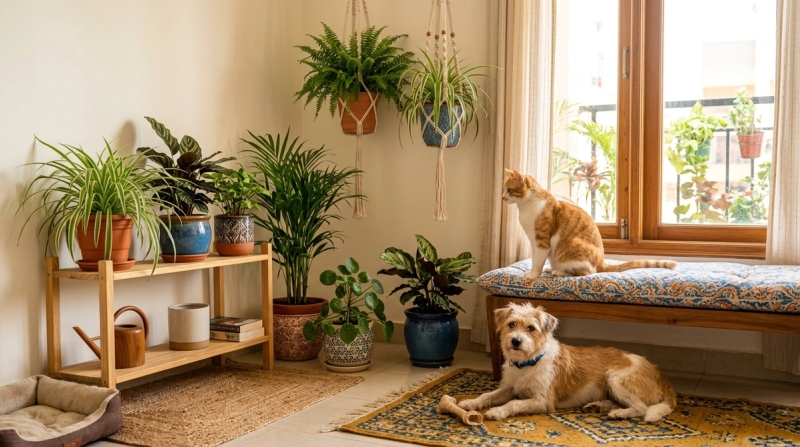
Looking for pet-safe indoor plants for your Indian apartment? Start with options like spider plant, Boston fern, areca palm, parlor palm, calathea or prayer plant, peperomia, haworthia, and Christmas cactus.
These are generally considered safe plants for cats and dogs, but here’s the important bit: “pet-safe” does not mean “snack-approved”. If your cat decides to shred a spider plant or your dog eats half a fern, they can still end up with an upset stomach.
If your pet has drooling, vomiting, unusual tiredness, tremors, breathing trouble, or you think they may have eaten a toxic plant, call your vet or a pet poison helpline right away.
Why pet-safe plants matter
#Plants make a home feel calmer and more alive. In Indian apartments, especially where balconies are small, sunlight is patchy, and rooms can feel a little closed in, even a few houseplants can make a big difference.
But when you live with cats or dogs, plant shopping needs one extra step.
Many popular Indian apartment plants are sold as “easy indoor plants”, “air-purifying plants”, “low-maintenance plants”, or “Vastu plants”. None of those labels mean the plant is safe for pets.
Some plants can irritate your pet’s mouth and throat. Some can cause vomiting or diarrhoea. And a few, like lilies for cats and sago palm for both cats and dogs, can be extremely dangerous.
Also, don’t worry too much about the whole “plants purify indoor air” promise. A couple of pots in your living room are not going to magically transform air quality. But they do make the space feel nicer, fresher, and more comforting, and honestly, that is reason enough.
The goal is simple: choose pet-safe houseplants, place them wisely, and still teach your pet that leaves are not chew toys.
A quick safety note before you buy any plant
#Before bringing a plant home, check the ASPCA toxic and non-toxic plant database or another trusted pet-safe plant source.
This is especially useful in India because plant names at local nurseries can be confusing. The same plant may be sold under different common names, and sometimes two very different plants have similar names. If possible, ask for the scientific name.
And remember: non-toxic does not mean edible.
A cat who keeps chewing a spider plant or a dog who digs into a fern may still get vomiting, loose motions, or stomach discomfort.
Call your vet if you notice:
- Drooling
- Vomiting
- Diarrhoea
- Lethargy or unusual tiredness
- Tremors
- Breathing difficulty
- Swelling around the mouth
- Loss of coordination
- Any sudden change after chewing a plant
Don’t try home remedies, and don’t wait for symptoms to become severe.
Pet-safe indoor plants for Indian apartments
#Here are some safer plant options that usually work well in Indian homes. Use this as a starting list, but still cross-check the exact variety before you buy.
These are good cat-safe indoor plants and dog-safe indoor plants for many apartments. But where you place them matters just as much as what you buy.
A “safe” plant kept at nose level in front of a bored puppy is still an invitation.
Toxic plants for pets to avoid
#Some of the most common indoor plants are not pet-safe. If you have a curious cat, a teething puppy, or a dog who treats leaves like salad, it is better to avoid these completely.
Lilies
#Lilies are especially dangerous for cats.
True lilies and daylilies are among the most serious houseplants toxic to cats. Even a small exposure can be risky. That includes:
- Nibbling a leaf or petal
- Licking pollen from fur
- Drinking water from a lily vase
If you have cats, the safest choice is simple: don’t keep lilies at home.
Sago palm
#Sago palm is highly toxic to both dogs and cats. All parts of the plant are unsafe, and the seeds are especially dangerous.
This is not a plant to keep “on a high shelf” or “away in one corner”. In a pet home, it is better not to keep it at all.
Pothos / Money plant
#Money plant, commonly pothos, is extremely common in Indian homes. Unfortunately, it is toxic to cats and dogs.
It contains insoluble calcium oxalate crystals, which can cause:
- Mouth irritation
- Drooling
- Swelling
- Pawing at the mouth
- Vomiting
Because pothos trails and hangs beautifully, pets can often reach it more easily than you expect.
Philodendron
#Philodendrons are popular because they grow well indoors and have glossy, attractive leaves. But like pothos, they contain calcium oxalate crystals and can irritate your pet’s mouth and throat if chewed.
Dieffenbachia / Dumb cane
#Dieffenbachia can cause strong mouth and throat irritation. Chewing it may lead to swelling, pain, drooling, and difficulty swallowing.
It is not a good choice for a home with pets.
Aloe vera
#Aloe vera is useful for people, but it is not safe for cats and dogs to chew. It can cause vomiting, diarrhoea, and lethargy in pets.
If you want a pet-safer succulent look, choose haworthia instead.
Jade plant
#Jade is a common tabletop succulent, but it is toxic to pets. Signs may include vomiting, depression, and loss of coordination.
ZZ plant
#ZZ plant is often recommended for low-light flats because it survives almost anything. But it is not pet-safe. If chewed, it can cause irritation and stomach upset.
Snake plant
#Snake plant is another low-light favourite, but it is toxic to cats and dogs. Eating it can cause nausea, drooling, and vomiting.
If you already have one of these toxic plants for pets, don’t panic. Just reassess honestly. If your pet ignores plants completely, you may be able to keep some out of reach. But if your pet is a determined chewer or climber, removing the plant is usually the safer option.
Indian apartment pet-safe home setup checklist
#A good pet-safe home setup is not only about picking the right plants. It is also about reducing temptation, access, and accidents.
1. Make the balcony safe
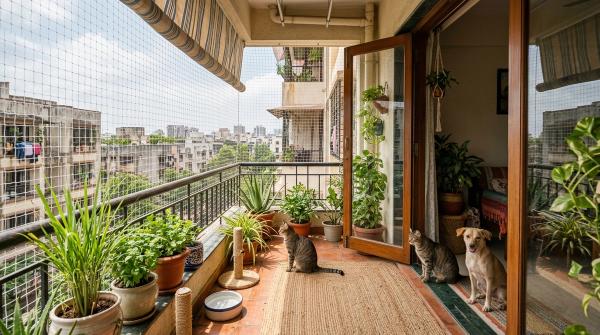
#Balconies in Indian apartments are often narrow, crowded, and exposed to strong sun.
Avoid placing pots on railings, ledges, or unstable stands. A cat can jump onto them, and a dog can bump into them. Either way, it can end badly.
Use broad, heavy pots that do not tip easily. If your balcony gets harsh afternoon sun, keep plants away from direct heat. Stressed plants often drop leaves, and fallen leaves are much easier for pets to chew.
2. Choose safer plants for low-light corners
#Many popular low-light plants, like ZZ plant and snake plant, are not pet-safe.
For dimmer rooms, consider safer options such as:
- Parlor palm
- Calathea
- Prayer plant
- Some peperomia varieties
Low light does not mean no light, though. If a plant starts looking weak, rotate it to a brighter spot for a while. Just make sure the temporary location is not somewhere your pet can easily reach.
3. Watch out during monsoon
#During monsoon, soil stays wet for longer. This can lead to fungus gnats, surface mould, and root problems.
Also, some dogs suddenly become very interested in damp soil. One minute you have a plant, the next minute you have mud across the living room.
To avoid this:
- Use pots with drainage holes
- Avoid overwatering
- Empty water trays regularly
- Let the top layer of soil dry when the plant allows it
- Keep dig-happy pets away from freshly watered pots
4. Use hanging planters carefully
#Hanging planters are great for spider plants and trailing greenery, but hanging does not automatically mean safe.
Check that the hook is strong and properly fixed. Avoid hanging heavy pots from weak false ceiling panels. Also look around the area like a cat would.
Is there a sofa nearby? A shoe rack? A window grill? A bookshelf?
If yes, your cat may absolutely use it as a launchpad.
5. Cover exposed soil
#Loose soil can look like a litter box to cats and a digging project to dogs.
Cover the top layer with large, heavy pebbles or stones. Make sure they are too big to swallow. Avoid tiny decorative gravel if your dog likes putting random things in their mouth.
6. Teach plant boundaries
#Even with pet-safe indoor plants, it is worth teaching your pet that plants are off-limits.
For dogs, practise a calm “leave it” cue and reward them when they move away from the plant.
For cats, focus on reducing boredom. Add climbing spaces, scratching posts, playtime, window perches, and safe alternatives like cat grass if your vet says it is okay.
And while training is still new, keep the most tempting plants out of reach.
7. Pick up fallen leaves
#Some pets ignore plants in pots but happily chew fallen leaves from the floor.
Pick up dropped leaves during your regular cleaning, especially after watering, pruning, or moving pots around.
It is a small habit, but it helps a lot.
How to shop for pet-safe houseplants in India
#When visiting a nursery or ordering online, don’t rely only on labels like:
- Indoor plant
- Air-purifying plant
- Vastu plant
- Easy-care plant
- Low-maintenance plant
These labels say nothing about whether the plant is safe for cats and dogs.
Use this simple buying process instead:
- Ask for the plant name.
- Ask for the scientific name if possible.
- Check the ASPCA toxic and non-toxic plant database.
- Avoid lookalikes if you are unsure.
- Choose a stable pot, not just a pretty one.
- Decide where the plant will go before bringing it home.
- Watch your pet closely for the first few days.
If your pet is a known chewer, keep your plant collection small and thoughtful. A safe little green corner is much better than a beautiful indoor jungle that your pet can destroy in one afternoon.