If you’re trying to learn how to trim cat nails at home, here’s the simple version:
Wait until your cat is relaxed. Gently press the paw pad so one claw comes out. Use cat nail clippers to snip only the clear, sharp tip. Stay well away from the pink quick, because that part has nerves and blood vessels. Then give your cat a treat.
And if you only trim one nail?
That counts. Truly.
Cat nail trimming does not have to be a big dramatic event. In fact, the less dramatic it feels, the better. Your goal is not to “win” against your cat or finish every claw in one sitting. Your goal is to make nail trims feel safe, short, and predictable.
Pet safety note: This guide is for routine cat grooming at home. It is not a substitute for veterinary care. Do not pin your cat down, force restraint, or continue if your cat is scared or fighting. Stop right away if you notice bleeding, pain, panic, hissing, biting, or aggression. Call a vet or professional groomer if a nail is overgrown, embedded in the paw pad, infected, badly broken, bleeding, painful, or your cat is too distressed to handle safely.
A lot of cat parents feel nervous the first few times. That’s normal. Cats can be perfectly sweet one minute and suddenly act personally offended the moment you touch a paw. You’re not failing. You’re just working with a cat.
Guidance from groups like VCA Animal Hospitals and the ASPCA usually comes back to the same basics: go slowly, get your cat used to paw handling, use proper clippers, trim only the clear tip, avoid the quick, reward often, and stop before your cat gets overwhelmed.
Why Indoor Cats Need Nail Trims
#Cats need their claws. They use them to stretch, balance, climb, play, scratch, and feel secure. Trimming your cat’s nails does not remove the claws. It simply takes off the sharp hooked tip.
Indoor cats often do not wear their nails down as much as outdoor cats. Soft rugs, blankets, couches, carpet, wood floors, and tile do not naturally file claws very much. Over time, the nails can get sharp, long, or curved.
You may notice:
- Nails catching on blankets, rugs, curtains, or furniture
- Accidental scratches during play or cuddling
- Clicking sounds on hard floors
- Your cat getting stuck on fabric
- Older cats developing thicker, more curved nails
- One claw looking longer than the others
Regular indoor cat care should include nail checks, even if you do not clip every time. Some cats need trims more often than others. Age, activity level, scratching habits, and nail growth all play a part.
If you see a nail curling into the paw pad, swelling, redness, discharge, a bad smell, bleeding, or signs of pain, skip the home trim and call your vet.
What You Need Before You Start
#You do not need a fancy grooming setup. Actually, simple is better.
1. Cat nail clippers
#Use clippers made for cats or small pets. Small scissor-style cat clippers are usually easiest for beginners because they are light, easy to control, and made for the shape of a cat claw.
Avoid large, dull, or awkward clippers. Dull clippers can crush or split the nail instead of making a clean cut.
2. Really good treats
#Use a treat your cat actually cares about. Not the everyday treat they casually sniff and abandon.
Treats are not just a bribe. They help teach your cat that paw handling and clipping lead to something good. You want the pattern to feel simple:
Paw touch. Tiny clip. Treat. Done.
3. Good lighting
#You need to see the nail clearly. This matters most when you are trying to avoid the quick.
On many light-colored cat nails, the quick is visible as a pink area inside the nail. If your cat has dark nails and you cannot see the quick, trim only the tiniest tip or ask a vet or groomer to show you where to cut.
4. A towel, if your cat likes it
#A towel can help your cat feel steady on your lap, couch, or bed. It can also keep them from slipping.
But a towel should not turn into a wrestling tool. Some cats tolerate a loose towel. Some hate it. If your cat panics when wrapped, don’t force it.
5. Styptic powder
#Styptic powder helps stop bleeding if you accidentally cut the quick. It is worth keeping nearby.
If bleeding happens, stop trimming. Apply gentle pressure and use styptic powder as directed. If bleeding does not stop or your cat seems very painful, call your vet.
Know the Nail: Clear Tip vs. Quick
#Before you trim cat claws, take a moment to look at the nail.
On many light-colored cat nails, you will see:
- A clear, curved, sharp tip at the end
- A pink area closer to the toe
The clear tip is the part you trim.
The pink area is the quick. The quick contains blood vessels and nerves, so cutting it can hurt and bleed.
Beginner rule: trim less than you think you need to.
A tiny trim is still useful. You can always clip a little more later. You cannot undo a cut that went too far.
How to Trim Cat Nails at Home: Step-by-Step
#This routine is designed for normal indoor cats, especially cats who do not enjoy being held for long. In other words, most cats.
Step 1: Get your cat used to paw handling first
#If your cat hates having their paws touched, do not start with clippers right away.
Start smaller.
When your cat is sleepy or relaxed, gently touch one paw for a second. Then give a treat. Later, touch the paw for two or three seconds. After that, gently press the paw pad so one claw extends, then let go and reward.
You may need to do this for a few days before clipping anything. That is fine.
If your cat pulls their paw away, let them. Try again later with an even shorter touch.
Step 2: Choose a calm time
#Pick a moment when your cat is relaxed, maybe after a meal or after playtime.
Do not try to trim nails when your cat is:
- Racing around with zoomies
- Hungry
- Hiding
- Irritated
- Already suspicious of you
- In the middle of intense play
If you live in a small apartment, reduce distractions where you can. Turn the TV down, keep other pets out of the room, and avoid busy doorways or noisy spots.
Step 3: Use a position your cat accepts
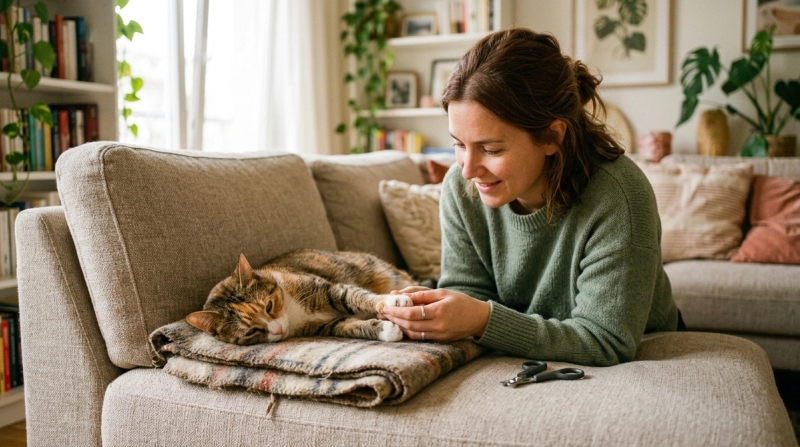
#Some cats do well sitting on your lap facing away from you. Some prefer lying beside you on the bed or couch. Some will only allow nail checks while they are lounging in their favorite sunny spot.
Use whatever position your cat tolerates best.
Hold the paw gently. Try not to grip your cat’s whole body unless necessary. The more trapped your cat feels, the more likely they are to struggle now and avoid you next time.
Step 4: Extend one claw
#Hold one paw gently. Press the top of one toe and the paw pad underneath it. The claw should slide out.
Do not squeeze hard. If the claw does not come out easily, pause and try again.
Step 5: Find the clear tip
#Look for the sharp hook at the end of the nail. That is the part you want to clip.
Stay away from the pink quick. If you are not sure where the quick starts, take only the very end.
Step 6: Clip one nail
#Place the clipper around the clear tip and make one steady, clean snip.
Try not to hover too long once the clipper is in place. A slow, nervous squeeze can feel strange to your cat and may crush the nail instead of cutting cleanly.
For your first few sessions, one nail may be enough. That is still progress.
Step 7: Reward immediately
#Give a treat right after the clip. Use calm praise too, if your cat likes it.
Timing matters. You want your cat to connect the nail trim with something good.
Step 8: Decide whether to continue
#If your cat stays relaxed, you can try another nail.
If your cat tenses up, flicks their tail, growls, pulls away, hisses, bites, or tries to leave, stop.
Do not push for “just one more.” That is often the moment a calm trim turns into a battle.
You can always come back later. Some cat parents trim one paw a day. Others trim one or two claws at a time. That is completely okay.
Quick Guide: Clip, Avoid, or Call a Vet or Groomer
#Cat Nail Clipping Tips for Nervous Beginners
#These cat nail clipping tips are simple, but they make a big difference.
Start with the front claws
#Front claws usually cause more snagging and accidental scratches. Back claws may wear down more naturally, though you should still check them.
If your cat only allows a short session, start with the front paws.
Keep sessions short
#A calm two-minute trim is better than a ten-minute wrestling match.
The more ordinary the routine feels, the easier it usually becomes.
Do not chase your cat with clippers
#If your cat walks away, the session is over.
Chasing your cat around the apartment turns nail trimming into something scary. Let them settle and try again another time.
Use the same routine each time
#Cats often like predictability. Use the same spot, same treats, same gentle handling, and the same calm voice if possible.
When your cat knows what to expect, the whole thing feels less alarming.
Clip less, more often
#For beginners, frequent tiny trims are usually safer than waiting until the nails are very long and trying to cut a lot at once.
A little trim now is better than a stressful big trim later.
Watch your cat’s body language
#Try to stop before your cat gets truly upset. Early stress signs can include:
- Tail flicking
- Ears turning sideways or back
- Pulling the paw away
- Skin twitching
- Low growling
- Stiff body posture
- Sudden attempts to leave
- Looking back at your hand repeatedly
Respect those signs. Your cat is telling you they need a break.
What If You Accidentally Cut the Quick?
#It happens sometimes, especially when you are new to cat nail trimming.
If you cut the quick:
- Stop trimming right away.
- Stay calm.
- Apply gentle pressure.
- Use styptic powder if you have it.
- Do not continue clipping.
- Call your vet if bleeding does not stop, your cat seems very painful, or you are worried.
Your cat may flinch, cry, pull away, or hide. Do not punish them for reacting. They are not being difficult; they are responding to pain.
Next time, trim less and go slower.
When You Should Not Trim Cat Nails at Home
#Home trimming is for normal nail maintenance. It is not for medical problems.
Call a veterinarian or professional groomer if:
- A nail is embedded in the paw pad
- The paw is swollen, red, bleeding, or painful
- There is discharge, odor, or possible infection
- The nail is badly broken
- Your cat is elderly and has thick, overgrown nails you cannot safely trim
- Your cat becomes aggressive or extremely distressed
- You cannot clearly see what you are cutting
- You are not confident doing it yourself
There is no shame in getting help. A vet or groomer can handle difficult nails more safely and may be able to show you exactly where to clip next time.
A Calm Nail Trim Routine for Small Apartments
#You do not need a special grooming room. If you live in a small apartment, just choose a quiet spot your cat already likes.
A simple routine might look like this:
- Keep the clippers and treats in the same drawer.
- Wait until your cat is resting.
- Sit beside them instead of grabbing them suddenly.
- Touch one paw and give a treat.
- Extend one claw.
- Clip only the clear tip.
- Reward right away.
- Stop while things are still calm.
That last step matters. Ending before your cat gets annoyed helps the next session go better.
If you keep a pet care checklist in your phone, notes app, or a tool like AllBlogs, you might add a reminder for regular nail checks. The habit itself is simple: calm cat, clear tip, tiny clip, treat, stop if stressed.
Common Mistakes to Avoid
#Cutting too much at once
#This is the biggest mistake. You do not need to make the nail very short. Just remove the sharp tip.
Holding your cat too tightly
#A hard grip may make you feel more in control, but it can make your cat panic. Gentle control is safer than force.
Waiting until the nails are badly overgrown
#Routine checks are easier than urgent trims. Look at your cat’s nails every couple of weeks, even if you do not clip them every time.
Trimming when you are rushed
#If you are late, stressed, or frustrated, wait. Cats pick up on tension, and shaky hands do not help.
Ignoring signs of pain
#If your cat reacts strongly to one toe or paw, stop. If you notice swelling, bleeding, heat, discharge, or anything that looks wrong, call your vet.
Using dull clippers
#Dull clippers can split or crush the nail. If the clipper feels like it is squeezing instead of cutting, replace it.
Final Takeaway
#Learning how to trim cat nails at home is mostly about patience.
Handle your cat’s paws before you ever bring out the clippers. Clip only the clear tip. Avoid the quick. Reward every small success.
You do not have to finish every nail at once. For many cats, one or two claws is a good session.
Keep it calm, keep it short, and stop before your cat feels trapped. And if a nail looks painful, infected, overgrown, or unsafe, ask a vet or groomer for help.