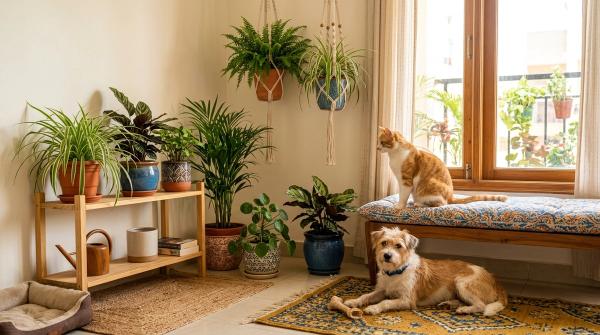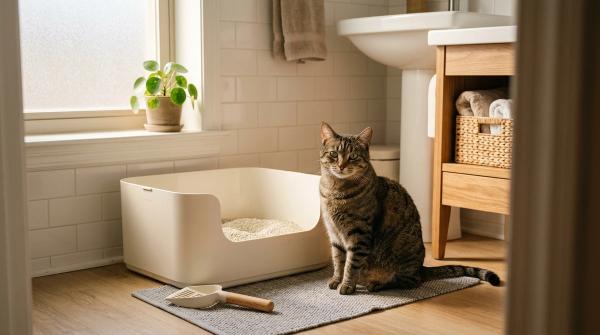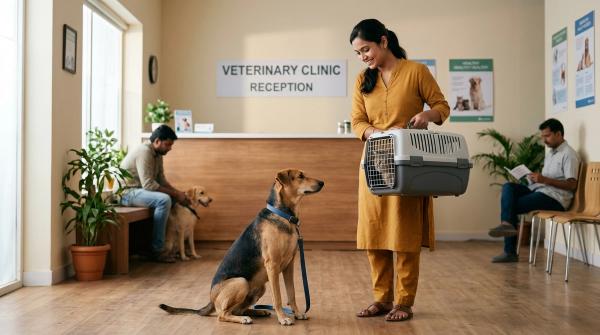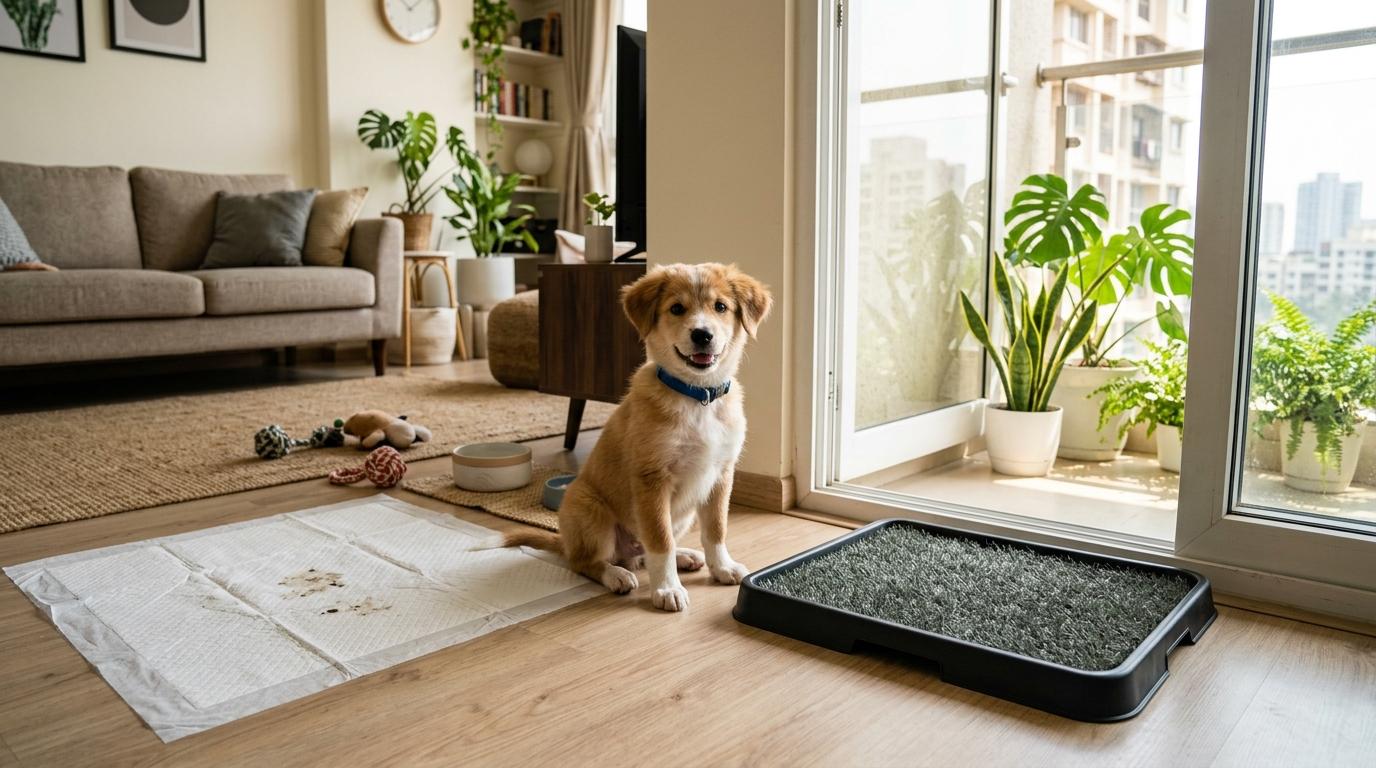
The simplest way to potty train a puppy in an Indian apartment is to choose one fixed toilet spot, take your puppy there often, and reward them immediately when they get it right. That spot could be a pee pad, a balcony potty tray, or an outdoor area, depending on your puppy’s age, vaccination status, and your building setup. Avoid punishment, clean accidents properly, and check with your vet before using shared lawns, streets, or society gardens if your puppy is not fully vaccinated.
Bringing a puppy home is exciting until you are standing in your living room at 6:40 am, half-asleep, staring at a tiny puddle and wondering how something so small can pee so much.
If that’s you, don’t worry. This is normal.
Potty training a puppy in an Indian apartment comes with its own challenges. You may have to manage lifts, corridors, neighbours, monsoon rain, hot tiles, shared lawns, street dogs, society rules, and vaccination safety. Your puppy, meanwhile, is not thinking about any of that. They just know they need to go.
The good news? Puppy potty training becomes much easier when the whole family follows one clear plan:
- One toilet spot
- One routine
- Quick rewards
- Calm clean-up
- No punishment
That’s the foundation.
Why Potty Training in an Indian Apartment Feels Different
#A lot of puppy advice online says, “Just take your puppy outside every hour.”
That sounds great unless you live on the 14th floor, the lift is taking forever, it’s raining heavily, and your puppy is already doing suspicious circles near the shoe rack.
Apartment life changes things.
The lift may not be fast enough
#Young puppies don’t give much notice. Some sniff. Some circle. Some suddenly stop playing and wander off quietly.
By the time you find your slippers, grab the keys, call the lift, wait for it, reach the ground floor, cross the lobby, and find the outdoor spot, your puppy may have already finished the job.
For very young puppies, a nearby pee pad or balcony potty area is often more realistic in the beginning.
Shared outdoor spaces may not be safe yet
#Before your puppy’s vaccinations are complete, shared lawns, streets, parking areas, and common dog-walking zones may carry infection risks.
This is not something to guess. Ask your vet when it is safe for your puppy to start using outdoor areas.
Until then, many apartment families use:
- Pee pads
- A balcony potty tray
- Artificial grass patches
- A washable indoor potty setup
Indian weather can ruin the plan
#Outdoor potty training sounds simple until monsoon starts.
Heavy rain, muddy lawns, wet corridors, slippery tiles, and flooded roads can all disturb your puppy’s routine. Summer is another problem because outdoor tiles, roads, and pavements can become too hot for puppy paws.
A backup indoor or balcony option can save you on difficult days.
Neighbours will notice
#In apartments, potty training is not only about your puppy. It also affects the people around you.
Balcony smell, urine dripping, hallway accidents, barking during late-night potty trips, or mess in common areas can quickly become a society complaint.
A clean, predictable system keeps your puppy on track and helps maintain peace with neighbours.
Too much freedom leads to accidents
#A new puppy should not have access to the whole flat immediately.
Bedrooms, rugs, carpets, curtains, sofa corners, and hidden spaces can all become accidental toilet spots. Start small, supervise closely, and slowly increase freedom as your puppy improves.
First Step: Choose One Toilet Spot
#Before you start training, decide where your puppy should go.
This is one of the most important parts of puppy house training. Puppies learn faster when the message is simple and consistent.
Your main options are:
- Indoor pee pad
- Balcony potty tray or artificial grass patch
- Outdoor potty spot in a safe area
Try not to switch between all three randomly in the first few days. If one person takes the puppy to the balcony, another uses the bathroom, and someone else takes them downstairs, your puppy may get confused.
Keep it simple:
Same spot. Same cue. Same reward.
Balcony vs Pee Pad vs Outdoor Walks
#There is no single best option for every Indian apartment. The right choice depends on your puppy’s age, your floor level, vaccination status, family schedule, and building rules.
Pick the option your family can follow every day, not just the one that sounds ideal.
Sample Puppy Potty Schedule for Indian Apartments
#Puppies usually need to pee or poop:
- After waking up
- After meals
- After play
- Before naps
- Before bedtime
Very young puppies may also need a night break.
Use this schedule as a starting point. Adjust it based on your puppy’s age, feeding routine, sleep pattern, and vet advice.
Daily routine checklist
#- Potty after waking up
- Potty after each meal
- Potty after playtime
- Potty before naps
- Potty before bedtime
- Reward immediately after success
- Clean accidents with an enzymatic cleaner
- Keep the toilet spot the same
- Supervise your puppy during free time
- Use a safe zone when you cannot watch closely
Step-by-Step Guide to Potty Train a Puppy in an Apartment
#Step 1: Set up a puppy-safe zone
#Don’t give your puppy the whole apartment on day one.
Use a playpen, baby gate, or one easy-to-clean room. This area should feel safe and simple, not like a punishment space.
Inside the puppy zone, keep:
- Bed or crate
- Water bowl
- A few safe toys
- Pee pad or potty tray placed away from the sleeping area
Most puppies don’t like to soil where they sleep. A smaller space helps them make better choices and gives you fewer accidents to manage.
Step 2: Take your puppy before they make a mistake
#In the beginning, don’t wait for your puppy to “tell you” they need to go.
Most puppies don’t know how to ask yet.
Take them to the potty spot:
- Immediately after waking
- 15 to 20 minutes after meals
- After play
- Before bedtime
- Before leaving them in the playpen
- Whenever they sniff, circle, squat, or suddenly wander away
If your puppy is very young, carry them to the pad or balcony spot when needed. This prevents them from peeing halfway there.
Step 3: Use one simple potty cue
#Choose one short phrase and ask everyone at home to use the same one.
For example:
- “Go potty”
- “Toilet”
- “Do potty”
- “Pee pee”
Say it calmly when your puppy is at the toilet spot.
Don’t keep repeating it in a tense voice. You are not trying to pressure your puppy. You are simply helping them connect the word with the action.
Step 4: Reward immediately
#This part matters a lot.
Many people wait until the puppy comes back inside and then give a treat. But by then, the puppy may think the treat is for walking back, jumping, sitting, or just being adorable.
Reward your puppy right after they finish peeing or pooping in the correct spot.
Use:
- A small treat
- Gentle praise
- A happy voice
- A quick cuddle if your puppy enjoys it
The timing should be clear: potty in the right place = good things happen.
Step 5: Supervise during free time
#When your puppy is outside the playpen, watch them properly.
If you are cooking, bathing, working, taking a call, or helping kids with homework, put your puppy back in the safe zone.
This is not being strict. It is preventing mistakes.
Freedom should increase slowly as your puppy becomes more reliable.
Pee Pad Training Tips for Puppies
#Pee pads are very useful in Indian apartments, especially for young puppies, high-rise homes, night breaks, and rainy days.
To make pee pad training clearer:
- Keep the pad in one fixed place.
- Don’t move it from room to room.
- Use a larger pad area at first if your puppy misses the edge.
- Change dirty pads regularly.
- Keep the pad away from food and bed.
- Reward every correct use.
- Remove rugs or mats nearby if your puppy confuses them with pads.
If your puppy chews or drags the pad around, use a pad holder or potty tray.
Some puppies think pee pads are toys. That doesn’t mean training has failed. It just means you may need better management, more supervision, and appropriate chew toys.
Balcony Potty Training: Useful but Needs Care
#A balcony can be a great potty spot in an apartment, but only if it is safe and clean.
Before using the balcony, check:
- Are the grills secure?
- Can your puppy squeeze through any gap?
- Is there netting if needed?
- Is the floor slippery?
- Can urine drip into another flat or common area?
- Can the area be cleaned easily every day?
For a balcony setup, you can use:
- A washable potty tray
- Artificial grass patch
- Pee pad holder
- Puppy toilet tray with drainage
Do not leave your puppy alone on the balcony, especially if they are small, curious, or the space is not fully secured.
Also, don’t let the balcony potty become a forgotten corner. If it smells bad to you, it is definitely unpleasant for your puppy and your neighbours.
Outdoor Potty Training in Apartment Complexes
#Outdoor potty training works well once your puppy is ready.
But with young puppies, timing matters.
Before taking your puppy to society lawns, streets, parks, parking areas, or places where other dogs pass through, ask your vet if it is safe. This is especially important while vaccinations are still in progress.
When you start outdoor potty trips:
- Use the same quiet spot each time.
- Avoid crowded dog areas at first.
- Keep treats ready.
- Carry poop bags.
- Reward immediately after your puppy finishes.
- Keep potty trips short and boring at first.
- Don’t turn every potty break into a full play session.
Some puppies get very excited outside. There are scooters, people, cats, dogs, smells, sounds, and leaves moving in the wind. They may completely forget why they came out.
If that happens, stand quietly and give them a few minutes. Don’t pull them around too much.
How to Handle Accidents in the House
#Accidents will happen. They are part of puppy training.
They do not mean your puppy is stubborn, naughty, or doing it “on purpose.”
Most accidents happen because:
- The puppy does not fully understand the toilet spot yet.
- The puppy got too much freedom too soon.
- The puppy could not physically hold it.
- The family missed the timing.
- The puppy was excited, tired, or distracted.
What not to do
#Please don’t:
- Yell
- Hit
- Rub your puppy’s nose in pee or poop
- Drag them to the accident angrily
- Punish them after the fact
- Lock them away as punishment
Punishment does not teach the correct toilet spot. It only teaches your puppy to be scared of you or to hide when they need to pee.
That makes potty training harder.
What to do instead
#If you catch your puppy in the act:
- Calmly say something like “oops.”
- Gently pick them up or guide them to the correct spot.
- Let them finish there if they can.
- Reward softly if they finish in the right place.
If you find the accident later, just clean it.
Your puppy will not understand punishment for something that happened minutes ago.
Cleaning Accidents Properly
#Cleaning is not only about keeping the house fresh. It is also part of the training process.
Dogs are drawn back to places that still smell like urine. Regular floor cleaners may smell clean to us, but your puppy’s nose may still detect the old accident.
For best results:
- Blot fresh urine first.
- Use an enzymatic pet cleaner when possible.
- Follow the cleaner’s instructions.
- Wash reusable mats and trays regularly.
- Don’t leave damp patches.
- Avoid relying only on strong perfumes or phenyl smells.
The goal is not to cover the smell. The goal is to break it down properly.
Common Mistakes That Slow Down Potty Training
#Changing the toilet spot too often
#Pad today, balcony tomorrow, bathroom the next day, lawn after that.
This is confusing for a puppy. Choose one main toilet spot first and stick with it.
Giving too much freedom too soon
#If your puppy disappears behind the sofa or into a bedroom, they may be looking for a quiet toilet corner.
Keep free time supervised.
Rewarding too late
#Reward your puppy at the potty spot, immediately after they finish.
Timing makes the lesson clear.
Scolding accidents
#Scolding may stop your puppy in that moment, but it does not teach them where to go next time.
It often creates fear and secretive peeing.
Expecting too much from a baby puppy
#Young puppies have small bladders. They cannot hold urine like adult dogs.
They need frequent chances to succeed.
Not involving the whole family
#Potty training becomes much harder if every family member follows a different plan.
Everyone should agree on:
- Toilet spot
- Cue word
- Schedule
- Reward method
- No-punishment rule
Consistency helps your puppy learn faster.
Monsoon, Summer, Lifts and Neighbour Problems
#Apartment puppy training in India has real-life complications. Plan for them.
During monsoon
#Rain, mud, wet lifts, slippery flooring, and flooded outdoor areas can make potty breaks difficult.
Keep a backup pee pad or balcony tray ready.
If your puppy is scared of thunder or heavy rain, stay calm. Keep the potty trip short and simple.
During summer
#Roads, pavements, and outdoor tiles can become very hot. Puppies can burn their paws or become uncomfortable quickly.
Avoid hot surfaces and choose shaded, cooler times whenever possible.
If outdoor potty breaks are not safe or comfortable, use a quick-access indoor or balcony option.
During lift delays
#If your puppy is young and the lift is slow, don’t depend only on downstairs potty breaks.
A nearby pad or balcony area can prevent repeated accidents.
In corridors and common areas
#Keep cleanup supplies handy when moving through shared spaces.
If your puppy has an accident in the corridor or lift lobby, clean it immediately. It is basic apartment courtesy and helps avoid complaints.
When to Call a Vet
#Sometimes potty problems are not training problems. They may be health-related.
Call your vet if you notice:
- Peeing very frequently in tiny amounts
- Straining to pee
- Crying while peeing
- Blood in urine
- Sudden accidents after good progress
- Vomiting or diarrhoea
- Dullness or loss of appetite
- Excessive thirst
- Unusual urination
- Strong stress signs that do not settle
Also speak to your vet before taking a young puppy to shared outdoor spaces, especially if vaccinations are not complete.
When to Call a Trainer
#If your puppy is healthy but potty training still feels very difficult, a positive-reinforcement trainer can help.
Consider calling a trainer if:
- Your puppy is very scared of the potty spot
- They hide to pee or poop
- They panic in the balcony, corridor, or lift
- Accidents continue despite supervision and routine
- Your family cannot agree on one method
- You feel stuck and frustrated
Choose a trainer who uses calm, reward-based methods.
Avoid anyone who recommends hitting, shouting, intimidation, alpha rolls, or “dominance” punishment.
Apartment Puppy Potty Training Checklist
#Save this on your phone or print it for the family.
- One main toilet spot chosen
- Pee pads, potty tray, or balcony grass patch ready
- Balcony secured with grills or netting, if using balcony
- Puppy-safe zone set up
- Bed, water bowl, and toys placed correctly
- Toilet area kept away from food and bed
- Treats kept near the potty spot
- One potty cue chosen
- Daily schedule shared with everyone at home
- Enzymatic cleaner available
- Poop bags ready for outdoor trips
- Vet guidance taken before using shared outdoor areas
- No-punishment rule followed by all family members
- Progress tracked calmly