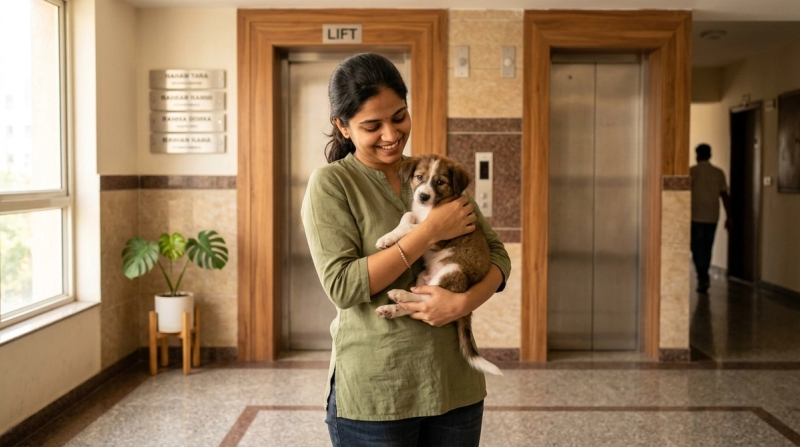
Yes, you can start socializing your puppy before all vaccinations are complete. You just need to do it sensibly.
Your puppy does not need to walk on the road, sniff the society garden, or meet every dog in the building to learn about the world. At this stage, they can learn plenty while being carried in your arms, a sling, or a secure carrier.
They can hear balcony sounds, meet calm visitors at home, experience the lift, watch traffic from a safe distance, and maybe meet one healthy, fully vaccinated dog you know well.
What they should avoid for now are public grounds, society lawns, dog parks, unknown dogs, pet shop floors, street corners, drains, and random sniffing spots until your vet says it is safe.
For many new puppy parents in Indian apartments, this period feels confusing. You want your puppy to grow into a friendly, confident dog, but you also keep hearing scary words like parvo, distemper, and infections.
The truth is not “keep them locked inside” and it is not “take them everywhere” either.
The middle path is best: give your puppy small, safe, happy experiences with normal life.
This guide will help you socialize your puppy in an apartment before full vaccination, while still being careful about health risks.
Why Puppy Socialization Should Not Wait Completely
#Puppies learn a lot in their early weeks. This is when they start forming opinions about people, sounds, places, surfaces, handling, and other dogs.
If a puppy is kept too isolated during this period, they may become more nervous or fearful later. Many veterinary and behaviour groups, including AVSAB, support controlled early socialization before the full vaccination series is complete, as long as sensible disease precautions are followed.
But controlled socialization does not mean careless exposure.
It means:
- Letting your puppy see and hear the world
- Keeping their paws away from risky public places
- Avoiding unknown dogs
- Following your vet’s vaccine and safety advice
- Keeping every new experience short and positive
Think of it this way: your puppy is not made of glass, but they are also not a fully protected adult dog yet.
They need safe exposure, not risky adventures.
The Indian Apartment Reality
#Apartment life in India actually gives you many safe socialization opportunities without needing to put your puppy on unsafe ground.
Your puppy can get used to:
- Lift doors opening and closing
- Neighbours passing by
- Doorbells and knocking
- Swiggy, Zomato, Amazon, courier, and grocery deliveries
- Traffic sounds from the balcony
- Honking, bikes, autos, buses, and school vans
- Street dogs barking in the distance
- Security guards, maintenance staff, domestic helpers, and visitors
- Pressure cooker whistles, mixers, brooms, mops, and vacuum cleaners
- Children playing in the corridor or compound, heard from a safe distance
All of this counts as real socialization.
A puppy who hears these everyday sounds early, in a calm and safe way, is more likely to handle apartment life confidently later.
The key is control. Your puppy does not need to sniff the lift floor, touch the street, or meet every dog in the building to learn.
Safe vs Risky Exposure Before Full Vaccination
#Use this as a general guide before your vet gives clearance. If your vet gives stricter advice because your area has a higher disease risk, follow your vet.
The Main Rule: Paws Off Public Ground
#Before your vet clears your puppy, treat public ground as off-limits.
This includes:
- Society garden paths
- Basement parking floors
- Lift lobbies
- Corridors used by dogs
- Streets and footpaths
- Pet shop floors
- Dog park grass
- Public park soil
- Vet clinic floors
Your puppy can still go out. They just should not walk around in these places yet.
You can use:
- A puppy sling
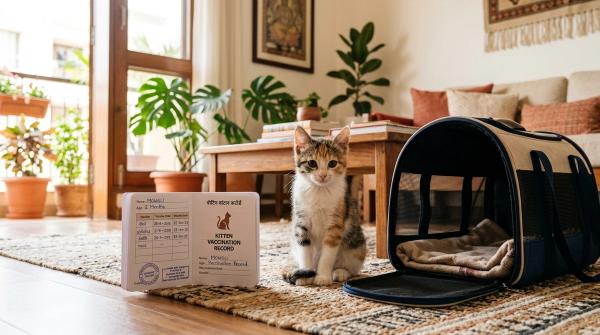
- A secure carrier
- A pet backpack
- Your arms, if your puppy is small and calm
- A clean blanket or mat if you are sitting in a controlled place
This way, your puppy gets to experience the world without taking unnecessary health risks.
What Safe Puppy Socialization Actually Looks Like
#Safe socialization is not about dumping your puppy into every new situation and hoping they adjust.
It is about showing them the world in small, positive pieces.
A good socialization session should be:
- Short
- Calm
- Positive
- Controlled
- Easy to stop
- Paired with treats, praise, or play
Watch your puppy’s body language.
You are on the right track if your puppy is:
- Curious
- Taking treats
- Looking around calmly
- Sniffing gently
- Recovering quickly after a sudden sound
- Able to relax again after something new happens
The session may be too much if your puppy is:
- Hiding
- Freezing
- Trembling
- Panting heavily
- Barking nonstop
- Refusing food
- Trying to escape
- Clinging to you in panic
If that happens, move farther away, make the experience easier, and try again another day.
Do not force it. Puppies remember scary experiences too.
7-Day New Puppy Socialization Checklist for Indian Apartments
#Here is a simple first-week plan. Keep each session short, even just a few minutes. If your puppy needs more time, repeat the same day again. There is no hurry.
Day 1: Balcony Sounds
#Sit with your puppy on your lap or on a clean mat in the balcony.
Let them hear:
- Traffic
- Horns
- People talking
- Street dogs barking from a distance
- Children playing
- Two-wheelers and autos
Give tiny treats or gentle praise when they stay relaxed.
Do not force them to look down from the railing. Do not keep them there if they seem scared. The goal is calm exposure, not “bravery training.”
Day 2: Indoor Surfaces
#Let your puppy explore different clean surfaces inside the house.
Try:
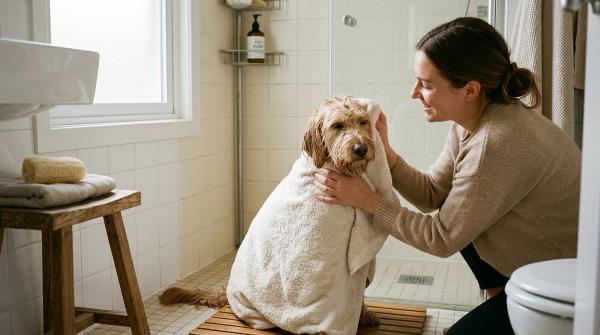
- Dry bathroom tiles
- A cotton rug
- A yoga mat
- A clean indoor doormat
- Smooth flooring
- A towel
- Cardboard
This helps your puppy get used to different textures without stepping into shared public spaces.
Day 3: Lift Practice in Arms
#Carry your puppy to the lift.
Let them experience:
- Lift doors opening
- Lift sounds
- Mirrors
- Neighbours entering, if everyone is calm
- Movement between floors
Keep it very short. You can go down one floor and come back up if your puppy is comfortable.
Do not place them on the lift floor.
Day 4: Doorbell and Delivery Practice
#Apartment puppies hear a lot of door activity, so it helps to practise this early.
You can use:
- Doorbell sounds
- Knocking
- A family member pretending to be a delivery person
- Opening and closing the main door
- The sound of keys
Reward calm behaviour.
If your puppy gets too excited or worried, move them farther away from the door and try again more gently.
Day 5: Household Objects
#Introduce normal home items slowly and casually.
Try showing:
- An umbrella opening slowly
- Broom movement
- Mop and bucket
- Pressure cooker whistle from a distance
- Mixer sound for a very short time
- Vacuum cleaner from another room first
Do not chase your puppy with objects or make it dramatic. Let them watch from a safe distance. Ideally, these things should start to feel boring and normal.
Day 6: Carrier or Car Exposure
#Help your puppy get used to travel without putting them on risky ground.
Try:
- Sitting in a parked car for a few minutes
- Taking a short drive around the neighbourhood
- Letting your puppy sit in the carrier with treats
- Watching traffic through a closed or safely controlled window
Keep your puppy secure. This is not about a long trip. It is just about making travel feel normal.
Day 7: Known Vaccinated Dog Visit
#If you know a calm, friendly, healthy adult dog who is fully vaccinated, you can invite them home.
Keep the meeting:
- Indoors
- Supervised
- Short
- Calm
- On clean flooring
Do not allow rough play.
Do not invite dogs who are coughing, vomiting, having diarrhoea, itching badly, carrying ticks, or recently ill.
If you are not sure, skip the dog meeting and ask your vet about safe puppy class options instead.
How to Handle People Socialization Safely
#Puppies should meet different kinds of people, but this does not mean everyone in the building needs to crowd around them.
You can gently introduce your puppy to:
- Men and women
- People wearing caps or helmets
- People with glasses
- Gentle children, always supervised
- Domestic helpers who are comfortable with dogs
- Security staff from a distance while you carry the puppy
- Calm friends who will not over-handle the puppy
Safety tips:
- Ask people to wash their hands first.
- Keep street shoes outside.
- Do not allow face licking.
- Do not let too many people crowd the puppy at once.
- Let your puppy approach if they want to.
- Give treats when the person is nearby, so your puppy builds a good association.
Also, not every person needs to pick up your puppy. Sometimes just seeing someone calmly is enough.
Can Your Puppy Meet Other Dogs Before Full Vaccination?
#Yes, but only in carefully chosen situations.
Safer dog exposure may include a dog who is:
- Known to you
- Fully vaccinated
- Healthy
- Calm and puppy-friendly
- Living in a clean home
- Not regularly mixing with unknown dogs in risky places
Avoid:
- Street dogs
- Unknown society dogs
- Dogs in parks
- Dogs with unknown vaccine history
- Dogs that are reactive, rough, or pushy
- Pet shop or boarding facility dogs unless your vet approves the setting
Dog socialization is useful, but quality matters more than quantity.
One calm, vaccinated, puppy-friendly dog is much better than ten random dog meetings.
Are Puppy Classes Safe Before Full Vaccination?
#Some puppy classes can be safe, but not all of them.
Before joining, ask:
- Do you check vaccination records for every puppy?
- Is the class indoors?
- How is the floor cleaned?
- Do you use cleaning products effective against serious puppy infections like parvovirus?
- Are sick puppies refused entry?
- Are adult dogs allowed in the same area?
- Is play supervised and stopped when it gets too rough?
- How many puppies are there per trainer?
A good puppy class should focus on confidence, gentle handling, basic manners, and safe exposure.
It should not be a chaotic free-play session where puppies are just running wild.
If your vet says the local disease risk is high, listen to them.
Vet Warning Signs and Safety Cautions
#Pause socialization if your puppy seems unwell.
Call your veterinarian if you notice:
- Vomiting
- Diarrhoea
- Blood in stool
- Loss of appetite
- Unusual tiredness or weakness
- Feverish behaviour
- Repeated coughing
- Nasal discharge
- Difficulty breathing
- Sudden collapse
- Refusing water
- Severe trembling or pain
Do not try to diagnose serious symptoms at home. Puppies can go downhill quickly, and early veterinary advice matters a lot.
Important Safety Cautions
#- Follow your vet’s vaccination plan.
- Do not delay, skip, or change vaccines without veterinary guidance.
- Do not rely only on online vaccine schedules.
- Keep your puppy off public ground until your vet clears them.
- Carry your puppy at the vet clinic unless staff tells you where it is safe to place them.
- Ask visitors to remove shoes or keep shoes away from puppy areas.
- Clean indoor areas before playdates.
- Avoid dogs who are sick or whose health status is unknown.
- Do not force exposure if your puppy is frightened.
- Keep sessions short and positive.
Your puppy’s needs depend on age, health, vaccine history, and local disease risk. Your own vet’s advice should always come first.
What If Your Puppy Gets Scared?
#It is completely normal for puppies to feel unsure sometimes.
Socialization is not about making your puppy “face their fear.” It is about helping them feel safe around new things.
If your puppy gets scared:
- Increase the distance from the sound, object, person, or dog.
- Speak calmly.
- Offer a treat or toy if they can take it.
- End the session if they stay worried.
- Try again later at a lower intensity.
For example, if the lift scares your puppy, do not ride it ten times in a row.
First, just carry them near the lift area. Let them hear the lift from a distance. Reward calm behaviour. On another day, try standing closer. Later, try one short ride.
Small wins build confidence. Forcing usually does the opposite.
Simple Daily Socialization Ideas for Apartment Puppies
#You do not need a perfect plan every day. Small moments in normal life are enough.
Try:
- Carrying your puppy to collect a parcel from the door
- Letting them hear the pressure cooker from another room
- Sitting near the balcony during traffic time
- Playing doorbell sounds softly on your phone
- Wearing a helmet at home and giving treats
- Letting them watch a family member sweep the floor
- Introducing gentle brushing
- Touching their paws gently and rewarding
- Opening and closing an umbrella slowly
- Carrying them to the parking area without placing them down
- Letting them watch people from a safe distance
- Practising calm time in the carrier
The goal is not to complete a huge checklist.
The goal is for your puppy to slowly learn: “New things happen, and I am safe.”
Final Takeaway
#Safe puppy socialization before vaccinations is not about choosing between confidence and safety. You can support both if you do it carefully.
For Indian apartment puppies, the safest plan is simple:
- Carry them outside instead of walking them.
- Use balconies, lifts, car rides, visitors, and home sounds for exposure.
- Invite only healthy, known, fully vaccinated dogs.
- Avoid public ground, dog parks, society lawns, and unknown dogs.
- Watch your puppy’s comfort level.
- Follow your veterinarian’s guidance.
A calm, confident puppy is built through many small, safe experiences.
Start gently, stay consistent, and keep your vet in the loop.
Source-Aware Notes
#This guide follows the general idea that controlled early puppy socialization is important, while high-risk exposure should be avoided. AVSAB and AVMA support appropriate early socialization before full vaccination when sensible disease precautions are taken, including avoiding unknown dogs and dog parks.
Vaccination decisions should remain veterinarian-led, in line with guidance from veterinary bodies such as AAHA and WSAVA.
This article is for general education only and does not diagnose illness or replace veterinary care.