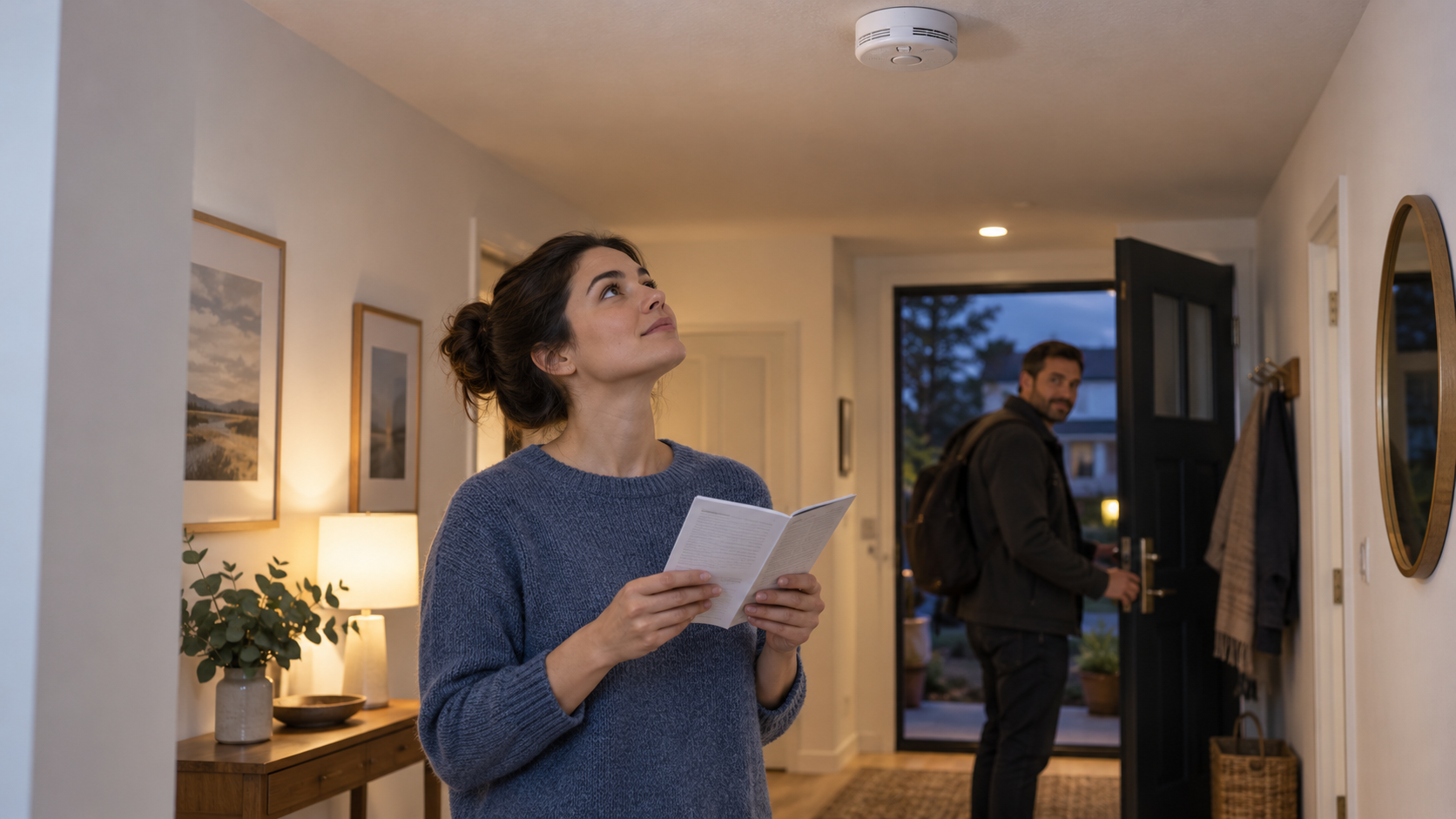
If a smoke alarm makes a short chirp every so often, it often needs attention rather than an emergency response. But do not decide that from annoyance alone. A loud repeating alarm, a voice warning, smoke, unusual heat, or any uncertainty is a reason to get everyone outside, stay outside, and contact local emergency services.
The safe order is simple: protect people first, identify the exact sound and device second, then follow that model’s instructions. Do not remove a battery just to make the noise stop.
Start by separating a chirp from an alarm
#A maintenance chirp is usually a brief, isolated sound with quiet time between repeats. A fire or carbon-monoxide warning is usually louder and repeats in a pattern, though the meaning can differ by brand and by whether the unit is a combination alarm. Voice alerts and lights add another clue, but the model label and manual are the final authority.
This table is a safety-first starting point, not a universal decoder.
| What you notice | Treat it as | First action |
|---|---|---|
| A short chirp at intervals, with no smoke, heat or voice warning | A maintenance or fault signal until the manual says otherwise | Find the device, read its label, and follow the model’s approved battery or test steps |
| Three loud beeps repeating, smoke, heat, or a spoken fire message | A possible fire emergency | Leave, stay out, and call local emergency services from a safe place |
| Four loud beeps repeating or a carbon-monoxide message | A possible CO emergency | Move everyone to fresh air, stay out, and call local emergency services |
| A sound you cannot identify | An unresolved safety signal | Treat it cautiously; leave if there is any sign of danger and get help rather than guessing |
Fire-safety education often uses three loud beeps for smoke/fire and four loud beeps for carbon monoxide. Your device may use a different pattern, especially if it is interconnected, hardwired, smart, or combines smoke and CO detection. That is why counting beeps is useful, but never enough on its own.
Find the actual source before touching anything
#Sound travels surprisingly well through hallways, stairwells, and hard ceilings. The alarm directly above you may not be the one chirping. In an apartment, the sound may even come from a common corridor or another unit.
Wait through one quiet interval and listen from room to room. Look for the small indicator light, display, or voice prompt your manual describes. If alarms are connected, one device can make every unit sound during a full alarm event; a maintenance chirp may still come from only one device.
Once you locate it, note four things before you open a cover:
- The brand and model number
- The manufacture date or replacement date
- Whether it has a battery drawer, a sealed case, or household wiring
- Whether it detects smoke only or both smoke and carbon monoxide
Taking a photo of that label and saving it with your home records makes a future chirp much less mysterious. It also stops a common mistake: buying a battery or replacement alarm before knowing what the unit actually requires.
If the alarm has a replaceable battery
#A periodic chirp can mean that the battery needs replacement. Use only the battery type and chemistry specified by the manufacturer. A battery that looks right is not automatically right for every alarm.
Check the basics slowly:
- Put the battery in with the correct orientation.
- Make sure the battery drawer or cover closes fully.
- Remove any protective pull tab or packing piece if the instructions mention one.
- Use the alarm’s own test button after the replacement, following the manual.
- Keep the alarm in service while you arrange a replacement battery whenever possible.
Do not use this as a reason to put a rechargeable battery into an alarm that calls for a different type. Do not bend contacts, pack material around a loose battery, or improvise a connection. A smoke alarm is safety equipment, not a device to repair by trial and error.
A sealed ten-year unit is different
#Some alarms have a long-life battery sealed inside. The battery is not a user-replaceable part. When a sealed device reports a low-battery, end-of-life, or fault condition, replacing the whole alarm may be the correct response.
Look for wording such as “sealed,” “10-year,” “replace by,” or an end-of-life symbol on the back. Do not pry a sealed alarm open or try to fit a new battery inside it. That can leave you with an altered device that no longer works as designed.
The useful question is not “Can I make this chirp stop?” It is “Is this device still within its service life and passing the manufacturer’s test?” If the answer is no, arrange a compatible replacement promptly.
Why it may chirp after a new battery
#A fresh battery rules out only one possible cause. If the chirp continues, pause before trying more fixes. Check the manual for the device’s reset procedure; some models need a manufacturer-directed reset after a battery change. Then check the label for the manufacture date and the required battery type.
Persistent chirping can also point to a partially closed drawer, the wrong battery, an expired alarm, a dirty sensing area, a fault, or a different alarm elsewhere in the home. The right next step depends on the model. Replacing batteries repeatedly without identifying the source can make it easier to miss an end-of-life warning.
Dust, steam, and placement need care, not shortcuts
#Dust or insects around vents can affect some alarms. Steam, humidity, cooking particles, and strong airflow can also cause nuisance behavior when an alarm is poorly suited to its location. That does not make it safe to leave the home unprotected.
Use only the cleaning method in the manual. For many alarms, that means a careful clean around the outside vents; it does not mean spraying cleaner, paint, water, or compressed products into the sensing chamber. If the instructions say the alarm must be replaced after contamination or fault, follow that direction.
A kitchen or bathroom problem may really be a placement problem. The answer is not to remove the alarm permanently. A qualified person or the responsible property party can help identify a safer placement or a device type that is appropriate for that area. The existing Allblogs placement guide can help when you are reviewing your home’s wider coverage, but do not move an alarm until you know that your local rules and its manual allow the change.
A worked example: the chirp that survives a battery change
#Imagine a hallway alarm gives one short chirp every minute. There is no smoke, no heat, and no spoken warning. The resident replaces the battery, but the sound comes back. The safe next move is not to keep pressing buttons or remove the device.
First, they listen again to make sure the hallway unit is really the source. Then they check the back label: it is a hardwired smoke-and-CO alarm with a backup battery, installed at the same time as two others. The manufacture date is nearly ten years old. The manual says a particular end-of-life signal requires replacement of the unit, not another battery.
That example leads to a better decision than “the battery did not fix it.” The resident can record the model and dates for the full group, ask a qualified person about compatible replacements, and keep the existing protection in place until it can be dealt with correctly. If the device instead had shown a power or interconnect fault, the same boundary would apply: no home wiring repair by guesswork.
The details will not be identical in every home. A battery-only alarm may need only the specified battery and a proper test. A sealed alarm may need replacement. A rental property may require a maintenance request. The repeatable part is the method: identify the model, check its age, follow its instructions, and escalate the work that is outside a resident’s safe role.
Hardwired and interconnected alarms have extra boundaries
#Hardwired alarms are connected to household power, but many still have a backup battery. They can chirp because that backup battery is low, because the unit is old, or because there is a power, interconnect, or device issue.
You can safely do only the user steps the manual clearly describes. Do not open a junction box, alter permanent wiring, swap wired units because plugs look similar, or disconnect an interconnect circuit. A hardwired alarm that continues to signal after the approved battery, test, and reset steps needs the responsible qualified person.
If several compatible alarms were installed at the same time, check the dates on all of them. One end-of-life chirp can be a useful reminder that the rest of the group may be near the same age. It does not automatically mean every alarm must be replaced that night, but it does mean the household should review compatibility before buying replacement units.
Four assumptions that can make a small problem worse
#Do not assume a chirp always means only a battery. It is often a battery warning, but a sealed unit, an expired sensor, a fault, or an electrical issue can use a similar attention signal. The model documentation settles that question.
Do not assume a quiet alarm is a working alarm. Press the test button on the schedule in the manual, and replace a unit that cannot complete its approved test. A device that has been silenced, disconnected, or left without its required power source is not a solution to nuisance noise.
Do not assume a smoke-only alarm can warn about carbon monoxide. Only a combination model or a dedicated CO alarm has that function. If an alarm identifies CO, or if people feel unwell around a fuel-burning appliance, leave first instead of trying to interpret the warning indoors.
Finally, do not assume the same model can always replace a wired alarm. Interconnected systems can have compatibility requirements that are not visible from the ceiling. Keep the model information and use qualified help when a permanent system needs replacement.
Renters: report the fault instead of repairing the system
#If you rent, a simple battery change may be allowed by your agreement and the alarm instructions. A sealed, damaged, hardwired, repeatedly chirping, or non-working alarm is different. Record the model, location, date, and what you observed, then tell the landlord, building manager, or maintenance contact.
Rules about who supplies, tests, or replaces alarms differ by country and rental agreement. The practical boundary is consistent: do not take responsibility for permanent wiring or a faulty installed system that you cannot safely verify. If the alarm does not work after the approved battery step, report it rather than accepting an unprotected room.
Make the next chirp easier to handle
#Most smoke-alarm stress comes from not knowing what is installed. A short household record removes that uncertainty. For each alarm, keep the room, model, power type, manufacture or replace-by date, and any compatible replacement notes. Review the record when you test the alarms.
General fire-safety guidance recommends testing alarms monthly and replacing units around the ten-year mark, while the exact manual and local requirements still take priority. A test button checks that the alarm can produce a sound; it does not prove every possible sensing condition. It is still a useful routine check, especially after maintenance.
If a household member cannot hear an alarm reliably, consider whether an approved visual, vibrating, or other accessible alert is needed for the home. That is a safety-planning decision worth discussing with local fire-safety services or the property provider, not something to postpone until a chirp becomes a crisis.
The decision to make tonight
#If the sound is a short periodic chirp and there are no emergency signs, identify the device and follow its manual. Replace a specified user battery, test the alarm, and replace a sealed, expired, damaged, or failed unit when the manufacturer directs it. If a hardwired system, interconnect, or rental-property repair is involved, ask the responsible professional or property party to handle it.
If the sound is loud and repeating, if a voice alert names smoke or carbon monoxide, or if you see or smell danger, do not troubleshoot from a hallway. Get out, stay out, and call local emergency services from a safe location.