Nothing ruins a cold morning faster than stepping into an icy shower and spotting a slow puddle creeping out from beneath a rusted hot water tank in the garage. Half an hour later a plumber is standing in your doorway pitching three totally different machines—a standard storage tank, a wall-hung tankless heater, or a tall hybrid heat pump water heater—while brochures floating around online still wave a $2,000 federal tax credit that quietly disappeared at the end of 2025!
Here is the real replacement picture in 2026 and 2027: first, the federal Section 25C tax credit dropped to $0 for any water heater installed after December 31, 2025, so check utility and state HEAR rebates instead of counting on an IRS write-off. Second, a same-fuel storage tank stays the fastest, cheapest emergency swap with no surprise pipe or wiring bills; a hybrid heat pump slashes monthly electric bills dramatically when basement space and utility rebates line up; and gas tankless only justifies its premium once gas pipe sizing, stainless venting, and cold winter flow math are checked upfront.
Let's cut past glossy sales pitches and compare real installed retrofit bills, why electric whole-home tankless systems blow right past normal home breaker panels in January, where hybrid heat pumps chill nearby rooms, and what annual upkeep each unit actually demands.
First Clear Up the 2026 Tax Credit Confusion (Section 25C Expired)
#Before building any ten-year payback spreadsheet, check what actually happened to federal credits so nobody drops $3,500 expecting IRS money next spring that isn't coming.
Following changes under Public Law 119-21 noted in IRS Energy Efficient Home Improvement Credit guidance, the Section 25C federal credit expired after December 31, 2025. Only homeowners who physically installed and put a qualifying unit into service on or before December 31, 2025 claim up to $2,000 (heat pump) or $600 (qualifying high-efficiency gas tankless) on Form 5695. For any heater installed during 2026 or later, Section 25C federal tax credits sit at $0.
Where real rebates still live right now in 2026:
- Local electric and gas utility instant rebates: Dozens of municipal and regional power utilities still take $400 to $1,500+ straight off an ENERGY STAR heat pump water heater when swapping out an old electric tank, often directly at distributor checkout or as a bill credit.
- State-run HEAR (Home Electrification and Appliance Rebates): Income-eligible households (generally under 150 percent of area median income under state-launched federal grant rollouts) can still tap sizable point-of-sale heat-pump water heater rebates depending on state rollout status. Always check active zip-code rebates before signing any plumbing quote.
Three-Way Comparison: Standard Tank vs. Tankless vs. Hybrid Heat Pump
#Comparing equipment price tags inside a warehouse skips half the invoice—installed totals swing wildly depending on whether your wall already carries heavy gas supply lines or a dedicated 240-volt circuit.
| Ownership Factor | Conventional Storage Tank | Gas Tankless (Condensing/Standard) | Hybrid Electric Heat Pump Tank |
|---|---|---|---|
| Typical Equipment Price | Lowest ($600 to $1,400 typical) | Moderate to High ($1,000 to $2,000+) | Moderate to High ($1,500 to $2,500+) |
| Surprise Retrofit Costs | Lowest on same-fuel like-for-like swap | Can add $800 to $2,000+ (gas pipe, venting, condensation drain) | Often low on existing electric tanks; 240V circuit needed if swapping gas |
| Typical Expected Lifespan | Roughly 8 to 12 years | Commonly 15 to 20 years with annual flushes | Roughly 10 to 15 years |
| Monthly Energy Cost | Moderate (heat standby losses from tank) | Lower than standard gas tank (zero standby heat loss) | Lowest electric usage (uses far less power than plain electric resistance tanks) |
| Endless Hot Showers | Runs out once 40-50 gallon tank empties | Continuous hot water while within GPM limit | Large 50-80 gal recovery; can run hybrid element backup when heavy |
| Room & Sound Footprint | Quiet, compact corner footprint | Tiny wall-mounted footprint frees floor space | Taller, needs room air volume (~700+ cu ft), hums gently like a fridge/AC, cools room |
Heat-pump appliances across a house share similar trade-offs too—just like comparing a heat pump vs condenser tumble dryer, moving ambient warmth instead of blasting bare heating coils drops monthly electric bills massively, as long as you give the unit smart placement and realistic recovery expectations.
Why 'Cheap' Tankless Swaps Surprise People With Big Retrofit Bills
#Walk down a hardware store aisle, spot a compact wall-mounted tankless unit tagged around $900 to $1,300, and it is super tempting to think you can trade out a rusty barrel tank without spending much more. Then two licensed contractors walk into your mechanical room and the installed quote quietly doubles or triples.
Three physical upgrades drive most tankless installation shocks:
- Upsizing the Gas Line (For Gas Tankless): An old 40-gallon gas tank sips around 36,000 to 40,000 BTUs steadily through a narrow 1/2-inch gas pipe. Firing up a whole-home gas tankless burner to feed two winter showers pulls 150,000 to 199,000 BTUs instantaneously—starving existing narrow 1/2-inch lines and forcing plumbers to run thicker 3/4-inch black iron or CSST lines all the way back toward your gas meter.
- Dedicated Stainless or PVC Venting: Old atmospheric storage tanks send gentle warm exhaust up cheap single-wall metal flue pipe. Non-condensing gas tankless models blast hotter pressurized exhaust requiring costly Category III sealed stainless steel pipe, while condensing models need dual PVC intake/exhaust holes drilled outside plus an acidic condensate neutralizer line.
- House Electrical Panel Limits (For Electric Whole-Home Tankless): Never confuse a tiny under-sink booster with a whole-home electric tankless unit! Look at the breaker numbers right below—installing whole-home electric tankless in cold winter cities often means discovering a 100A or 150A house panel needs a $2,500+ main service upgrade before the box even turns on.
How to Size Tankless Flow Rates for Freezing Winter Water
#Big print on tankless boxes loves screaming "9.5 GPM Max Flow Rate"—then tucks "at a 35-degree F temperature rise" into tiny footnote text. That one marketing shortcut leaves plenty of cold-climate homes standing under lukewarm January showers!
Think simply about Temperature Rise (how many degrees the heater lifts cold water) without turning this into some physics class: a tankless unit warms whatever icy tap water rolls in from underground city pipes up to your desired 120 degrees F output.
- In mild southern cities like Phoenix or Tampa, winter ground water sits around 65 degrees F—so heating it to 120F requires only a 55 degrees F rise (120 minus 65). Even mid-sized units handle two showers smoothly!
- In freezing northern states or Canadian winters (Chicago, Toronto, Boston, Minneapolis), street mains chill down to 40 to 45 degrees F—forcing the exact same heater to lift water 75 to 80 degrees F (120 minus 45)!! Look what happens on gas tankless in January: that big "9.5 GPM" sticker rating cuts right in half down to 4.5 to 5.0 GPM, barely feeding two low-flow 2.0 GPM showers without somebody hitting the washing machine cold-fill valve.
Now run Electric Whole-Home Tankless numbers through standard U.S. Department of Energy electric sizing (Required kW = GPM x Temp Rise / 6.83):
Suppose two taps run at once totaling 3.5 GPM (one 2.0 GPM shower plus a 1.5 GPM kitchen sink) during a 75 degrees F winter temperature rise (45F city inlet to 120F shower output):
Required kW = (3.5 x 75) / 6.83 = 38.4 kW!
Dividing 38,400 Watts by normal 240 Volts demands 160 Amps purely for hot water alone!! Mainstream whole-home electric boxes run 18 kW to 36 kW (75 Amps to 150 Amps split across two, three, or four heavy 40A double-pole breakers). Unless you live in a warm coastal climate with huge 200A–400A service capacity—or just need a tiny single-sink point-of-use heater—whole-home electric tankless seldom makes sense on northern homes. Gas tankless or hybrid heat-pump tanks beat it almost every single time.
(Safety note: Never guess breaker space or mess with 240V high-amperage wiring or gas lines yourself—have a licensed electrician check panel load math and a licensed plumber verify venting and gas capacity before ordering hardware online.)
When a Hybrid Heat Pump Quietly Wins—And Where It Annoys You
#If your home currently runs a standard 50-gallon electric resistance tank (heating water 24/7 with pricey resistance coils) and you want serious monthly savings without pulling new gas pipes through finished walls, ENERGY STAR hybrid heat pump water heaters hit a really strong sweet spot right now.
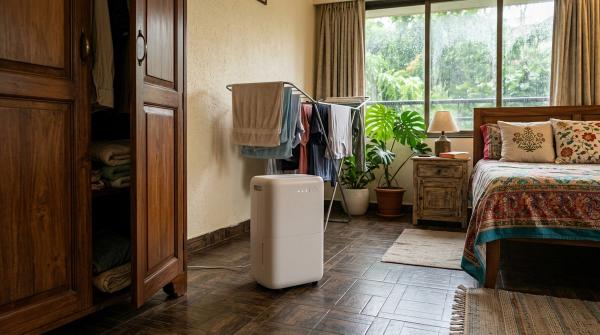
Instead of turning raw electricity straight into heat, a heat pump pulls ambient warmth out of the air in your garage or basement (using a compressor sitting on top of the tank, basically like a refrigerator working backward) and pushes that heat into stored water. Moving existing room warmth rather than generating heat from scratch cuts water-heating electricity bills by roughly two-thirds compared to regular electric tanks—saving real cash every month even without old Section 25C federal credits.
Just weigh four real-world quirks plumbers forget to bring up before installation:
- It blows cool dry air and pulls warmth from small rooms: Inside a hot humid garage in Georgia or Texas, cool dry exhaust feels like a nice free bonus dehumidifier! Tucking an un-ducted heat pump inside a cramped hallway closet or small finished Michigan basement in January steals indoor warmth your main home furnace already paid to heat—unless you duct air paths or meet open room volume rules (typically ~700+ cubic feet of open air or louvered doors).
- Soft compressor hum: Regular electric tanks stay dead silent. Hybrid heat pumps run a quiet fan and compressor humming around 45 to 55 dBA (similar to a fridge or soft window fan) while reheating after showers, so avoid thin drywall backing straight onto someone's bedroom pillow.
- Slower pure-heat-pump recovery vs gas: "Hybrid / High Demand" mode automatically switches on backup electric resistance coils when six guests shower sequentially, yet pure heat-pump mode takes longer to recharge—so sizing up to a 65-to-80 gallon hybrid tank instead of settling for 50 gallons keeps multi-bathroom households happier.
- Extra height and condensate drain: Mounting the compressor above the tank adds noticeable height and produces steady clean condensation needing a nearby floor drain or small condensate pump.
Maintenance Reality: Flushing Scale vs. Swapping Anode Rods
#The purchase price is only half the life story—ignoring cheap mineral upkeep ruins both storage tanks and expensive tankless units years before their time.
When municipal water heats up inside metal chambers, dissolved calcium and magnesium solidify into hard rocky calcium carbonate scale (we broke down how local hardness builds up inside our hard water calcium scaling explainer):
- Tankless Maintenance (Annual Descaling): Gas and electric tankless machines push water rapidly through tight copper or stainless heat-exchanger channels. In moderate or hard-water cities, skipping an annual vinegar or food-safe descaling flush through service isolation valves lets limestone choke flow sensors and overheat metal passages—cutting a 20-year machine down near 7 years and often voiding factory warranty claims without maintenance records! Add a scale filter or proper softener if local water runs above roughly 7 to 10 grains per gallon (around 120 to 170 ppm).
- Storage & Hybrid Tank Maintenance (Draining + Anode Rod Checks): Standard and hybrid tanks sit water inside glass-lined steel protected against rust by a sacrificial magnesium or aluminum anode rod threading straight into the top cap. Spending twenty minutes checking and replacing that ~$30 to $60 anode rod every three to five years (before it erodes down to bare steel wire) plus draining sediment yearly regularly stretches a basic tank past 12 to 15 years!
A Quick 60-Second Filter to Pick Your Next Water Heater
#Dont overcomplicate an emergency water-heater leak when the garage floor is already wet. Match your existing utilities and realistic budget first:
- Pick a Same-Fuel Standard Storage Tank if: Your tank just started leaking midweek, you want a fast $1,000 to $2,200 like-for-like swap instead of $3,500+ retrofit bills, or an older 100A electrical panel and tight 1/2-inch gas lines leave zero upgrade room.
- Pick a Gas Tankless Unit (Condensing) if: Accessible 3/4-inch gas capacity and clean exterior wall venting already sit nearby, freeing closet floor space matters, consecutive long family showers keep emptying a 50-gallon tank, and you wont skip a quick annual scale flush.
- Pick a Hybrid Heat Pump Tank if: You already heat water on 240V electricity (or are planning panel capacity alongside our Level 1 vs Level 2 home EV charging planning guide), have open airy basement or garage square footage near a floor drain, plan to stay five+ years, and live where utilities still hand out strong rebates.
Ask every quoting contractor to split their estimate cleanly into two separate lines—hardware cost vs gas/vent/electrical retrofit charges—and verify live local utility rebates before giving the go-ahead. Honestly people defintely skip that one question when water is pooling on the floor, and paying slightly closer attention upfront easily saves a grand in surprise add-ons.