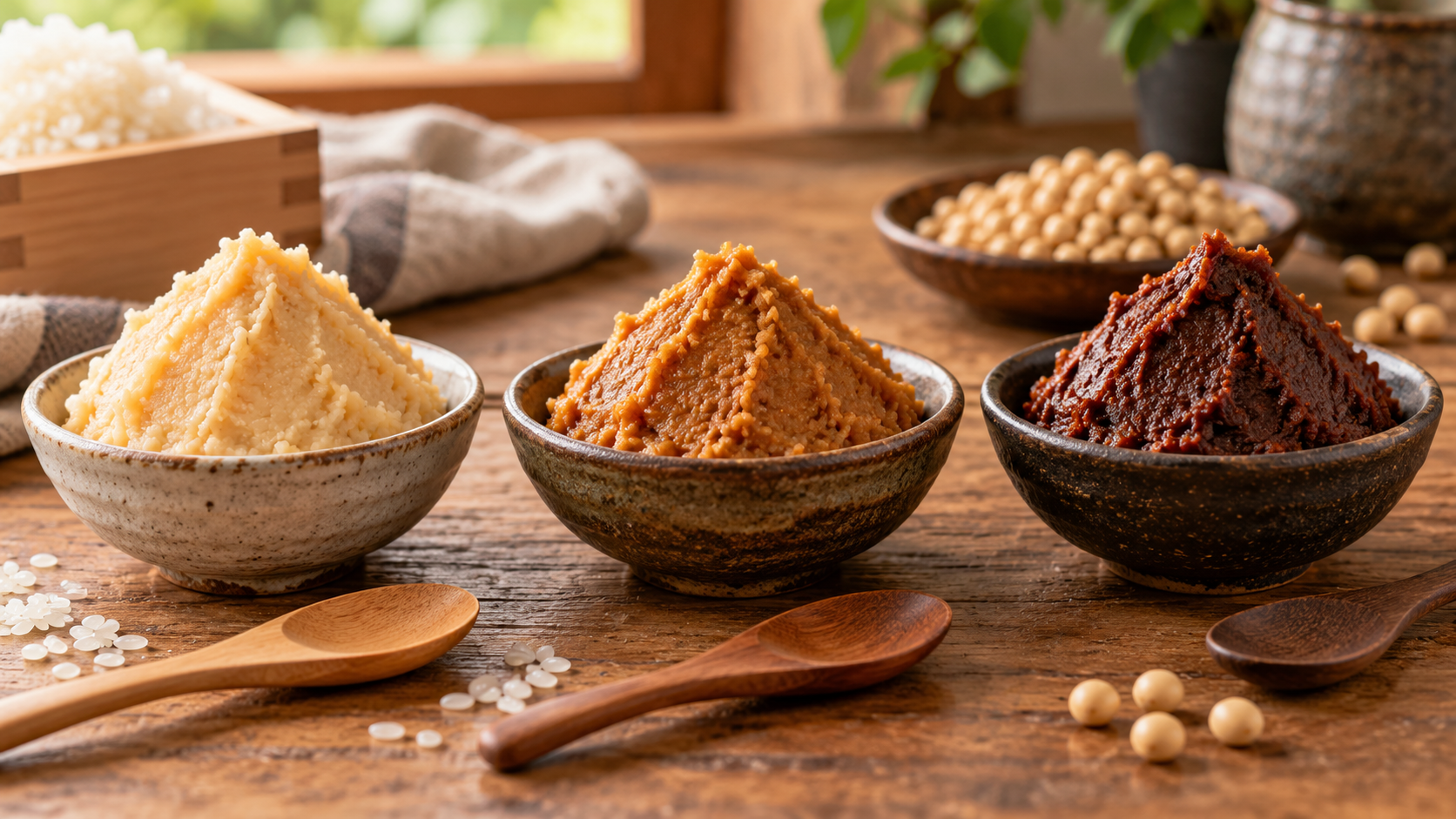
Start with white or awase miso if you want one flexible tub for everyday cooking. Choose red miso when you want a more assertive fermented flavor. Then turn the package over: its ingredients, added stock and salt information tell you more than the color alone.
The useful difference between white and red miso is usually flavor intensity. White tends toward gentle sweetness; red often brings a deeper, stronger savory taste. Awase means a blend. None of those names guarantees a particular salt level, ingredient list or suitability for a special diet.
That matters when a recipe asks for white miso and the shop has three beige tubs, a dark paste and an instant soup packet. They are not necessarily interchangeable. Here is how to choose the right kind, understand the label and make a sensible adjustment when you already have a different tub open.
Miso has more than one kind of name
#Miso is a Japanese fermented seasoning, usually made with soybeans, salt and koji. Koji is the fermentation starter; it can be grown on rice, barley or soybeans. The finished paste provides umami, the savory quality that makes a broth or sauce taste fuller.
Several naming systems overlap. A package can describe the grain used, its color, a regional style and whether stock has been added. Think of these as separate questions rather than competing names for the same thing.
Kome miso uses rice koji. Mugi miso uses barley koji. Mame miso uses soybean koji. A white rice miso and a red rice miso can therefore belong to the same ingredient family while tasting quite different. Conversely, two dark pastes may use different ingredients and have different aromas.
You do not need to memorize every regional name before making dinner. Learn to recognize the distinctions that affect the food in front of you: sweetness, savory intensity, texture and added seasoning. The rest becomes useful as you discover the styles you enjoy.
White, red and awase at a glance
#| Label or description | What it suggests | A useful starting point | What still needs checking |
|---|---|---|---|
| White or shiro | Often lighter, with some sweetness | Gentle sauces, dressings and lighter soups | Whether it is a particularly sweet style or an everyday savory white miso |
| Red or aka | Often a stronger aroma and deeper savory flavor | Hearty broths and robust sauces | Actual salt level, ingredients and intended recipe style |
| Awase | A blend of misos | Everyday soup and flexible general cooking | Which styles are blended and whether dashi is included |
| Yellow or light-colored | A color description often used for everyday miso | General cooking when the flavor description fits | The maker's terminology and the package directions |
| Saikyo-style sweet white | A particularly sweet, delicate direction | Recipes designed around sweet white miso | Whether a less sweet substitute would change the dish |
Use this table to narrow the shelf, not to skip the back label. Miso classifications are more varied than a simple light-to-dark scale suggests.
White miso is not always the very sweet one
#A pale, sweet white miso such as a Saikyo style can behave differently from an everyday white miso. Both may look like sensible choices for a recipe that simply says “white miso,” yet the balance of the finished sauce can change.
One real example is Hikari's Organic White Miso, which the producer describes as Shinshu-style, with a savory balance and subtle sweetness. It is not a promise that every product sold as white miso has the same character. If a recipe specifically names sweet white miso, preserve that detail when shopping.
For a first purchase, ask what you will actually make. A general savory white paste is a practical option for a range of meals. A particularly sweet style makes more sense when you have a recipe that calls for it. Neither is the better product in every situation.
Red describes color, not one fixed recipe
#Red miso often has a mature aroma and a more forceful flavor. That makes it useful when you want the miso to remain noticeable alongside strong ingredients. It does not mean every red miso is equally dark, equally salty or made entirely from soybeans.
Japan's Ministry of Agriculture, Forestry and Fisheries distinguishes sweet red rice miso as well as other red styles. That is an important exception to the common shortcut that all red miso is salty and all white miso is sweet. Color gives a clue; the particular style completes the answer.
If you dislike a very strong paste on its own, do not assume you dislike red miso in food. A seasoning is meant to be judged in context. Equally, choosing a darker paste simply because it sounds more authentic does not make it right for a delicate sauce.
Awase is a blend, not a universal midpoint
#Awase miso combines miso styles. It can be a convenient everyday choice, but the word does not specify a fixed proportion of white and red or one exact taste. Look for the maker's description of the blend.
Choose it when flexibility matters and the label suits your cooking. If you need to reproduce a dish whose character depends on a particular miso, the named style is more useful than a general promise of balance. A blend is a deliberate flavor choice, not a guarantee that every substitution problem has disappeared.
Read the label in this order
#First check that you are buying the product the recipe expects. Thick miso paste, liquid miso seasoning and an instant soup mix are different formats. A measured spoonful of liquid seasoning should not automatically replace the same spoonful of paste. Follow the product's own dilution instructions when using a prepared soup base.
Next, read the ingredients for the grain or bean base. This helps explain the style and matters when someone needs to avoid an ingredient. Barley miso contains barley; rice miso commonly still contains soybeans. “Made with rice” does not mean “made without soy.”
Then check for added dashi. Dashi is stock, and dashi-iri means stock is included. It can be helpful for quick soup, but it also commits the paste to that stock's ingredients and flavor. A plain paste leaves you more control over the broth you use.
For example, Hikari's Dashi Iri White Miso lists bonito, a fish ingredient, alongside kelp. That particular product is not suitable for a vegetarian meal. Other products use vegetable stock, so the lesson is to read the ingredients rather than assume every dashi is fish-based or every miso is vegetarian.
Finally, compare salt or sodium information using the same serving size or weight. A smaller printed number can be misleading if the manufacturer's serving is smaller. For dietary restrictions or allergies, use the current pack's ingredient and allergen declarations; ask the manufacturer when essential information is unclear.
Choose for the meal you want to cook
#For a light dressing or sauce, begin with a mild white miso unless the recipe specifies otherwise. It gives you room to build the other flavors without immediately making the paste the loudest ingredient. Smooth texture is convenient here, particularly when the sauce needs to coat a leaf evenly.
For everyday miso soup, white or awase is a reasonable starting point. Red can also make good soup when you want a stronger character. The broth is a separate decision: adding miso to an already salty stock requires different seasoning judgment from adding it to an unsalted base.
For a hearty stew, a robust red miso may fit the depth you want. If the stew already contains salty ingredients, keep those in mind before adding more. A richer taste is not a reason to ignore the combined seasoning of the whole pot.
For a sweet glaze or a dessert, follow the specified style more closely. A mild paste can support the other ingredients, while a strong one can change the intended balance. A recipe developed around sweet white miso is a better starting point than improvising a direct swap in an unfamiliar bake.
These are cooking directions, not rigid rules. A mild soup can be delicious, and so can a bold one. The practical aim is to choose deliberately rather than discover the difference after adding the entire amount.
Can you substitute red miso for white miso?
#Often you can adapt a flexible soup or sauce, but there is no dependable universal conversion. The replacement may change sweetness, color, aroma and saltiness together. Reducing the amount addresses intensity; it does not automatically reproduce the missing sweetness or texture.
For an adjustable dish, keep some of the recipe's miso back at first. Dissolve a small amount of the replacement in a little of the dish's liquid, combine it thoroughly and taste before adding more. Hold back other salty seasonings until the miso is incorporated.
If the dish becomes too assertive before it tastes like the original, stop chasing an exact match. Decide whether the new direction still suits the meal. You may prefer a different sauce, a smaller amount of miso or a recipe designed for the paste you own.
Going the other way needs judgment too. More mild white miso will not necessarily recreate the mature aroma of a dark paste. Adding spoon after spoon may make a dish too salty before the desired flavor appears. Accept a gentler result when it works, or buy the named style when that flavor is central.
A worked shopping decision
#Imagine you want one tub for a mild vegetable soup now and a dressing later. The shelf offers plain white paste, fish-dashi white paste and a strong red paste. This is an illustrative choice, not a product test.
If both meals need to be vegetarian, check the ingredient lists first. Eliminate the fish-dashi option for that requirement. Between the remaining two, plain white is the more straightforward fit for the gentle flavor you planned. Check whether it is a sweet specialty style or a general savory one before buying.
Now imagine the next recipe asks for red miso. You can decide whether a milder version of the dish is acceptable instead of buying another tub automatically. What you should not do is add unlimited white miso in an attempt to force the exact red-miso character. The recipe's purpose determines whether adaptation makes sense.
Add miso without lumps or accidental over-seasoning
#In soup, a useful method is to finish cooking the other ingredients, turn off the heat and then mix in the miso. This helps preserve its aroma. It does not mean a soup is ruined if it briefly comes back to a simmer, or that every miso dish must stay unheated.
Before adding a thick paste, loosen it in a small bowl with a little warm broth. Work it smooth, then stir it back into the pot. This lets you distribute the seasoning evenly instead of leaving a dense lump at the bottom and over-correcting a bland spoonful from the top.
For a cold sauce, the same mixing principle applies: loosen the paste with part of the liquid, then incorporate the other ingredients. Taste it with the food it will accompany. A sauce that seems strong on a bare spoon may be balanced when spread across a larger portion of vegetables or noodles.
Glazes follow their own cooking method. Miso is used on grilled or broiled food as well as in soup, so “never heat miso” is too broad. Use a recipe that tells you when to apply the glaze and watch its surface as it cooks. Do not turn advice about preserving soup aroma into a ban on cooked miso dishes.
Three problems worth catching early
#If the dish is too salty, stop adding salty condiments. In a flexible soup, an appropriate unsalted liquid can dilute the seasoning, though it also changes the body and the quantity. Adjust only as far as the dish can tolerate. Sugar or lemon can change the balance of tastes, but they do not remove salt.
If the sauce tastes heavier than intended, ask whether you chose a stronger miso or added too much. Trying a little sauce with the intended food is more useful than immediately adding several new ingredients. For a future batch, change one thing at a time so you know what helped.
If the texture is grainy, inspect the style before calling it a mistake. Some misos deliberately retain visible grains. For a smooth finish, choose a smoother paste next time or work the current paste carefully into the liquid. Graininess, strong aroma and dark color are different characteristics; none alone tells you everything about quality.
Keep the tub useful after opening
#Follow the package's storage directions and refrigerate opened miso. Use a clean, dry utensil, close the container tightly and keep sauce residue or crumbs out of the original tub. Measure what you need into a separate bowl before mixing it with other ingredients.
Miso can gradually darken during storage. That can be a normal change, not proof that the paste has spoiled. It also does not make every changed-looking tub safe: follow its date and storage instructions, and seek product-specific advice if you are unsure. This guide does not set one shelf life for every formulation.
The best first purchase is a tub you can use for meals you already want to cook. Check the format and ingredients, choose the flavor direction, and keep control of the final seasoning. Once you know how that particular miso tastes in your food, choosing the next style becomes much easier.