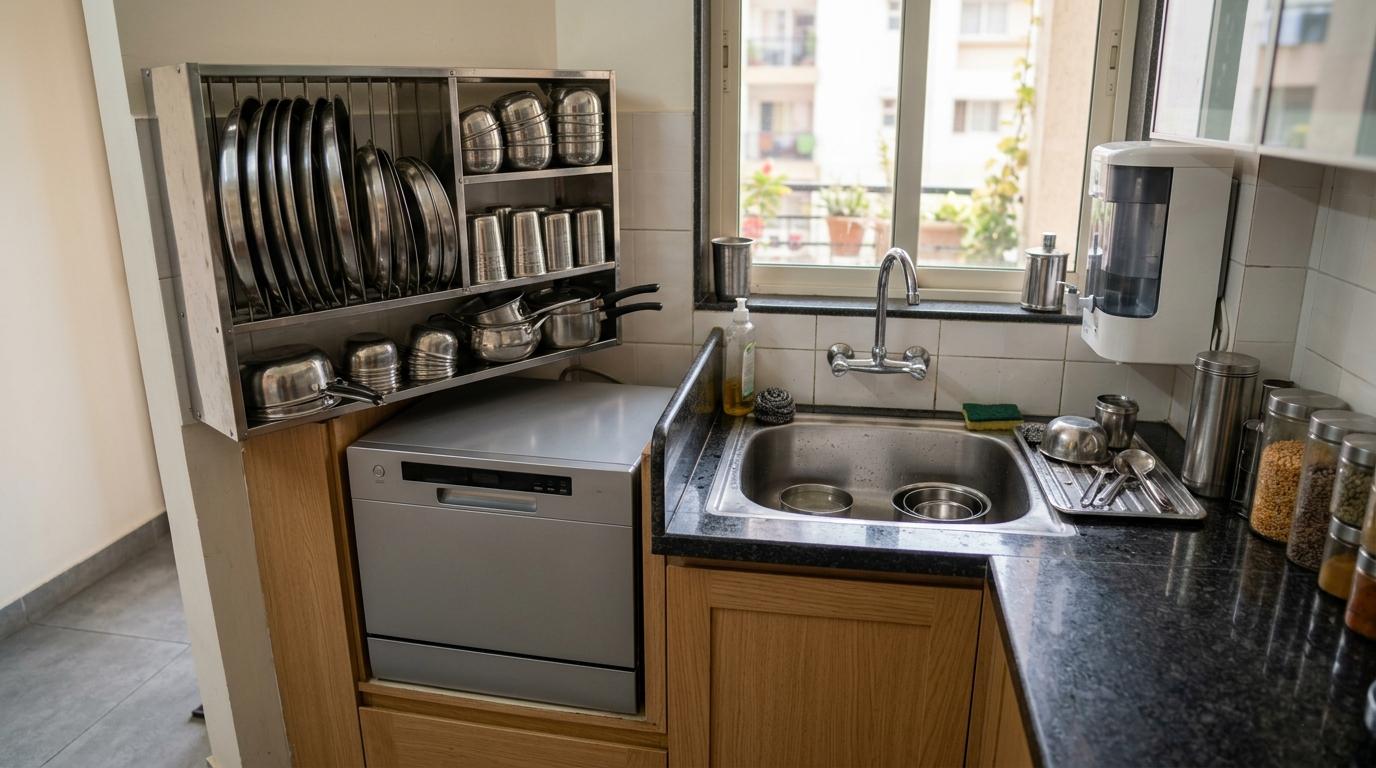
Short answer: if your family cooks Indian food every day and has safe space, plumbing and power, a full-size dishwasher is usually the better long-term choice. If you rent, live alone, or have a tiny kitchen, a countertop dishwasher can help with plates, cups and small pans. If space, budget or utensil type does not fit, hand washing is still valid—just avoid a constantly running tap.
When hand washing still makes sense
#Hand washing is not outdated. It is flexible, cheap to start and works for items that many dishwashers should not handle: cast iron, copper, brass, wood, delicate glass, sharp knives with special handles and plastics not marked dishwasher-safe.
It also works when you need one cup or pan immediately. A dishwasher is best as a batch-cleaning tool, not a one-spoon emergency tool.
The weak point is water and consistency. If dishes are washed under a running tap, water use can rise quickly. Cleaning also depends on the person washing, the detergent, water temperature and how much effort goes into oily cookware. For busy households, that inconsistency is often the real reason to consider a machine.
When a countertop dishwasher is the practical middle path
#A countertop dishwasher can make sense for small apartments because it avoids major cabinet work. Some models connect to a tap; some allow manual filling; all need a safe drain plan. Always check the manual before buying, not only the product listing.
Its biggest advantage is rental-friendliness. If you move, you can usually take it with you. It can handle plates, bowls, cups, spoons, glasses, smaller pans and lunch boxes for a small household.
Its biggest limitation is capacity. Large kadais, cooker lids, tall vessels and multiple serving bowls may not fit well. If your daily sink is full after lunch and dinner, a countertop model may only solve half the problem.
Choose a countertop dishwasher if it can sit close to the sink, your utensil load is modest and your kitchen platform can safely support it. Skip it if you expect it to replace heavy family-level dishwashing.
When a full-size dishwasher is worth it
#For families that cook proper Indian meals daily, a full-size freestanding dishwasher is usually the better fit. It has more rack space, handles larger loads and is more realistic for steel plates, bowls, glasses, cooker parts and oily pans.
Look for practical features, not hype: adjustable racks, foldable lower-rack tines, a removable filter, clear salt/rinse indicators, a built-in water softener for hard-water areas and a heavy or intensive wash program suitable for greasy utensils. Check the product manual for temperature, materials and cycle details rather than assuming every model works the same way.
A full-size dishwasher works best when you scrape food waste, load dishes through the day and run one full or near-full cycle. Running multiple half-empty cycles weakens the water and energy argument.
Water and electricity trade-offs
#Modern efficient dishwashers can use less water and energy than washing the same load by hand under a running tap because they spray and recirculate water instead of keeping water flowing continuously. Official efficiency guidance from ENERGY STAR and the US Department of Energy supports this general principle for efficient models, though Indian homes should still check local model labels and manuals.
That does not mean every dishwasher run is automatically efficient. You get better results when you scrape instead of pre-wash, use the right cycle, clean the filter and run fuller loads.
Electricity is the trade-off. Dishwashers use power for pumping, heating, controls and drying support. Intensive cycles use more than quick or eco cycles. So the real comparison is water, electricity, detergent, effort, time and cleaning consistency—not just appliance versus no appliance.
Installation checklist for Indian apartments
#Before buying, check the kitchen—not the discount banner.
- Water inlet: Is there a spare tap or inlet near the machine location?
- Drain route: Can dirty water drain without leaks, backflow or smell?
- Safe socket: Is there a properly rated socket nearby? Avoid loose extension boards.
- Door clearance: Can the dishwasher door open fully without blocking the kitchen?
- Rack access: Can you stand comfortably and load vessels without twisting awkwardly?
- Water hardness: Do you need salt and a built-in softener?
- Rental rules: Will plumbing or cabinet changes violate your rental agreement?
- Service access: Can a technician reach and move the machine if needed?
Dishwasher buying checklist
#Use this quick checklist before paying:
- Match capacity to household size and cooking habits.
- Measure width, depth, height and door swing.
- Confirm whether your largest plates, bowls and common cookware fit.
- Check if your steel, glass, ceramic and plastic items are dishwasher-safe.
- Keep cast iron, wood, copper, brass and delicate items for hand washing unless the maker says otherwise.
- Prefer adjustable racks for Indian mixed loads.
- Check service availability in your city.
- Budget for detergent, rinse aid and dishwasher salt where needed.
- Read the manual for cleaning, filter care and water-hardness setup.
- Avoid buying only because a brand says “Indian kitchen friendly.” Verify the rack layout and cycle details.
Maintenance habits that matter
#A dishwasher is not maintenance-free. Scrape large food pieces before loading. Clean the filter regularly. Use only dishwasher detergent, not regular dish soap. Refill salt if your model and water hardness require it. Use rinse aid if you see water spots or poor drying. Let the machine air out after cycles according to the manual.
If dishes smell, come out cloudy or remain oily, the usual causes are blocked spray arms, overloaded racks, clogged filters, wrong detergent, no salt in hard water or a cycle that is too light for the load.
Final verdict
#Buy a full-size dishwasher if you cook daily for a family, have space and can set up water, drain and power safely. Choose a countertop dishwasher if you rent, cook lightly and can place it near the sink. Continue hand washing if your loads are small, your utensils are not dishwasher-safe, or the setup would be unsafe or inconvenient.
The best choice is the one that fits your kitchen, water quality, utensils and routine—not the fanciest appliance on sale.