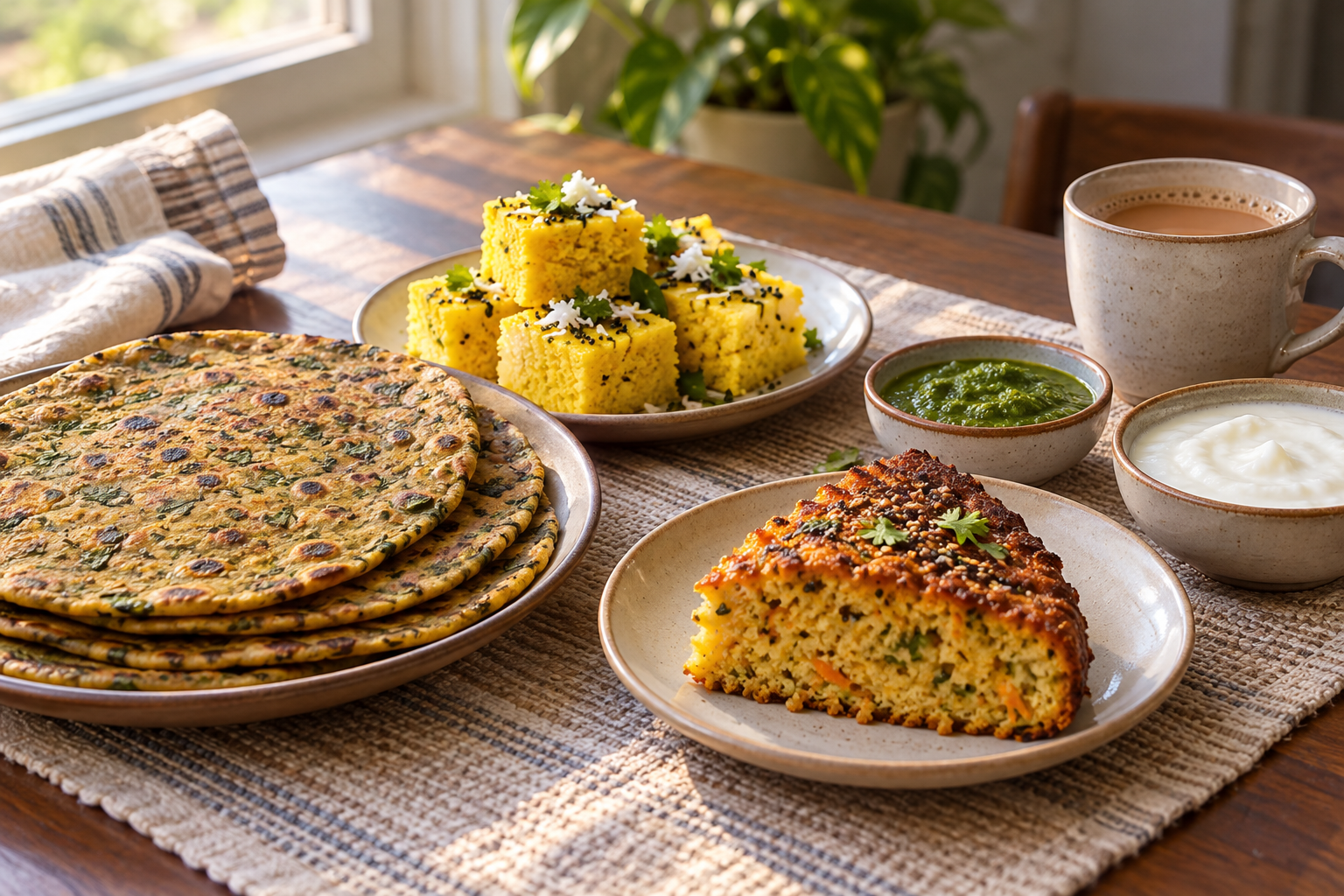
Gujarati breakfast is bigger than fafda and jalebi. If you want a simple starting point, try thepla for a filling flatbread, khaman for something soft and savoury, or handvo for a heartier slice. Fafda and jalebi make a memorable sweet-and-crisp pairing, but they are only one part of the morning table.
This guide is for choosing what to order or make, not for treating every Gujarati snack as a breakfast staple. The same dish can turn up at breakfast, with afternoon tea, or as part of a larger meal. Families, shops and regions serve them differently.
Start with the texture you want
#| If you want | Try | What to expect |
|---|---|---|
| A soft flatbread you can eat with curd or pickle | Thepla | Spiced, flexible and easy to carry |
| A light, spongy savoury bite | Khaman | Steamed gram-flour squares, often with a tempering and chutney |
| A more substantial slice | Handvo | A savoury lentil-and-rice cake, often with bottle gourd and a browned crust |
| Something thin and crisp with tea | Khakhra | A dry, toasted flatbread that breaks with a snap |
| A hot street-style treat | Fafda with jalebi | Crisp, salty gram-flour strips beside a syrupy sweet |
| A quick griddle breakfast | Pudla | A savoury pancake, commonly made with gram flour |
These are descriptions, not fixed serving rules. Ask what is fresh that morning, especially for steamed items. If you are ordering for several people, a mix of soft, crisp and filling dishes is more useful than six versions of the same snack.
Thepla: the everyday flatbread
#Thepla is a thin spiced flatbread, often made with wheat flour, gram flour and fenugreek leaves. It works as breakfast, a snack or part of a meal. Gujarat Tourism describes it with dahi, chhundo and garlic chutney; that combination shows why thepla is easy to adapt: mild bread, something creamy, and a sharper accompaniment. Its description of thepla also notes bottle-gourd and radish variations.
If a menu says methi thepla, methi means fenugreek leaves. A plain thepla is useful when you want something you can hold or pack. It is not the same experience as a freshly steamed khaman: thepla has chew and can form the centre of a plate. Add curd or a savoury side if you want a fuller breakfast. Check the actual ingredients if you avoid dairy or gluten; recipes vary.
Khaman and dhokla: similar names, different batters
#Khaman is usually the bright yellow, airy steamed square people picture when they hear “dhokla.” Gujarat Tourism distinguishes khaman from dhokla: its description uses gram flour for khaman and calls it softer and fluffier. Dhokla can refer to other steamed batters, including rice-and-lentil versions. Shops sometimes use the names loosely, so the useful question is “Which batter is this, and is it fresh?”
Khaman suits a lighter plate with chutney. Khatta dhokla, where offered, tends to be a different, tangier choice. Avoid assuming that every yellow steamed square has identical ingredients or texture. If you need to avoid a particular ingredient, ask the vendor instead of relying on the label.
Handvo: a savoury slice with more substance
#Handvo is closer to a savoury cake than a fluffy steamed square. Common versions combine lentils and rice with bottle gourd, then cook until the outside browns. A slice can make breakfast feel more complete, especially beside curd or chutney. The centre should feel set, while the edge gives some texture.
This is a good option when you want something less fragile than khaman. It also shows why “Gujarati breakfast” is not one cooking method: thepla is griddled, khaman is steamed, and handvo is cooked to form a crust. Recipes and accompaniments differ, so there is no single official breakfast plate.
Khakhra and pudla: two very different quick choices
#Khakhra is thin and crisp. It travels well and works with tea, curd or a savoury dip. It is convenient when you want a dry snack, but a few pieces alone may feel more like a snack than a full meal. Pair it with something substantial if breakfast has to last you through a long morning.
Pudla goes in the other direction: a soft savoury pancake cooked on a griddle. Gram-flour versions can include chopped vegetables, herbs and spices. Order it hot if you want the tender texture; a packed khakhra is the better choice when crispness and portability matter. These dishes should not be confused just because both can be quick breakfasts.
Fafda and jalebi: the street breakfast pairing
#Fafda is fried gram-flour dough shaped into crisp strips. Jalebi adds a hot, syrupy sweet contrast. Gujarat Tourism calls fafda a breakfast treat and notes its festival connection, especially Dussehra. The pairing is worth trying for its contrast, but it is not a template for every household's daily breakfast.
For a first order, ask what is being made fresh and add the accompaniments the shop serves, such as chutney, fried chilli or papaya sambaro. The specific sides vary. If you would rather skip a fried-sweet pairing, choose thepla, khaman or handvo without treating them as lesser versions of the “real” breakfast.
What to choose in three common situations
#At home on a busy morning: Thepla made ahead with curd, or khakhra with a fuller side, is simpler than assembling several shop snacks. Pudla works when you have a pan and want something hot. Choose by the time and ingredients you actually have.
At a farsan shop or café: Farsan is a broad term for savoury snack dishes, many of which also appear at breakfast or tea time. Ask what is freshly made. Try one steamed item such as khaman and one contrasting item such as handvo or thepla. You will understand more than if you order three similarly soft squares.
Trying Gujarati food for the first time: Start with thepla, khaman and a small taste of fafda-jalebi if available. That gives you griddled, steamed and fried textures without pretending one famous plate represents the whole cuisine. If you are ordering with someone who needs a particular diet, check the actual batter, oil, chutney and dairy ingredients before buying.
There is room for regional and household variation. The useful way to explore Gujarati breakfast is to recognize the dish in front of you, ask how it is made, and choose the texture and size of meal you want. For a separate dietary angle, Allblogs already has a low-GI Gujarati breakfast guide; this article is about the dishes and the choice between them.