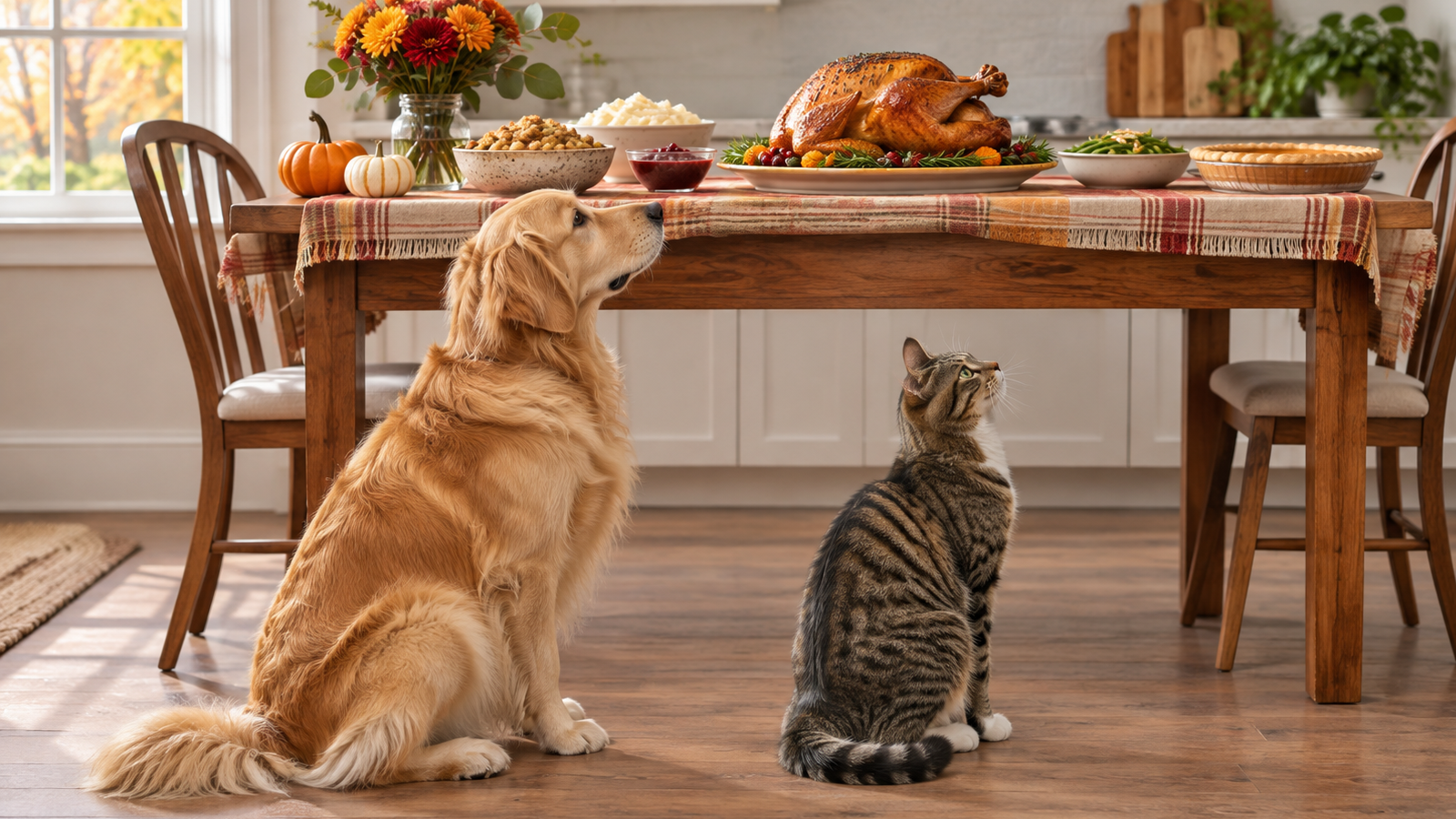
Yes, most healthy dogs and cats can have a little plain, fully cooked turkey meat. That means no skin, no bones, no gravy and nothing from the stuffing bowl. The meat is rarely the problem. Everything that comes with it on a Thanksgiving plate is.
Pull a few bites from the middle of the breast before it gets buttered, salted or sauced, and keep everything else off the floor.
What "safe" turkey means for a dog
#For a dog, safe turkey is cooked all the way through, boneless, skinless and unseasoned. It's the plain slice you'd cut for yourself before anyone touches it with butter, herbs or pan juices.
The ASPCA says the same thing in simple terms. If you share turkey, keep it boneless and fully cooked, and stay with your dog's normal diet for the rest. Pet Poison Helpline calls plain, boneless, skinless turkey a minor concern for many pets, but it adds that every pet is different.
That last part matters. "Fine for most dogs" is not "fine for yours today." A dog with a sensitive stomach, a dog that has had pancreatitis, or a puppy that has never eaten anything but kibble can react to a new food even when it's plain. Start with a tiny piece. If your dog is fine, that's your answer for this time.
Dark meat can work if it's plain and trimmed. PetMD notes it has more calories and fat than breast, so breast is the easier pick.
Skip the skin, the drippings and the gravy
#Skin is the part most people want to hand over. It's also the part vets keep warning about.
Turkey skin and gravy are high in fat. Pet Poison Helpline says that kind of fat can trigger pancreatitis, a painful inflammation of the pancreas. The signs it lists are vomiting, diarrhea, loss of appetite and belly pain, and they may not show up right away. So a dog that looks fine at the table can be unwell later that night or the next day.
The Merck Veterinary Manual describes the same picture. In dogs, a common risk factor is simply eating something they shouldn't have, and severe cases bring vomiting, weakness, belly pain and dehydration. In cats the signs are vaguer, often just lethargy and not eating. Mild cases in both species can look like little more than a low appetite or loose stool.
Gravy needs its own warning, because people think of it as just a drizzle. Between the fat, the salt and often onion or garlic, it's one of the worst things to put on a pet's dinner. The ASPCA also points out that bouillon cubes used for stocks and gravy are high in sodium.
Pan drippings and buttery roasting juices belong in the same bucket. If you want your dog to feel included, a spoon of plain cooked turkey in the regular bowl does more good than any sauce.
Cooked bones, twine and the carcass
#Never give a cooked turkey bone. Not the wing tip, not the drumstick, not the carcass "after we're done."
Cooked bones can splinter. The ASPCA calls poultry bones a major choking hazard, and in its list of foods to avoid it says bones can injure or block the digestive tract, sometimes seriously enough to need surgery. Pet Poison Helpline adds twine, skewers, foil and corn cobs to the list, since any of them can cause a blockage or injure the gut. Its advice is to call even if your pet seems fine at first.
So the danger isn't only what's on the plate. It's the roasting pan, the trussing string, the foil, and the trash bag with the carcass in it. The ASPCA says to empty the trash through the day or keep pets out of the area, because garbage holds bones, chocolate, onions and other holiday hazards. A bin with a lid isn't enough for a determined dog. Put the bag outside, or in a room with a closed door.
Some raw feeders give raw meaty bones, including turkey necks. The AKC says those carry their own risks, including salmonella, and suggests talking to your vet before trying it. That's a different conversation from the holiday table, and it isn't one to start with the carcass from your oven.
Raw turkey, brine and the bucket by the door
#Raw or undercooked turkey can carry salmonella. The ASPCA says so directly, and it's the reason "just a taste" of an uncooked bird isn't a good idea for a pet or for you.
The FDA adds a point people miss. Dogs and cats can carry salmonella without looking sick, and they can still pass it to people and other pets through their stool and saliva. The FDA's advice is to wash your hands with soap and warm water for at least 20 seconds after touching raw meat or poultry, and after feeding or handling your pets. So the sink matters as much as the bowl.
For cats, the picture is stricter. Cornell's feline health center says raw meat isn't recommended as a food or treat for cats, because of infection risks, toxoplasmosis among them.
Then there's brine. A wet-brined turkey sits in heavily salted water, and Pet Poison Helpline warns that too much salt can throw off a pet's fluid balance. That shows up as extreme thirst, a lot of peeing, vomiting and diarrhea, and in serious cases the brain can be affected. Pour used brine out right away, and don't leave a brining bucket where a dog or cat can reach it.
Can cats eat turkey?
#Yes, in the same plain form, and in even smaller bites. Cats are obligate carnivores. Cornell says they rely on nutrients found only in animal products, so plain cooked meat isn't strange food for them. That's different from saying a cat needs turkey from your table. A cat on a proper complete food doesn't.
PetMD's vet-reviewed guide suggests a bite about the size of your thumb tip, only for a healthy cat, and only after a tiny first try while you watch for vomiting or diarrhea. Treat that as a general size guide rather than a dose, since a six-pound cat and a twelve-pound cat aren't the same.
Where cats differ from dogs:
- Onion, garlic, chives and leeks hit them harder. The ASPCA and Pet Poison Helpline both say cats are more sensitive to these than dogs, so even a little stuffing is a bad trade.
- Raw meat is off the table for them. See above.
- Pancreatitis is easy to miss. The Merck manual notes that in cats the signs can be vague, so a cat that goes quiet and skips breakfast after a holiday is worth a call, even without dramatic vomiting.
- Deli turkey, turkey bacon and sausage are not the plain meat you meant. PetMD says deli turkey is usually high in sodium and may contain seasonings, preservatives or nitrates.
What about stuffing, sides and dessert?
#This is where most of the actual harm happens. The turkey is the easy part.
| Food | Dogs | Cats | Why |
|---|---|---|---|
| Plain cooked turkey meat | Small bites | Small bites | Fine for most healthy pets, in small amounts |
| Skin, drippings, gravy | No | No | High fat, can trigger pancreatitis; gravy often has salt and onion |
| Cooked bones, twine, skewers | No | No | Splinters, blockages, gut injury |
| Stuffing | No | No | Often onion, garlic, butter, sometimes raisins |
| Onion, garlic, chives, leeks | No | No, higher risk | Can damage red blood cells; cats are more sensitive |
| Raisins, grapes, currants | No | Keep away | Can cause kidney injury in dogs |
| Sugar-free desserts, gum | No | Keep away | Xylitol can cause a dangerous blood sugar drop in dogs |
| Chocolate | No | No | Poisoning risk in both species |
| Raw bread dough | No | No | Keeps rising in the stomach and makes alcohol |
Some detail behind the table.
Onion family. Pet Poison Helpline says cooked forms still count. A large amount of sautéed onion, garlic or leek can poison a pet, and so can large amounts of garlic powder. The risk is damage to red blood cells, and signs can include lethargy, pale gums, fast breathing and a loss of appetite. A pet that ate a spoonful of stuffing and looks fine tonight is still worth a call, since signs of that kind of damage don't always show right away. If you cook with onion every day, our guide to homemade dog food goes into the same trap in everyday cooking.
Raisins, grapes and currants. Pet Poison Helpline says these can cause kidney injury in dogs, and fruitcake is one place they hide. The ASPCA says the toxic component is still only "speculated," so don't gamble on an amount. Dogs should get none.
Xylitol. Pet Poison Helpline's xylitol page covers dogs only, and says low blood sugar can start within 10 to 15 minutes. It turns up in sugar-free desserts, gum, sugar-free pudding, some jams and syrups, and some peanut butters. Check the label before you leave anything on a low table. Keep it away from cats too, since the page just doesn't speak to them.
Nutmeg and sage. These two sound scary but aren't the main worry. Pet Poison Helpline says the small amount of nutmeg in a recipe is very unlikely to cause serious problems, and that toxicity needs a very large amount. The ASPCA lists sage as non-toxic to dogs and cats. The fat and onion in the dish around them are the real issue.
Chocolate and dough. The ASPCA lists chocolate as a risk for vomiting, tremors, seizures and worse. Raw yeast dough keeps rising in a warm stomach and also makes alcohol, per Pet Poison Helpline. Neither one belongs in reach, even for a minute.
Salt. The ASPCA says too much salt can cause thirst, frequent urination and, in severe cases, death. A plate full of salty sides is mostly a salt dose for a small animal.
How much counts as "a treat"
#No bite count fits every pet, and the thumb-tip bite for cats above is only a size guide. What you can use is the treat rule.
The common guideline is that treats and extras should stay under about 10 percent of daily calories. VCA Animal Hospitals gives that figure for dogs. Cornell's feline health center gives a looser rule of thumb for cats, 10 to 15 percent of daily calories.
Here's the math with made-up numbers, as an example only. Say your dog eats 1,000 calories a day. Ten percent is 100 calories, and that's for every treat, chew and scrap that day, not just turkey. If the dog also gets a dental chew and a training treat, the turkey gets whatever is left.
If you don't know your pet's daily calories, ask your vet. They can work it out from weight, age and health in about a minute.
One more point. A holiday plate is not a day's treats. Giving "a little of everything" can easily add up to far more than 10 percent, even when no single item looks like much.
Who should skip the turkey, or ask first
#A few pets should check with the vet before they get any people food at all.
- Puppies and kittens. Their diet is built around growth, so a vet can tell you whether any extras fit.
- Senior pets. Older dogs and cats often have health issues you can't see yet. Our senior dog checklist and senior cat checklist cover what to watch in daily routines.
- Any pet that has had pancreatitis, or is on a low-fat diet. Merck says a low-fat diet is part of how vets manage pancreatitis, so fatty extras can undo that.
- Pets with kidney disease, diabetes or other conditions on a prescription diet. Their food plan is deliberate, so a vet should say whether turkey fits in it.
- Pets that are overweight, since the calorie limit matters more for them.
You can ask a vet in one short message. "Can she have two bites of plain cooked turkey breast?" is enough.
A plate for your pet that actually works
#Say you're hosting and your dog is hovering. Here's a plate that keeps the peace.
A small pile of plain turkey breast, cut into bite-size pieces, sized to the treat rule above. That's it. Put it in the regular bowl, or into a puzzle toy, at a quiet time before dinner starts.
For a cat, one or two small pieces of plain turkey on a saucer is plenty. Their main food does the real work.
Cook the pet portion first. Set it aside before you season the bird, brine it or baste it. It's easier to do that than to scrape seasoning off later.
If you'd rather skip people food altogether, that's a fair choice. A stuffed chew toy or a pet-safe treat is easier to measure, and nobody has to wonder what was in it.
A table guard plan for guests and kids
#Most Thanksgiving mishaps aren't the owner's choice. They're a cousin slipping a piece of skin under the table, or a child "sharing" a drumstick. Say it once, early, and make it short.
- Tell guests before they sit. "She's on a diet. Please don't feed her anything from the table."
- Give kids a job instead. They can hand your dog one pre-measured treat from a small bowl you set up.
- Keep the pet in another room or behind a gate during carving and serving, when the food and the commotion peak.
- Clear plates straight into the kitchen. Don't stack them on a low coffee table.
- Take the trash out as the meal ends, and tie the bag. Bones, foil and string end up here.
- Keep desserts up high, especially anything sugar-free, with raisins, or with chocolate.
- Put the carcass in a bin outside, or in a room with a closed door.
That's the whole plan. It takes about five minutes to set up, and most of it is telling people.
If your pet steals a plate or swallows a bone
#Stay calm and find out what and how much. Then call.
Call your vet, an emergency clinic, or a poison hotline before you do anything else. Pet Poison Helpline's advice is to call before you treat anything at home, and to call even if your pet seems fine at first. Tell them what your pet ate, roughly how much, and when. If you can, bring the packet, the label or a sample of the dish.
If you're in the US, two services answer around the clock. The ASPCA Animal Poison Control Center is at (888) 426-4435, and Pet Poison Helpline is at (855) 764-7661. Both say they're staffed around the clock, and both can charge a consultation fee. Outside the US, those numbers may not suit you, so start with your own vet or the nearest 24-hour clinic. It's worth saving that number now. Our pet first aid kit checklist has a short contact-sheet idea that fits here.
Don't make your pet vomit unless a vet tells you to. Pet Poison Helpline says vets sometimes direct a home method for dogs in certain cases, but only after a call, and that there is no safe home way to do it in cats. Vomiting can also do harm when what was swallowed is sharp, like a bone. Don't use salt, mustard or anything else you've heard works. Ask first.
Call or go in right away if you see any of these:
- Your pet is choking, gagging hard, or struggling to breathe.
- Repeated vomiting, straining, or retching with nothing coming up.
- A swollen or tight belly, or your pet cries out when touched.
- Weakness, collapse, tremors or seizures.
- A bone or other sharp or large item went down, even if your pet seems fine. Pet Poison Helpline tells owners to call in that case.
- The dog ate something with xylitol, since low blood sugar can start within 10 to 15 minutes.
- Pale gums or fast breathing after onion or garlic, though that one can be slow to show.
Watch closely if everything seems fine. After a fatty meal, pancreatitis signs can come on later. Look for vomiting, diarrhea, a lost appetite and belly pain over the next day or two, and call if you see them. A cat that hides and refuses food needs the same attention as a dog that vomits.
None of this is a diagnosis. Only a vet can examine your pet and say what's going on.
The short version
#Plain, cooked, boneless, skinless turkey in small bites is the one holiday food most healthy pets can share. Skin, drippings, gravy, bones, stuffing and sweets stay out of reach, and the bin goes outside.
Plan the pet's plate before the meal. Tell the guests once. If something goes wrong, call the vet or a poison line first, and save the home remedies for when a vet says so.